
The thermal drone market has developed an unhealthy obsession with sensor resolution, and it’s producing remarkably mediocre aircraft.
Every product sheet screams about detector pixels. Every launch event zooms into colorful heat maps. Meanwhile, almost nobody talks about electrical architecture, stabilization bandwidth, payload density, thermal latency, mounting constraints, or network integration. Those are the reasons missions succeed—or quietly fail after the marketing cameras stop recording.
Look, if your thermal payload loses horizon lock during a banking turn, those extra pixels become expensive decoration.
Here’s where the math actually breaks down. A surprisingly large number of commercial thermal drones carry payloads that were designed as isolated cameras rather than integrated sensing systems. The result is predictable: oversized housings, awkward center-of-gravity shifts, excessive current draw, vibration-sensitive optics, and mounting systems that force airframe designers to redesign everything around the camera instead of the mission.
That design philosophy belonged ten years ago. A modern dual-sensor payload weighing only 117 grams fundamentally changes structural decisions long before anyone discusses image quality. A payload that combines a 2560 × 1440 visible-light camera with a 384 × 288 thermal sensor inside that weight class reduces the pitching moment acting on the gimbal mount, lowers servo workload during aggressive acceleration, and gives multicopter flight controllers a far easier job maintaining attitude under varying battery mass.
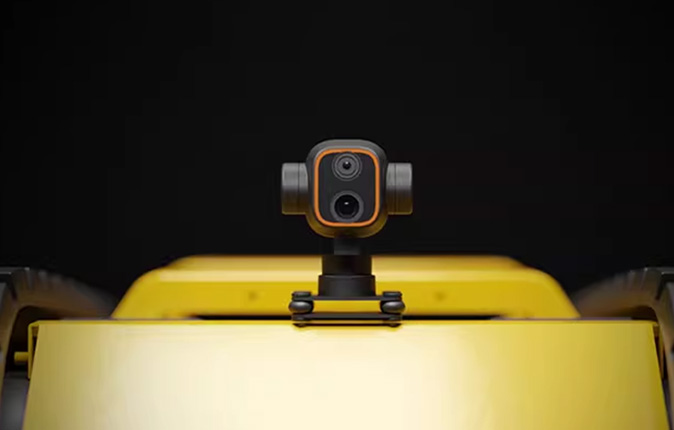
Engineers notice this immediately. Marketing departments almost never do. People love comparing thermal resolution while completely ignoring optical physics. Detector count is only one variable inside an imaging chain. Lens transmission, detector pitch, spectral response, stabilization accuracy, and thermal response speed determine whether small temperature gradients survive the trip from reality to the operator’s display.
Take the thermal module itself. A 7 mm F1.0 lens paired with a 12 μm pixel pitch across the 8–14 μm long-wave infrared spectrum represents a very deliberate engineering compromise rather than a specification race. The fast aperture increases incoming radiant energy reaching the detector. Smaller pixel pitch improves spatial sampling efficiency without demanding physically enormous optics. The result is a payload that remains compact while preserving useful thermal contrast instead of forcing designers toward oversized front elements that make gimbals unnecessarily heavy.
Physics wins. Spec sheets don’t care. Then there’s something hardly anyone discusses outside actual system integration meetings: thermal time constant.
Less than 10 milliseconds sounds like an obscure laboratory number. It isn’t. The thermal time constant determines how quickly the detector reaches equilibrium after observing changing thermal scenes. During low-altitude flight, especially over industrial infrastructure, forest edges, rooftops, or rapidly changing terrain temperatures, sluggish sensors effectively smear thermal transitions over multiple frames. Operators mistake delayed detector response for motion blur or poor stabilization when the real limitation exists inside the sensor package itself.
That confusion wastes an astonishing amount of troubleshooting time. Seriously, I’ve watched teams replace perfectly good gimbals because someone blamed vibration for what was actually detector latency. Frame rate deserves similar skepticism.
People instinctively complain whenever they see ≤25 Hz, assuming higher numbers automatically improve operational capability. Not necessarily.
Thermal imaging rarely behaves like FPV racing footage. Identification tasks depend far more on temporal stability than cinematic smoothness. If the detector updates consistently while the gimbal maintains angular stability, operators receive reliable thermal information instead of beautifully smooth but mechanically unstable imagery. Excessive frame rate without sufficient stabilization simply delivers more blurry thermal frames every second.
That’s hardly progress. Now consider the visible-light camera. Its 100-degree horizontal field of view combined with a 3.5–4.75 mm F2.0 lens creates a useful reconnaissance geometry because it balances situational awareness with manageable distortion. Extremely wide optics may impress demonstration videos, yet they complicate object measurement, reduce edge detail, and introduce geometric correction workloads that embedded processors eventually have to absorb.
Those processor cycles are not free. Neither is battery capacity. The inclusion of 4× digital zoom should also be viewed realistically. Digital zoom cannot manufacture information that the sensor never captured. What matters is whether the optical chain maintains sufficient native detail before digital enlargement occurs. Engineers understand this. Marketing brochures frequently pretend otherwise.
Let’s talk about stabilization. Three-axis stabilization isn’t interesting by itself anymore. The actual motion envelope tells the real story.
Pitch movement from -90° to +10°, Yaw ±90°, and Roll ±45° creates a surprisingly flexible observation geometry that accommodates inspection, mapping, pursuit, infrastructure monitoring, and underside observation without forcing awkward aircraft repositioning. Those extra degrees often eliminate entire flight corrections, reducing energy consumption while keeping propeller wash farther from sensitive imaging angles.
Tiny geometric decisions accumulate into meaningful endurance improvements. Nobody puts that on a sales banner. Electrical architecture is another neglected battlefield.
Supporting an input range from 7.2 V to 72 V dramatically simplifies integration across fixed-wing aircraft, multirotors, tethered systems, autonomous ground platforms, and hybrid power architectures. Instead of designing dedicated voltage conditioning hardware for every airframe family, engineers can standardize around one imaging payload across multiple vehicle classes.
That reduces inventory complexity. It also reduces integration mistakes. And yes, wiring errors still happen far more often than software engineers like to admit. Current consumption tells another story.
Approximately 210 mA is remarkably modest considering the sensing capability being packaged. Lower electrical demand means less waste heat inside enclosed payload bays, reduced stress on voltage regulators, and fewer thermal management compromises elsewhere in the aircraft. Electrical efficiency quietly improves reliability because every unnecessary watt eventually becomes heat that someone has to remove.
Heat always sends the bill eventually. Mechanical packaging deserves equal attention.
A housing measuring only 62 × 65 × 86 mm offers unusual flexibility for aircraft designers trying to preserve aerodynamic cleanliness or maintain compact folded transport dimensions. Better yet, the ability to install the payload upright or inverted removes one of those irritating mechanical constraints that routinely force custom brackets, additional wiring runs, and avoidable center-of-gravity shifts. I’ve lost count of how many supposedly “universal” payloads became universal only after machining three different adapter plates.
Network output may be the least glamorous specification here, yet it has enormous operational consequences. Native LAN and RTSP streaming transforms the payload from being merely a camera into a networked sensing node. That distinction matters because modern unmanned systems increasingly distribute processing across onboard AI computers, edge servers, IP radios, and remote command stations rather than relying on isolated video transmitters. Standard IP transport dramatically lowers integration friction compared with proprietary video interfaces that lock operators into closed ecosystems.
That’s how modern architectures scale. Not through prettier user interfaces. The uncomfortable reality is that the best thermal drone isn’t defined by whichever aircraft advertises the highest detector resolution. It’s the platform whose imaging system minimizes structural penalties, reduces electrical complexity, preserves optical performance under motion, responds rapidly to changing thermal conditions, integrates cleanly into existing network infrastructure, and avoids forcing engineers into unnecessary mechanical compromises.
Everything else is brochure design. Engineering doesn’t care about brochures. It cares about systems that still work after hundreds of flight hours, rough landings, voltage fluctuations, freezing mornings, scorching afternoons, and operators who absolutely will mount something upside down despite every warning label you’ve ever written.