
I’d like to put forward a very bold prediction: I suspect that within the next five years, most formal field operations will begin to phase out multirotor drones. Instead, they will shift to hybrid platforms, such as tiltrotor and fixed-wing drones. This shift is not driven by voluntary technological evolution, but rather by the inherent limitations of multirotor drones, such as battery life, which will force them out of the picture, allowing other, more promising platforms to take up the baton and continue fulfilling their missions.
I learned this the hard way. We tried to stretch a high-end quadcopter across a 12 km pipeline inspection route. On paper, it worked—great payload, stable hover, easy deployment. In reality, we spent more time swapping batteries than collecting usable data. The endurance ceiling wasn’t a software problem. It was aerodynamic truth. Lift via thrust is expensive. Always has been.
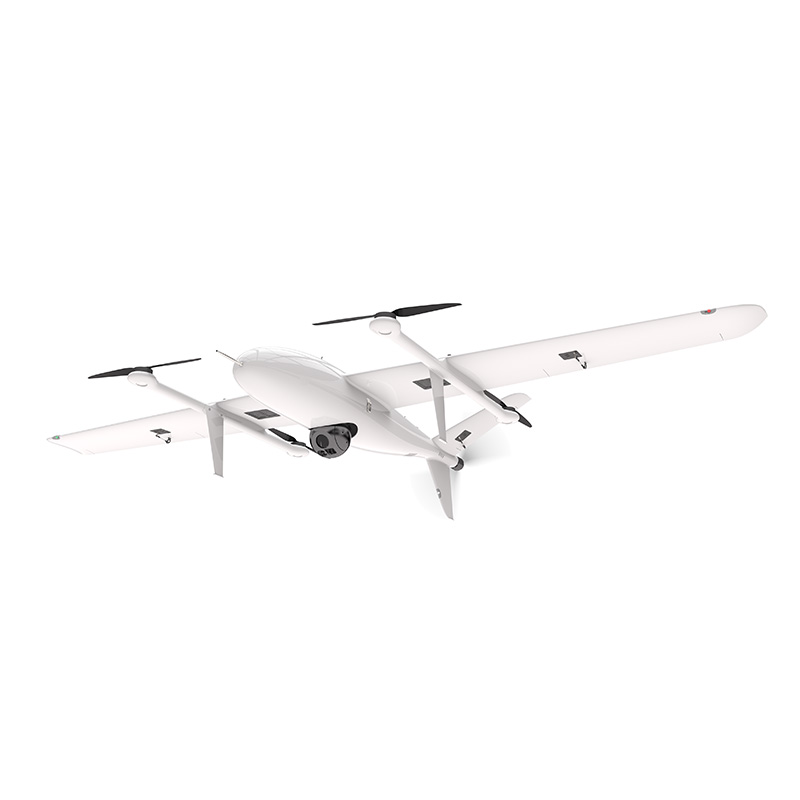
That’s the backdrop where platforms like the VTOL Fixed Wing UAV – ROC WING MD-35 start making sense—not as a novelty, but as an inevitable correction.
The Hybrid Trade-Off Most Teams Underestimate
The industry still pushes a convenient myth: “VTOL gives you the best of both worlds.” That’s marketing shorthand. In engineering terms, hybrid UAVs are about managing compromises more intelligently.A pure multirotor:
– High control authority
– Excellent low-speed maneuverability
– Catastrophic energy inefficiency over distance
A fixed-wing:
– Exceptional aerodynamic efficiency
– Long endurance
– Operational friction (runways, launch systems, recovery risk)
The MD-35 sits in the uncomfortable middle—and that’s exactly why it works.Vertical takeoff eliminates launch infrastructure. Fixed-wing cruise slashes energy consumption once airborne. The transition phase? That’s where most designs quietly fall apart. Stability during transition is not trivial, and frankly, many systems in this class still feel like beta products.
The MD-35, built on an Ardupilot-based control stack, leans on a mature ecosystem rather than reinventing flight logic. That’s not glamorous, but it’s a practical decision. I’d take predictable control loops over proprietary black boxes any day.
Airframe Size Isn’t Just About Payload
The spec sheet calls out a “larger airframe,” which sounds like a sales bullet. It’s not. It’s the foundation of the entire performance envelope.A bigger wing does three critical things:
- Improves lift-to-drag ratio
Longer wingspan reduces induced drag. That directly translates into longer cruise endurance.
2.Enables heavier payload integration without destabilizing flight
Smaller VTOL hybrids often claim payload flexibility, but once you mount a serious sensor (say, a LiDAR unit or stabilized EO/IR gimbal), flight characteristics degrade fast. The MD-35’s reinforced EPP composite structure actually anticipates this.
3.Creates thermal and power headroom
Larger frames dissipate heat better and accommodate higher-capacity battery packs without turning into a thermal management nightmare.
Engineers tend to roll their eyes at “reinforced composite structure” claims—and fair enough. But in this case, the structural scaling aligns with the mission profile. You don’t push 90-minute endurance on a fragile foam platform without consequences.
Endurance: The Number Everyone Quotes, Few Understand.“Up to 90 minutes.”That phrase needs context, or it’s meaningless.
Endurance in UAV systems is a function of:
– Wing loading
– Cruise speed optimization
– Battery energy density
– Payload mass and drag profile
The MD-35’s 90-minute ceiling is plausible under controlled conditions—minimal payload, optimized cruise, low wind. In real deployments, you’re looking at something lower. Still, even at 60–70 minutes, it outperforms most multirotors by a wide margin.
Here’s the critical distinction:Endurance isn’t just about time—it’s about mission continuity.A multirotor might give you 30 minutes. Sounds decent. But if your inspection route requires continuous forward motion over 20+ km, stopping every half hour destroys efficiency.The MD-35’s endurance allows:
– Fewer launch cycles
– Reduced operator fatigue
– More consistent data sets
And that last point is underrated. Data stitching errors often come from inconsistent flight segments, not sensor quality.
VTOL Hover Time: The Hidden Constraint
Hover time is listed at approximately 20–25 minutes.That’s actually more interesting than the 90-minute cruise figure.Why? Because hover is where energy consumption spikes. VTOL phases—takeoff, landing, and any stationary observation—are the most expensive parts of the mission.
Many operators misuse VTOL hybrids by hovering excessively, treating them like oversized drones. That defeats the entire design philosophy.The MD-35’s hover window is enough for:
– Precision takeoff and landing
– Short-duration inspection holds
– Emergency repositioning
It is not designed for prolonged stationary observation. If that’s your primary mission, you’re better off with a multirotor. Different tool, different job.
Communication Range: 30 km Isn’t the Whole Story
A 30 km control and video transmission range sounds impressive—and under FCC conditions, it is.But range specs are notoriously optimistic. Real-world performance depends on:
– Terrain
– RF interference
– Antenna orientation
– Ground station quality
What matters more is link stability under marginal conditions.The MD-35’s digital HD transmission system prioritizes signal integrity over raw distance. That’s the right design choice. A stable 15 km link is far more valuable than a flaky 30 km connection.Also worth noting: 1080P transmission isn’t about aesthetics. It directly impacts:
– Target identification accuracy
– Inspection detail resolution
– Post-processing reliability
Lower-resolution links often force re-flights. That’s where operational costs quietly pile up.
Autopilot: Open-Source Done Right (and Wrong)
Using an Ardupilot-based system is both a strength and a liability. Strengths:
– Proven flight control algorithms
– Massive community support
– Customizable mission planning
Weaknesses:
– Requires competent setup and tuning
– Not “plug-and-play” for inexperienced operators
Let’s be blunt: open-source autopilot systems don’t forgive sloppy configuration. If your PID tuning is off, or your mission planning is careless, the platform won’t save you.
But for professional teams, this flexibility is gold. You can adapt the MD-35 to highly specific workflows—mapping grids, corridor inspections, autonomous patrol routes—without being locked into proprietary constraints.
Payload Reality: “Multi-Sensor Support” Isn’t Infinite
The MD-35 advertises increased payload capability with multi-sensor support. That’s accurate—but physics still applies.Every added sensor:
– Increases weight
– Alters center of gravity
– Adds aerodynamic drag
The real advantage here isn’t “more payload,” but better payload tolerance.You can mount:
– Mapping cameras
– Gimbal-stabilized inspection systems
– Environmental sensors
And still maintain stable flight characteristics. That’s not something smaller VTOL hybrids handle gracefully.Still, stacking sensors indiscriminately is a common mistake. Engineers love adding capability. The aircraft doesn’t.
Where This Platform Actually Wins
The MD-35 isn’t a universal solution. It excels in specific scenarios:
1. Large-area mapping
Fixed-wing efficiency dominates. VTOL simplifies deployment in remote terrain.
2. Linear infrastructure inspection (pipelines, power lines)
Long, continuous routes benefit from sustained cruise performance.
3. Border patrol and surveillance
Endurance and range reduce operational cycles.
4. Disaster response
Rapid deployment without runway dependency is critical.
In contrast, it’s not ideal for:
– Dense urban inspection requiring constant hover
– Close-quarters maneuvering
– Short-duration, high-frequency missions
The Real Reason Hybrid Platforms Are Gaining Ground.It’s not innovation hype. It’s cost per kilometer.When you factor in:
– Battery consumption
– Operator time
– Mission repetition due to limited endurance
Hybrid VTOL systems like the MD-35 start to look less like niche tools and more like baseline infrastructure for serious operations.Engineers don’t adopt new platforms because they’re exciting. They adopt them because the old ones quietly fail under scale.
Conclusion
The ROC WING MD-35 vertical takeoff and landing (VTOL) is a coherent design that works with aerodynamic realities rather than against them. If you are still attempting to adapt multirotor aircraft for long-range missions, you are not optimizing—you are merely compensating for their shortcomings. In engineering, compensation is often just a slow-acting form of feedback that acknowledges you have chosen the wrong path. Instead, choosing a VTOL fixed-wing aircraft that maximizes operational range and endurance and supports field deployment will save you a great deal of unnecessary detours.