
A few years ago, during a routine logistics transport test, I watched a heavy-duty drone “crash.” According to the specs, it was supposed to be able to lift 40 kilograms. With its high-power motor, oversized propellers, and carbon-fiber body, the promotional materials made it sound like it could do anything. But once we got to the site, the drone had barely taken off before it started veering wildly from side to side, flying all over the place like a shopping cart with a flat tire.
That experience permanently changed how I evaluate cargo drones. Payload numbers are cheap. Stability under load is expensive. There’s a massive difference between a drone that can briefly lift 50 kg and one that can repeatedly transport 50 kg through real operational environments without turning every flight into a maintenance event. The best cargo https://seboar.com/cargo-drones/drones in 2026 are being separated by engineering maturity, not by brochure statistics.
The Industry Finally Learned That Payload-to-Structure Ratio Matters. For years, industrial UAV manufacturers chased headline numbers. Bigger payloads. Bigger batteries. Bigger rotors. Not enough attention went into structural geometry. That’s why the Seboar MRT50H is interesting from an engineering perspective. Not because it claims a 30–50 kg payload range — several platforms can claim that now — but because its 2420 mm wheelbase tells you the design team prioritized loaded-flight stability from the beginning. That detail matters more than many buyers realize.
A cargo drone carrying 50 kg behaves very differently from a cinematic drone or an agricultural spraying platform. Once you introduce dense payloads, the aircraft’s inertia profile changes dramatically during acceleration, braking, and yaw correction. Small-frame cargo drones compensate with aggressive PID tuning. That works right up until gust loading or uneven payload distribution enters the equation. Then the aircraft starts fighting physics instead of managing it.
A large wheelbase reduces the correction intensity required from the flight controller. That translates into smoother attitude control, lower motor stress, and less oscillation during hover transitions. Engineers know this already. Sales teams rarely mention it because “2420 mm wheelbase” sounds boring compared to “50 kg heavy lift.” The boring specification is often the one keeping the aircraft in the air.
Why the MRT50H Sits in a Very Practical Segment? There’s an awkward gap in industrial drone logistics right now. Small logistics drones under 20 kg payload are useful for medical kits, sensors, and lightweight field delivery. Massive 100 kg-class systems exist too, but they introduce regulatory headaches, transport complications, and significantly higher operating costs.
The 30–50 kg category is becoming the real commercial sweet spot. That’s exactly where the Seboar MRT50H positions itself. At 29.5 kg empty weight, the aircraft avoids becoming absurdly oversized while still delivering meaningful transport capability. That balance is harder to achieve than people think. Heavy-lift drones usually fail in one of two ways:The frame becomes excessively heavy, reducing mission efficiency.The aircraft becomes too lightweight structurally and develops vibration fatigue problems after repeated load cycles.
The MRT50H appears to aim directly between those extremes. And honestly, that’s the correct strategy for industrial logistics. Nobody operating infrastructure support missions cares whether a drone looks futuristic. They care whether it can survive repetitive transport cycles carrying tools, batteries, replacement parts, or emergency equipment without requiring constant recalibration.
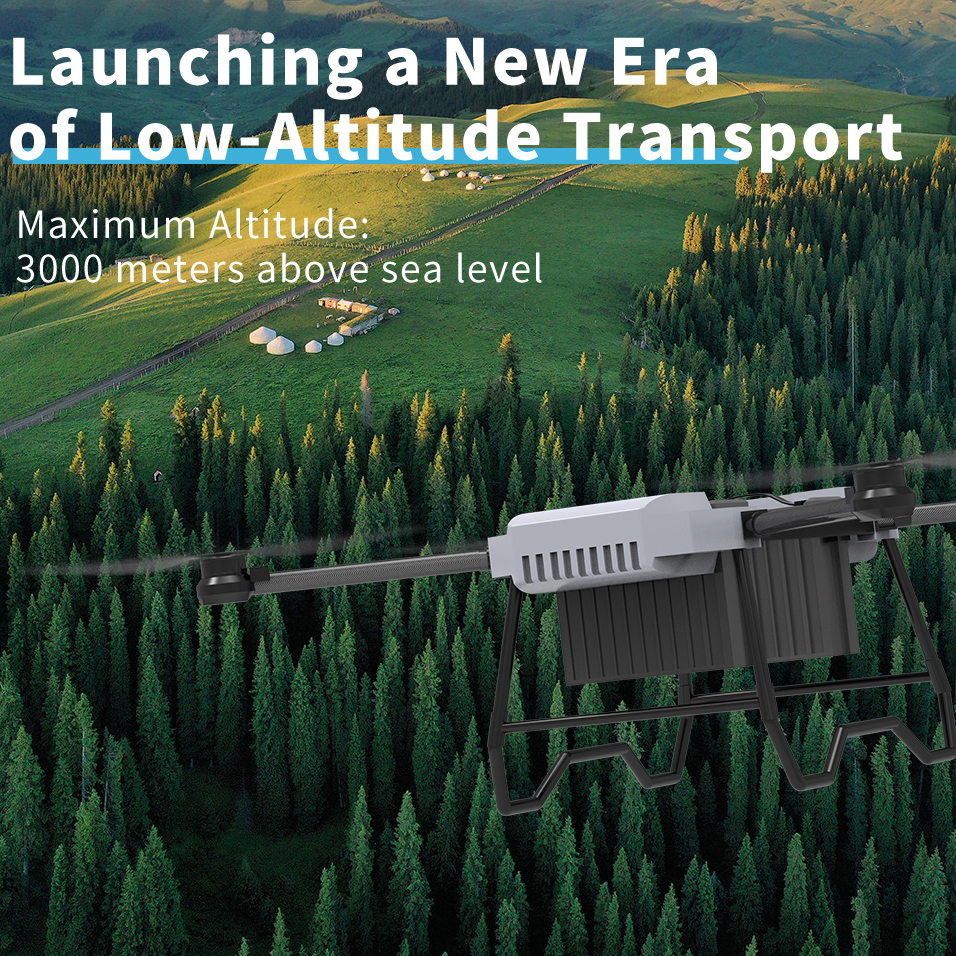
Speed Numbers Are Frequently Misunderstood. The MRT50H lists a maximum flight speed of 15 m/s. A lot of inexperienced buyers immediately compare that number against FPV drones or military interceptors and think it sounds slow. That comparison is nonsense.
Cargo drone performance should be evaluated using loaded transport efficiency, not raw airspeed. A fully loaded industrial UAV flying at 15 m/s while maintaining stable power distribution and predictable thermal performance is doing real engineering work. Pushing higher speeds introduces serious penalties:
Motor heat increases sharply
ESC reliability decreases
Battery sag becomes more severe
Structural vibration grows exponentially
Payload stabilization becomes harder
I’ve seen manufacturers advertise aggressive speed figures that are technically achievable for about 90 seconds before voltage collapse starts wrecking flight consistency. Professional operators hate that kind of tuning. The best cargo drones are intentionally conservative in the right places.
The Hidden Metric Nobody Discusses: Operational Stability
Industrial UAV buyers often obsess over peak payload. That’s understandable but incomplete. Operational stability is the metric that actually determines deployment success. For example, a drone transporting emergency medical supplies into mountainous terrain may encounter:
uneven air density
sudden crosswinds
unstable landing zones
repeated altitude changes
partial payload imbalance
In those conditions, stable flight geometry matters more than theoretical lift capacity. The MRT50H’s large-frame configuration likely improves three critical operational factors:
1. Reduced Attitude Oscillation
Larger motor spacing improves control authority during correction events. The aircraft does not need to overreact to maintain orientation.
2. Better Payload Isolation
Heavy payloads generate frame resonance. Wider structures help distribute those forces more evenly instead of concentrating stress near the center plate.
3. Improved Hover Precision
Cargo delivery often requires accurate positioning over constrained landing areas. Large-frame stability improves low-speed control behavior.
These are not glamorous engineering achievements. They are the reason some drones survive commercial deployment while others become warehouse decorations after six months.
Comparing Modern Cargo Drone Classes. The MRT30, MRT50H, and MRT100 comparison actually reveals a broader industry trend.
| Model | Payload | Wheelbase | Speed | Weight |
| MRT30 | 30 kg | 1495 mm | 3–10 m/s | 23.6 kg |
| MRT50H | 30–50 kg | 2420 mm | 15 m/s | 29.5 kg |
| MRT100 | 100 kg | 1900 mm class | 12 m/s | 52 kg |
One detail immediately stands out. The MRT50H uses a significantly larger wheelbase than the heavier MRT100 class reference. That suggests the designers prioritized stability margins rather than compact transport dimensions. Good decision. Too many manufacturers try to make heavy-lift drones artificially compact for marketing photos and shipping convenience. Then they compensate with aggressive flight-control tuning and oversized propulsion systems. That approach usually increases maintenance frequency.
Wide-frame heavy-lift systems are less visually elegant. They are often more operationally honest. Emergency Logistics Is Quietly Becoming the Biggest Growth Segment Most people still associate cargo drones with e-commerce fantasies. Tiny packages flying across cities. Coffee deliveries. Consumer nonsense. The real industrial growth is happening elsewhere:
emergency supply transport
infrastructure maintenance
remote equipment delivery
mining logistics
energy-sector inspection support
agricultural material movement
These environments reward ruggedness over aesthetics. A drone delivering replacement tools to a damaged transmission tower after a storm does not need cinematic smoothness. It needs predictable performance under load. That distinction is reshaping cargo UAV design philosophy. You can already see the market shifting away from lightweight experimental platforms toward industrial-grade transport systems with conservative engineering margins. Frankly, it’s overdue.
Battery Reality Still Limits the Entire Industry. Here’s the uncomfortable truth nobody likes discussing at trade shows:
Battery chemistry is still the bottleneck.
Not AI navigation.
Not autonomous routing.
Not obstacle avoidance.
Energy density remains the limiting factor for cargo drones. A platform carrying 50 kg while maintaining acceptable flight duration is balancing an extremely unforgiving equation between:
propulsion efficiency
battery weight
motor thermal limits
structural rigidity
environmental conditions
This is why practical cargo drones rarely chase absurd speed numbers or ultra-long endurance claims simultaneously. Physics eventually sends the invoice. The smarter manufacturers optimize around mission realism instead of fantasy specifications.
The MRT50H’s configuration suggests a system designed around achievable industrial deployment rather than laboratory benchmark chasing. That’s probably why the platform makes more sense than many overengineered competitors currently appearing in the market.
What Actually Defines the Best Cargo Drones in 2026? Not autonomous buzzwords. Not folding arms. Not flashy AI marketing. Not exaggerated range claims tested with empty payloads. The best cargo drones today share several characteristics:
structurally stable airframes
predictable loaded-flight behavior
conservative but reliable speed profiles
maintainable propulsion systems
efficient payload-to-weight ratios
realistic deployment engineering
That last point is the important one.
Those actually working on industrial projects are more concerned with whether the device can operate reliably, how long it can go without maintenance, and whether it will malfunction after completing hundreds of consecutive missions. A drone capable of reliably carrying out thousands of repetitive transport missions is undoubtedly far more valuable than those flashy but impractical prototypes. The cargo drone industry is finally beginning to shift away from superficial showmanship and toward a phase that truly prioritizes reliability and practical implementation. And let’s be honest—this industry should have returned to reality a long time ago.