
There’s a common misconception about the solar energy industry: some people believe that because cleaning drones are so fast, the industry has a very promising future. This view is actually inaccurate.
It’s incomplete. The real engineering shift isn’t measured in square meters per hour. It’s measured in how maintenance strategies are being redesigned around autonomous aerial systems instead of forcing people into repetitive, high-risk work above fragile photovoltaic modules.
Look, those are two very different conversations. China surpassed 900 GW of cumulative photovoltaic capacity by the end of 2025, and every additional gigawatt quietly creates another maintenance problem. Dust accumulation alone can reduce energy production by 5–25%, while neglected sites suffering from bird droppings, industrial deposits, or compacted dirt may experience losses approaching 40%. Those numbers make cleaning less of a housekeeping task and more of an operational decision affecting revenue.
The obvious solution seems simple: send drones. Well… not exactly. Most contamination isn’t uniform. One array may only collect airborne dust that disappears after a light rinse. The neighboring string could have months of hardened bird droppings baked into tempered glass under intense sunlight. Treating both surfaces with identical cleaning methods usually wastes either water, flight time, or both.
That distinction explains why modern cleaning drones increasingly combine AI vision, autonomous route planning, and dedicated cleaning modules instead of functioning as ordinary spraying aircraft.
The aircraft isn’t the innovation. The workflow is. A typical professional multirotor cleaning drone can service roughly 15,000 to 25,000 square meters in a working day, often achieving three to five times the productivity of manual crews. Large photovoltaic projects demonstrate the scaling effect. Three aircraft can maintain a 50 MW solar installation within several days, while six drones reportedly completed cleaning at a 200 MW photovoltaic site in Ningxia in only five days, reducing overall project duration by roughly 85%.
Those figures sound dramatic. They also deserve context. Cleaning speed says nothing about cleaning quality. Loose dust behaves very differently from bonded contamination. Atomized water droplets smaller than 50 micrometers remove suspended particles efficiently while reducing water consumption by more than 70% compared with traditional washing methods. Hardened moss, oily industrial residue, mineral deposits, and dried organic material remain much more resistant. No amount of optimistic marketing changes surface chemistry.
Wait, let me check that assumption again—no, field observations continue pointing to the same conclusion. Drone cleaning commonly removes around 80–90% of loose surface dust, yet stubborn contamination often requires mechanical contact or localized manual treatment.
That reality has quietly reshaped maintenance planning. Instead of expecting one machine to solve every cleaning problem, operators increasingly deploy layered maintenance cycles: aerial coarse cleaning first, robotic deep cleaning second, and targeted manual touch-ups only where necessary. Counterintuitively, adding another maintenance stage frequently reduces total labor rather than increasing it because technicians spend less time performing repetitive washing across enormous solar fields.
Architectural Benchmarks: Market Standards vs Modern Engineering. Most commercial cleaning drones still inherit architectural compromises from agricultural spraying platforms.
The onboard water supply becomes the limiting factor long before battery capacity does. Every refill interrupts flight cycles, creates additional logistics, and reduces effective productivity even when theoretical endurance appears acceptable on paper.
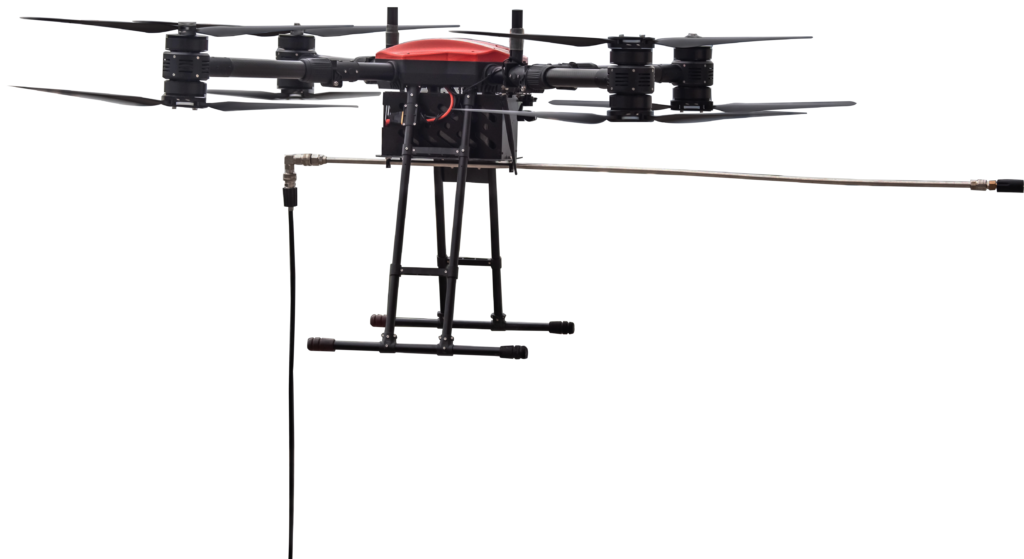
The Seboar QX140-X8 approaches the problem from a different systems perspective. Rather than treating onboard water storage as mandatory, the platform supports tethered water supply for continuous cleaning operations. That sounds like a minor configuration detail until operational mathematics enters the picture. Eliminating repeated water refills changes the maintenance bottleneck entirely, allowing flight endurance and cleaning planning to revolve around battery management instead of liquid transport.
There’s another engineering decision hiding beneath the specification sheet. The modular cleaning platform accepts interchangeable spray assemblies using either fixed or oscillating nozzles. Four nozzle geometries—0°, 15°, 25°, and 40°—allow operators to match hydraulic energy with contamination characteristics instead of blasting every surface with identical spray dispersion. Narrow jets concentrate pressure into confined gaps. Wider patterns improve rinsing efficiency across larger panel sections while reducing overlap.
Hydraulics matter here. Rated operating pressure reaches 10 MPa, with instantaneous output peaking at 20 MPa through a 1500 mm spray pipe delivering 16 liters per minute. Pressure without controlled nozzle geometry simply wastes energy. Controlled pressure matched with spray angle determines how effectively kinetic energy transfers into contaminant removal.
Cleaning output naturally changes with contamination density. Light surface contamination reaches approximately 1000 square meters per hour, while deep cleaning averages closer to 500 square meters per hour. That reduction isn’t a weakness. It reflects realistic hydraulic engineering. More aggressive cleaning requires slower travel speeds and increased dwell time over difficult surfaces.
Here’s the thing, engineers usually trust numbers that get worse under tougher conditions more than numbers that somehow stay perfect regardless of reality.
Environmental tolerance also deserves attention because maintenance schedules rarely wait for perfect weather windows. The platform operates between −10°C and 40°C with humidity ranging from 0% to 90% RH, while maintaining stability in winds up to 12 m/s. Recommended stand-off distance remains between two and three meters, balancing spray effectiveness with flight safety around elevated structures.
Navigation accuracy influences cleaning consistency just as much as hydraulic performance. RTK positioning combined with autonomous route planning enables repeatable flight paths over photovoltaic arrays, curtain walls, wind turbines, transmission towers, and insulator strings. Consistent overlap reduces missed areas while minimizing unnecessary repeated spraying, which directly affects water consumption and project efficiency.
One overlooked specification caught my attention, actually. The aircraft folds from 110 × 110 × 70 cm down to 76 × 76 × 70 cm for transport. That doesn’t improve cleaning performance by itself, but logistics often determine whether specialized equipment actually gets deployed across multiple sites instead of remaining parked in a warehouse.
Why Cleaning Drones Still Have Limits. No serious engineer should claim aerial cleaning eliminates every maintenance challenge.
Battery swaps remain unavoidable. Wind still affects spray trajectories. Rain, sandstorms, and severe weather continue grounding flight operations. Surface chemistry still decides whether water alone can remove contamination. Those limitations aren’t signs that cleaning drones failed.
They’re reminders that maintenance systems should be designed around engineering constraints rather than marketing promises.The most effective photovoltaic operators increasingly treat drones as one component within an integrated asset maintenance strategy instead of expecting autonomous aircraft to replace every existing cleaning method.
This shift may well be the most significant change in the industry, because it’s not just that drones can clean solar panels—it’s that they’re transforming maintenance planning into a data-driven, modular model that vastly improves the efficiency of labor-intensive workflows.