
That’s probably the least interesting part of the story.
A 7-kilogram tiltrotor UAV with a wingspan exceeding 2.5 meters recently completed a successful maiden flight in China, using a bamboo-based composite material that accounts for more than 25% of the aircraft structure. Flight endurance exceeded one hour. Cruise speed surpassed 100 km/h. More than one hundred experimental iterations reportedly led to the final platform.
The media narrative immediately locked onto the obvious angle: bamboo is cheaper than carbon fiber.
Sure. But that framing misses what could become the more disruptive shift inside the VTOL fixed wing drone price equation.
For years, drone manufacturers have treated airframe cost as a fixed reality. Carbon fiber wasn’t merely a material choice; it became an industry assumption. Lightweight. Strong. Mature supply chains. Predictable manufacturing behavior. Nobody seriously questioned it outside academic research circles.
Now that assumption looks a little less permanent. The reported economics are difficult to ignore. Bamboo-derived composite sheets are said to cost roughly one-quarter the price of conventional carbon fiber fabric while delivering a weight reduction exceeding 20% compared with some carbon-fiber-based drone structures.
No, the real implication is even more interesting. Most discussions around VTOL fixed wing drone price focus on batteries, propulsion systems, avionics, AI payloads, or manufacturing labor. Yet airframe materials remain a significant contributor to overall production cost, especially in medium-sized UAVs where large wing surfaces and structural skins consume substantial quantities of composite material.
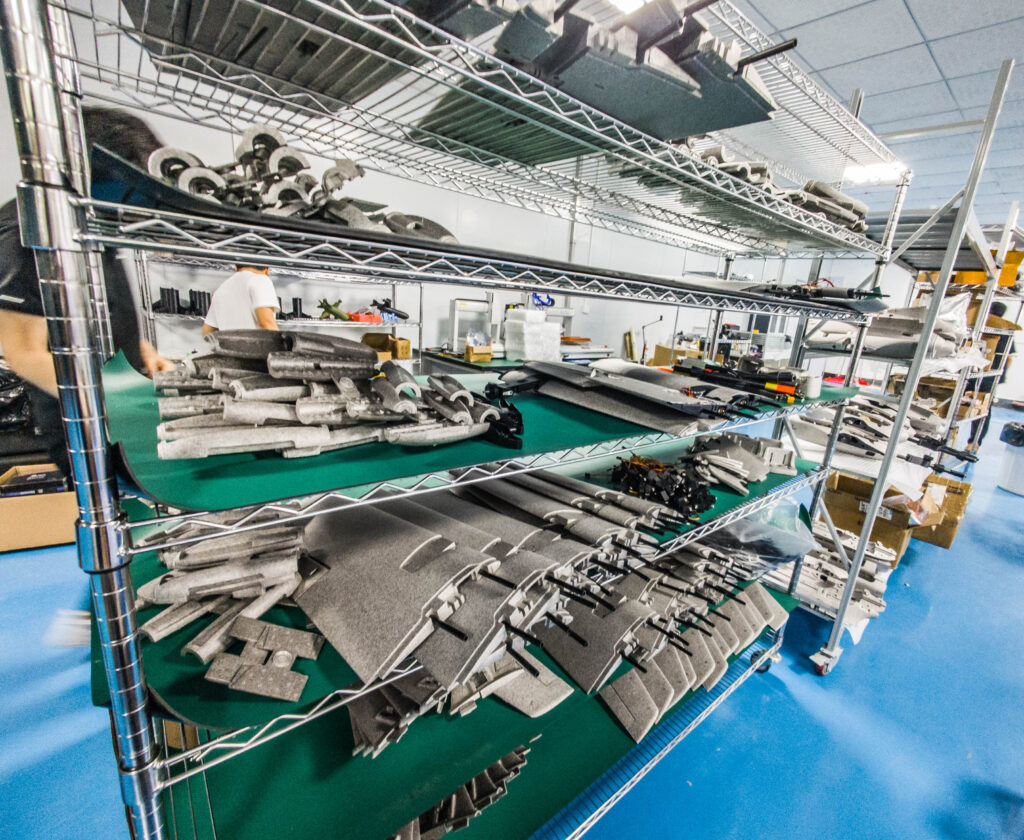
A 75% reduction in raw material cost doesn’t automatically create a 75% cheaper aircraft. That’s not how aerospace manufacturing works. Tooling, quality control, certification requirements, assembly labor, electronics integration, and testing still dominate major portions of the bill. But even partial substitution changes the math.
If bamboo composites eventually replace only 20% to 30% of carbon-fiber usage across wing skins, fuselage shells, fairings, and tail structures, the companies facing immediate pressure may not be drone manufacturers at all. The first shockwave could hit carbon-fiber fabric suppliers, prepreg producers, and smaller composite-processing firms whose business models rely on relatively stable aerospace demand.
That’s where the story starts getting uncomfortable. Because material disruption rarely announces itself as disruption. It usually enters the market disguised as a niche experiment. Then procurement teams start asking questions. Then suppliers start losing contracts. Then everyone pretends they saw it coming.
Look, aerospace history is full of examples where dominant materials appeared untouchable until a new manufacturing constraint emerged. Steel. Aluminum. Fiberglass. Each enjoyed periods of near-monopoly thinking. Carbon fiber has reached a similar psychological position inside the UAV sector.
The bamboo-composite flight test doesn’t prove carbon fiber is obsolete. Not even close. It does suggest the monopoly mindset may be obsolete. And there’s another layer almost nobody is discussing.
The industry keeps emphasizing cost reduction and weight savings. Engineers working on modern autonomous drones often worry about something entirely different: electromagnetic transparency.
Carbon fiber has a well-known drawback. Its conductive properties can interfere with radio-frequency performance, create signal attenuation issues, and complicate antenna placement. Designers frequently need dedicated radomes, antenna windows, or specialized structures to prevent communication degradation.
Bamboo-based composites introduce a potentially different design pathway. The reported material characteristics include favorable wave-transmission properties alongside high specific strength, stiffness, and vibration-damping performance. In an era where UAVs increasingly depend on FPV links, AI perception systems, radar sensors, satellite communications, and electronic warfare resilience, that matters.
A lot. A future drone may not choose between carbon fiber and bamboo. It may use both.
Structural load paths could remain carbon-based while communication housings, sensor covers, radar-transparent sections, and RF-critical zones migrate toward bio-derived composite materials optimized for electromagnetic performance. That’s a very different market from the one most commentators are imagining.
And frankly, a more plausible one. The broader lesson for anyone researching VTOL fixed wing drone price is that airframe economics are no longer purely a manufacturing discussion. Materials science is beginning to influence platform architecture itself. Once a new material starts affecting communications performance, sensor integration, and electronic survivability—not just weight and cost—it moves from procurement conversation to systems-engineering conversation.
That’s when industries change. Not when a prototype flies. When engineers quietly redesign the assumptions underneath the prototype. The successful flight itself is impressive. The engineering validation matters. The supply-chain implications matter more. The real story isn’t that someone built a drone from bamboo.
The real story is that 2026 may be remembered as the year bio-based aerospace composites stopped being a laboratory curiosity and started becoming a credible competitor in the UAV materials stack.
And if that trend survives scale-up, carbon fiber’s biggest challenge won’t come from another carbon-fiber company. It may come from a plant.
If this trend continues into the mass production phase, the biggest challenge facing the carbon fiber industry will not come from another carbon fiber company, but may well come from just a single factory.