
Some FPV pilots spend weeks comparing the speed of racing drones, video latency, motor KV ratings, and drone battery chemistry… only to become frustrated by some simple theoretical principles.
Transportation. Not flight performance. Not signal quality. Just getting the drone from one place to another.
That sounds almost ridiculous until you’ve actually carried a large FPV platform through a construction site, an inspection corridor, a mountain trail, or the back seat of a vehicle already packed with equipment. Suddenly, a few centimeters of folded frame geometry become more important than another 5 km/h of airspeed.
Back in 2015, a report discussing drone education programs at Kansas State University focused heavily on flight safety, operational awareness, battery handling, and understanding airspace. Looking at it today, the interesting part isn’t the training itself. It’s what the training revealed about the industry’s priorities. People were still learning how to fly safely. The hardware was almost secondary.
Fast-forward a decade and the situation has changed. Pilots have access to better electronics, more reliable radio systems, stronger batteries, and dramatically improved FPV cameras. Yet many operational challenges remain stubbornly practical rather than technological.
How quickly can you deploy? How easily can you transport equipment? How much mission flexibility can one airframe provide? Those questions often determine whether a drone gets used or stays in storage. The Strange Problem With Traditional FPV Platforms
Look, most FPV discussions online revolve around performance specifications. Everyone wants to talk about speed. Nobody wants to talk about vehicle trunk space.
But operators who actually perform inspections, infrastructure surveys, industrial monitoring, or long-range exploration quickly discover an annoying reality: fixed-frame drones are inconvenient. Very inconvenient.
A rigid frame that performs perfectly in the air may become a logistical headache on the ground. Larger drones often require dedicated transport cases. Some need partial disassembly before transport. Others consume so much storage volume that bringing backup equipment becomes difficult.
This is where foldable airframes start making sense. Not because folding is exciting. Because logistics matter. A lot. Why Foldability Became an Engineering Requirement. Many people assume foldable designs emerged mainly for consumer convenience. That’s only part of the story.
In industrial operations, deployment speed can become a measurable operational advantage. Inspection crews moving between multiple sites during a single day don’t want lengthy setup procedures. Security teams responding to incidents need equipment that can be transported rapidly. Field engineers often work from vehicles rather than dedicated control stations.
A foldable structure addresses these issues directly. Wait, I should clarify… A folding mechanism isn’t automatically beneficial. Poorly designed folding systems introduce additional failure points, increase vibration, and reduce structural rigidity.
Engineers know this trade-off well. Every hinge creates a question mark. Every moving joint creates another potential maintenance item. The challenge isn’t making a drone fold. The challenge is making it fold without compromising performance.
When Payload Matters More Than Aerobatics. Consumer FPV culture often emphasizes agility. Industrial FPV operations rarely do.
An inspection mission may require thermal cameras, optical zoom systems, environmental sensors, communication relays, or specialized imaging payloads. Suddenly, the conversation shifts away from flips and dives toward carrying useful equipment.
This is where larger foldable platforms become particularly interesting. Take the ZD-10 Folding FPV Drone as an example.
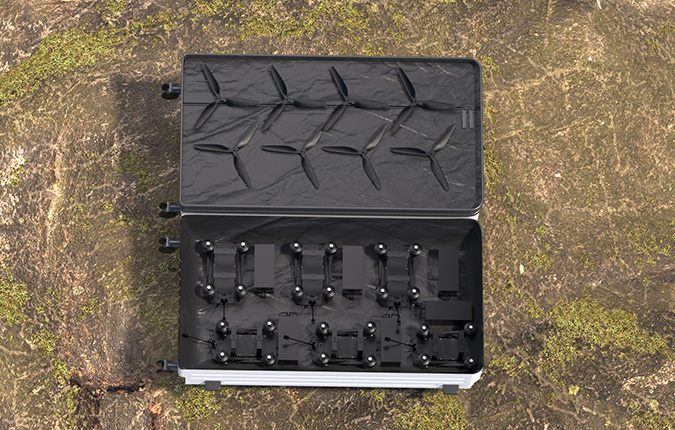
Instead of focusing solely on racing-style performance, the platform was designed around a different question: how much operational capability can be packed into a transportable frame?
Its aviation-grade aluminum folding structure addresses mobility concerns while maintaining the durability expected from field deployments. More importantly, the platform supports payloads approaching 3 kg depending on configuration. That changes the mission profile entirely. You’re no longer discussing a recreational FPV aircraft. You’re discussing a multi-role aerial platform. Different category. Different priorities.
Long-Range Operations Create Unexpected Design Challenges. Range specifications are easy to advertise. Maintaining reliable operations at range is harder.
Many operators underestimate how quickly mission complexity increases once aircraft move beyond visual proximity. Communication reliability, power management, video quality, and navigation stability all become increasingly important.
A platform capable of supporting control distances up to 15 km isn’t simply extending flight distance. It’s expanding the types of tasks that become feasible. Infrastructure inspections. Remote environmental monitoring. Long-distance exploration. Extended perimeter observation.
The interesting part is that these applications rarely appear in traditional FPV marketing discussions. Yet they represent some of the most practical real-world uses of FPV technology.
Flight Time: The Specification People Misunderstand. The internet loves top-speed numbers. Flight endurance receives far less attention. That seems backwards.
A drone capable of flying 180 km/h sounds impressive. A drone capable of staying airborne for approximately 45 minutes sounds less exciting. Yet which capability creates more operational value? The answer depends entirely on mission requirements.
For inspection work, observation tasks, mapping operations, or industrial monitoring, endurance often becomes the limiting factor. Every battery swap introduces downtime. Every landing interrupts workflow.
An operator performing a lengthy survey may gain more value from additional flight time than additional speed. Not glamorous. Just practical. Engineering frequently works that way.
The FPV Camera Debate Never Really Ends. Camera discussions have become surprisingly tribal. Some pilots prioritize image quality. Others prioritize latency. Some want cinematic footage. Others want maximum situational awareness. The reality is that professional FPV systems often require balancing all these factors simultaneously.
A 2000TVL wide-angle FPV camera configuration, paired with a dedicated transmission system, reflects that balancing act. The objective isn’t necessarily producing movie-quality footage. The objective is providing reliable visual information that supports decision-making during flight. Different mission. Different optimization target.
A Niche Application That Doesn’t Get Enough Attention. One area where foldable FPV platforms deserve more discussion is infrastructure inspection. Bridges. Utility corridors. Industrial facilities. Large construction sites.
These environments often require operators to move repeatedly between locations while carrying tools, batteries, communication equipment, and safety gear. In those situations, portability stops being a convenience feature. It becomes an operational requirement.
A large fixed-frame aircraft may offer excellent flight characteristics, but if transportation and deployment consume excessive time, overall mission efficiency suffers. That’s the kind of engineering trade-off that rarely appears in specification sheets. Yet it affects real-world outcomes every day.
The Industry Is Growing Up. Reading older drone training discussions from the mid-2010s is fascinating because they reflect an industry still learning its foundations. Safety education. Basic flight operations. Battery awareness. Airspace understanding. Those remain important.
But today’s conversations increasingly revolve around mission effectiveness, deployment efficiency, payload flexibility, and operational scalability. The technology has matured. The questions have changed.
And that may explain why foldable FPV drones continue gaining attention among professional users. Not because folding mechanisms are revolutionary. Not because portability alone changes everything.
But because practical field operations reward equipment that balances transportation, deployment speed, endurance, payload capability, and flight performance in a single package.
In fact, we often need to look at things from different perspectives. Take this drone that can fly through obstacles, for example: the most valuable innovation isn’t actually making it fly faster, but staying true to our original vision—we simply want to get drones to fly. Stripping away all the flashy gimmicks, that’s the whole story.