
A patent for a foldable carbon fiber rotor guard highlights a contradiction in current drone design.
Competition is intensifying across all major industries. Take the drone industry, for example: everyone is striving for higher speeds, greater power, and lighter weight. However, they rarely consider whether a drone can continue to operate normally or remain functional after even a minor collision. In fact, many drones are damaged not by severe crashes, but by a minor collision, a near-miss with a wall, or even just a slight bump to the rotors.
As the parameters of the power system are constantly pushed to their limits, impact resistance is often the aspect that gets overlooked.
Not catastrophic crashes. Not full-speed ground strikes. Small collisions.
Tree branches. Wall corners. Cable trays. Indoor infrastructure. Random contact events that happen every day during inspection, mapping, security patrol, and confined-space operations.
The ugly truth? Many so-called rugged drones remain mechanically fragile. A 3-gram propeller strike can trigger a failure chain capable of destroying a multi-thousand-dollar airframe.
The physics are not complicated. A rotor blade contacts an obstacle. The blade chips. Rotor thrust becomes asymmetric. Flight control software attempts correction. Motor loading changes. Vibration spikes. IMU data quality degrades. Attitude estimation becomes less reliable. The aircraft begins chasing its own instability. Sometimes recovery works. Sometimes it doesn’t.
Field operators know this story by heart. Marketing departments rarely mention it. Patent CN224361410U is interesting not because it introduces a revolutionary aerodynamic breakthrough. It doesn’t. What it does reveal is how badly conventional protection strategies have stagnated.
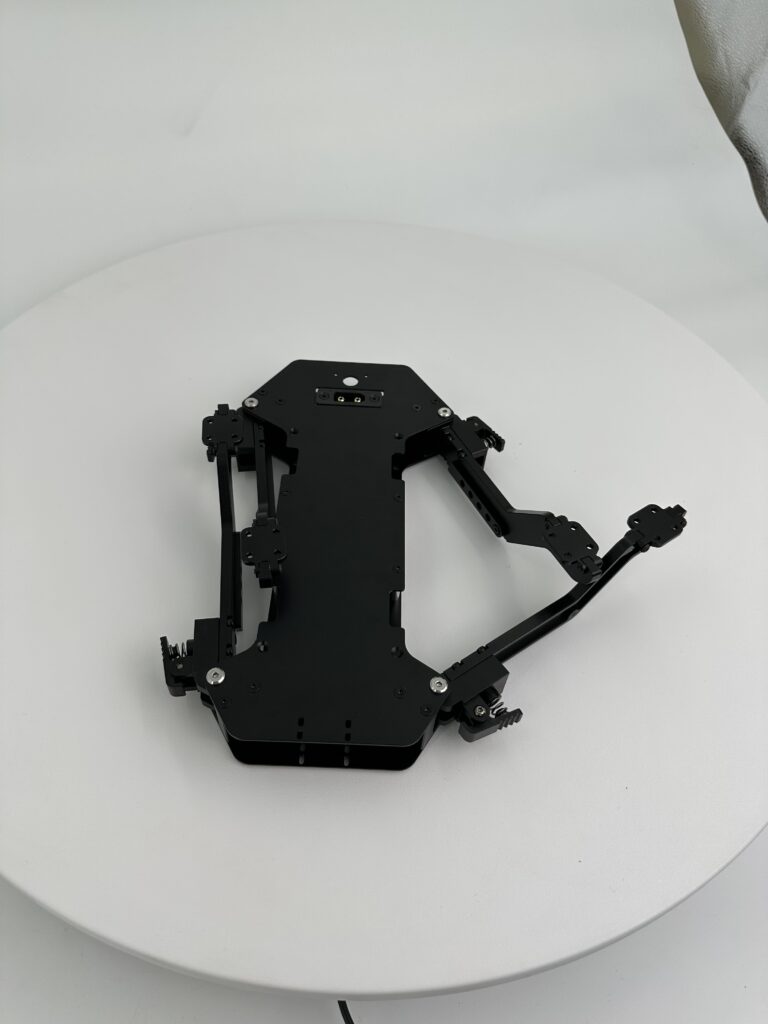
The architecture combines a circumferential carbon-fiber protective ring, reinforcement rods, extension rods, adjustment rods, and threaded load-transfer interfaces arranged around the propulsion system. That sounds ordinary until you examine the load path. Most commercial protection guards operate as sacrificial accessories. Impact occurs. Guard deforms. Force concentrates at a few mounting points. Local structural stress rises dramatically. Mounting tabs fail. Guard breaks. Problem temporarily solved. Replacement required.
Here the design attempts something different. The protective ring becomes the first contact surface while reinforcement members redistribute collision energy into multiple structural nodes before forces reach sensitive propulsion components.
That distinction matters. A lot. Rotor blades hate concentrated loads. Motor shafts hate bending moments. Bearings hate impact shock.
Distribute those loads early enough and the probability of secondary damage drops dramatically. Not eliminated. Reduced. There’s a difference. Engineers who confuse those two concepts end up writing warranty reports.
Here’s where the math actually breaks down: Most foldable FPV drone manufacturers advertise protection systems without publishing a single useful impact metric. No absorbed energy value. No maximum survivable collision velocity. No peak transmitted load. No structural fatigue data. No fold-cycle durability. No quantified thrust penalty. Nothing. Just glossy renderings and words like “enhanced safety.” Meaningless.
A carbon-fiber ring can be brilliant or terrible depending on laminate schedule, fiber orientation, wall thickness, connection geometry, and impact direction. T700 behaves differently than T300. A thin tube behaves differently than a thick-walled ring. An ovalized section behaves differently than a circular section. Without numbers, engineers are guessing. And guessing is expensive.
The most overlooked feature inside this architecture isn’t the carbon fiber. It’s the threaded interface.
Look carefully at what the design is trying to accomplish.
The extension rod and adjustment rod create a connection capable of limited axial movement during impact loading. That microscopic displacement allows frictional dissipation to occur before the entire collision impulse reaches the primary frame structure.
Many drone designers still treat structural rigidity as a religion. Rigid isn’t always better. Sometimes rigid simply means the impact energy arrives faster. The result? Higher peak loads. More shaft bending. More bearing damage. More cracked mounting structures.
The threaded interface appears to function as a primitive mechanical fuse. Not a perfect energy absorber. Not a dedicated crash structure. But potentially enough compliance to lower transient overload events. That is a far more interesting engineering discussion than another argument about motor power-to-weight ratios. Let’s be real for a second.
Foldability itself has become an industry buzzword. Everyone claims portability. Everyone claims rapid deployment. Everyone claims operational efficiency. Few manufacturers acknowledge the structural compromises created by folding mechanisms. Every hinge introduces potential play. Every hinge introduces tolerance accumulation. Every hinge introduces fatigue risk. Every hinge becomes a future maintenance event.
Seriously, if I see one more folding arm with measurable torsional flex under load, I’m going to start carrying a dial indicator to trade shows. The protection architecture described here partially sidesteps another overlooked issue. Traditional fixed rotor guards create transportation nightmares.
Packaging volume increases. Storage efficiency drops. Vehicle integration becomes harder. Deployment becomes slower. Operators eventually remove the guards because the logistics become annoying. Then the next branch strike destroys a propeller. Predictable outcome.
A foldable protection perimeter at least attempts to reconcile operational practicality with collision mitigation. Whether it succeeds depends entirely on the durability of the folding joints—a specification not publicly disclosed.
And that omission matters. Another uncomfortable reality for the foldable FPV drone manufacturer community: Most impact failures are not actually blade failures. They are system failures. The blade strike is merely the first visible symptom. The real damage often appears elsewhere. Motor shaft runout. Bearing brinelling. Frame resonance shifts. Fastener loosening. Sensor vibration contamination. Connector fatigue. You can replace a propeller in thirty seconds. You cannot always identify a slightly bent motor shaft before it starts poisoning flight stability data. That’s why a protection system that intercepts collisions before force reaches the propulsion assembly deserves serious attention.
Not because it looks safer. Because it changes the load path. Engineers should always follow the load path. Marketing teams follow aesthetics. Different professions. Different outcomes. One prediction. Within the next five years, serious industrial FPV platforms will stop competing primarily on motor efficiency and battery density gains alone.
Those improvements are becoming incremental. Single-digit percentages. Marginal advantages. Survivability will become the next battlefield. Not military survivability. Operational survivability. How many branch contacts can the aircraft endure? How much impact energy reaches the motor system? How much structural degradation occurs after 100 minor collisions? How many maintenance hours are generated per 1,000 flight hours?
Those are the metrics that determine lifecycle cost. Those are the metrics procurement teams eventually care about. And those are the metrics the industry still avoids publishing. The irony is almost funny.
Drone manufacturers spend millions optimizing flight performance while ignoring the far more common event that ends missions in the real world:
A drone touching something it wasn’t supposed to touch.