
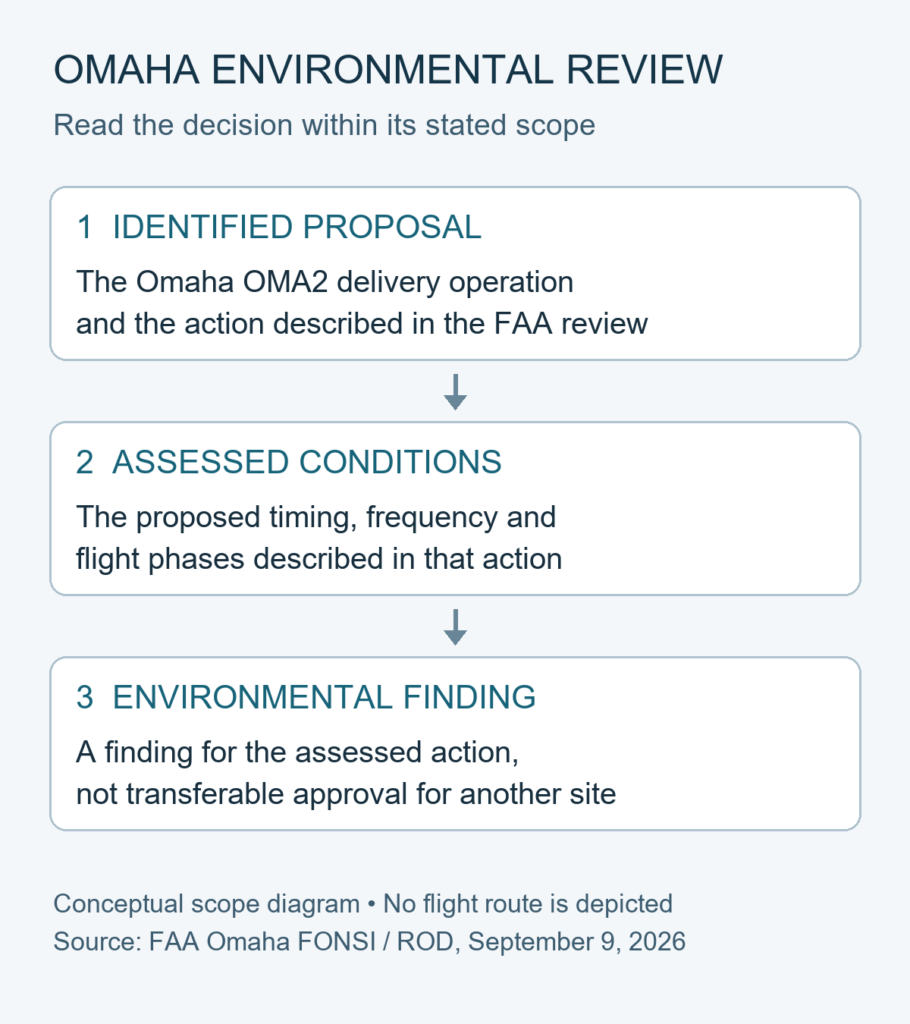
The FAA’s September 9, 2026 Omaha environmental decision evaluates drone package delivery as an operation tied to a particular hub and operating profile. Its practical lesson is that aircraft capability, environmental analysis and operating authorization answer different questions. For a project planner, the useful starting point is the activity evaluated at the site, including where flights occur, their frequency and their timing.
The Omaha decision evaluates a specific federal action and location
The FAA’s signed Omaha environmental decision concerns Amazon Prime Air’s proposed expansion at the OMA2 location in Omaha, Nebraska. It addresses the environmental effects associated with amending the operator’s Operations Specifications and related approvals for that operation. The finding concludes that the evaluated action would have no significant environmental impact, so an Environmental Impact Statement is unnecessary for that action.
The document places that conclusion alongside an identified operator, location and proposed activity. For planning purposes, those elements form a connected scope: a hub serves an operating area, flights follow the proposed profile, and the analysis evaluates the resulting effects. The finding belongs to that combination rather than to an aircraft category in the abstract.
The FAA’s current public environmental-review index records the September 9 signature date. That is the substantive decision date relevant to this update. Supporting technical work can be older and still contribute to the assessment; the age of a technical appendix and the date of the federal decision describe different parts of the evidence chain.
The proposed flight profile supplies inputs to environmental analysis
The Omaha proposal describes up to 1,000 delivery flights per operating day, seven days per week, with approximately 365,000 annual delivery operations and an operating period from 6:00 a.m. to 10:30 p.m. These are planning quantities for the assessed operation, not measured delivery results. The decision also identifies 100 daily operations within the combined early-morning and late-evening periods outside 7:00 a.m. to 10:00 p.m.
For workload, keep the daily proposal separate from achieved throughput. For timing, retain the distribution across the operating period rather than spreading the same total uniformly by assumption. For location, distinguish hub activity, en-route passages and delivery activity. Together, those variables describe exposure more usefully than a single statement that the aircraft is electric.
The supporting Technical Noise Report estimates exposure separately for the delivery center, flight paths and delivery locations. Its method combines sound events and the applicable activity counts to estimate longer-term exposure. A single pass-by sound level and a day-night average represent different quantities; copying one into the role of the other loses the operating context.
This is also why a busy hub and an individual delivery address need separate attention in the analysis. They encounter different combinations of flight phases and event counts. The report’s numerical predictions remain tied to its aircraft, assumptions and modeled circumstances; this article derives no universal separation distance from them.
For readers following drone operations and regulatory developments, the important boundary is the connection between the assessed activity and the conclusion. Preserve that connection when comparing projects, including the conditions that make two apparently similar delivery operations materially different.
A changed project needs its own scope comparison
The Omaha decision links environmental findings to the described location and operating profile, and states that expansion beyond the authorized area and limitations may require further Operations Specifications amendments and appropriate environmental review. A new project can use that relationship to organize its planning: identify what is changing, then compare the change with the scope of its applicable approvals and analysis.
Changes in hub position, daily activity, operating times or route distribution should therefore remain visible as distinct design inputs. The applicable authority and project circumstances determine the required review; the Omaha result supplies an example of a bounded decision, not transferable permission for another operator.