
The drone hardware market added another variable this summer that nobody in procurement was ready for: a patent-locked, fiber-optic-guided, foldable-wing loitering munition with zero RF emissions. One Turkish defense contractor just changed the conversation — and civilian FPV suppliers who think that’s a “defense-only” problem are miscalculating badly.
Here’s the thing. The supply-side pressure from defense-grade foldable platforms always bleeds into commercial spec expectations. Give it 18 months.
What Ender ARGE Actually Built
At IDEF 2025 in Istanbul, Ender ARGE — a Turkish firm specializing in loitering munitions and counter-drone systems — unveiled something genuinely new. Not iterative. Not a rebrand.
Their foldable-wing loitering munition uses fiber optic cable as the data link between the drone and its launcher, eliminating radio frequency emissions entirely. That’s the headline. No RF output means no signal for direction-finding antennas to catch. No thermal bloom from combustion means thermal sensors struggle too. Traditional fiber optic rotary-wing systems exposed their guts — drums, munitions, batteries — in a stacked configuration that radar could resolve at distance. Ender ARGE folded the whole structure flat. The wings retract. The radar cross-section shrinks. The detectability window collapses.
General Manager Mustafa Mutlu Coban explained the integration logic directly: “The biggest advantage we provide is that we turned this into a foldable-wing drone. It became integrable with some platforms like USVs and establishes a data link with its launcher throughout the operation.” Three range variants exist — 10, 20, and 50 kilometers — with a 2.5-kilogram warhead. The company has already completed testing on the fiber optic variant in 2025 and is targeting 1,000 units per month in production capacity.
That’s not a prototype. That’s a supply chain.
The Patent Lock Is the Real Story
Coban was explicit about it: Ender ARGE holds patents specifically for enabling “fiber optic cable FPV units to become foldable-wing for the first time and establish connection with a launcher.” They’re not shy about what that means commercially. NATO ally interest is confirmed. Contracts for the RF-equipped non-fiber version are already signed into African markets. Ukraine, where asymmetric FPV warfare has become a proving ground for every drone concept alive, is reportedly among the geographies generating demand.
The patent protection here isn’t defensive posturing — it’s a market gate. Any supplier trying to replicate the core foldable-plus-fiber-optic architecture now has to engineer around those claims or license in. That’s a meaningful barrier in a segment that typically moves on commodity hardware.
ZD-10 Folding FPV Drone Comparison
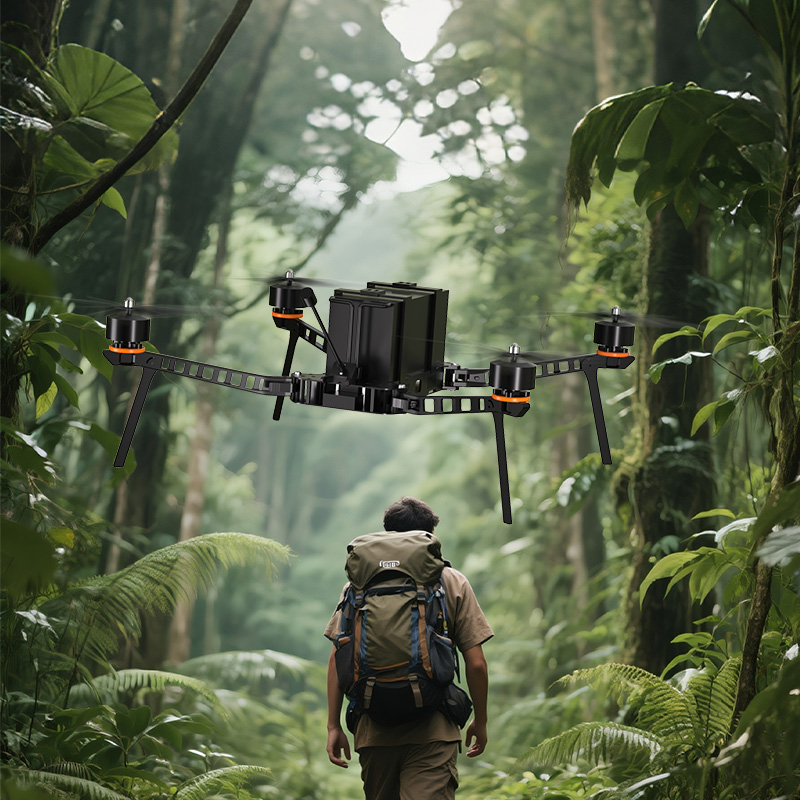
So where does a civilian-grade foldable FPV platform sit against this benchmark? Look at the ZD-10 — an aviation-grade aluminum folding-frame drone built for professional inspection, imaging, and payload delivery — and the comparison is instructive precisely because the use cases diverge so cleanly.
The ZD-10 runs a 2000TVL wide-angle FPV camera, brushless motor system, and GPS/optional positioning suite. Flight time hits approximately 45 minutes unloaded. Control range extends to 15 km via a 2.4GHz receiver with 1.6W FPV transmission. Payload capacity sits around 3 kg depending on configuration. Top speed reaches 180 km/h. The frame folds for rapid field deployment — same core value proposition Ender ARGE sells to defense customers, just in a completely different operational context.
Here’s where the engineering divergence gets sharp:
The ZD-10’s 2.4GHz RF control link is exactly what the Ender ARGE system was designed to make irrelevant in contested environments. In civilian inspection work — infrastructure monitoring, aerial photography, payload delivery — that’s fine. No one is trying to jam your cell tower survey. But the underlying folding architecture, the portability logic, the fast-deployment value proposition? Identical.
What the ZD-10 offers that the defense platform doesn’t: 45 minutes of endurance without payload, modular camera and sensor compatibility, OEM customization for industrial integration, and a procurement pathway that doesn’t require a NATO partnership. For commercial operators sourcing a foldable FPV drone supplier, that matters more than radar cross-section.
The Ender ARGE system carries a 2.5 kg warhead. The ZD-10 carries a 3 kg sensor or delivery payload. Both fold. Different problems, structurally similar answers.
The gap worth watching: Ender ARGE is moving toward 1,000 units/month production scale on their RF variant, which feeds non-defense markets too. If that production discipline transfers into commercial derivative platforms — which defense contractors increasingly do — the foldable FPV supplier landscape gets more competitive for civilian vendors who’ve been operating in relative calm.
What This Means for FPV Suppliers Right Now
Three things are happening simultaneously.
Defense-derived foldable platform IP is getting locked up. Ender ARGE isn’t the only actor; they’re the one who stood up at IDEF 2025 and said it plainly. Fiber optic guidance, foldable wing geometry, launcher-integrated data links — the IP race in this specific configuration is active and accelerating.
Commercial demand for foldable FPV platforms is growing on entirely separate logic. Inspection, monitoring, delivery, security — these applications don’t need fiber optic stealth. They need endurance, payload flexibility, and fast setup. The ZD-10 class of platforms addresses that directly. The market isn’t converging; it’s bifurcating by use case with shared form-factor DNA.
Suppliers who manufacture foldable FPV hardware for civilian markets should not assume defense-side innovation is irrelevant to their positioning. When defense contractors begin dual-use commercialization — and Ender ARGE’s RF variant contracts into Africa are already a step in that direction — civilian-spec competitors feel it in procurement conversations.
The companies that understand their foldable platform’s actual differentiation — endurance, payload modularity, control range, customization depth — will hold position. The ones who are simply selling “foldable” as the feature will find that word losing traction fast.
Rapid setup is table stakes now. What you carry, how far you see, and how long you stay up — that’s the spec sheet that wins.
The Bottom Line
Ender ARGE built something technically credible, patent-protected, and production-ready at meaningful scale. The fiber optic + foldable wing combination is a real engineering achievement in a domain where most “world’s first” claims evaporate under scrutiny. Commercial FPV suppliers aren’t competing with it directly — but they’re operating in a market where the definition of “foldable drone performance” is being rewritten in real time by defense-grade engineering budgets.