
The sticker price will kill your budget. The operational math will save it.
Here’s the part nobody in procurement wants to hear: the buyers who obsess over vtol fixed wing drone price end up spending more. Not occasionally. Almost universally. They find the cheapest platform, deploy it into a real-world inspection corridor, and then spend the next six months bleeding money on battery swaps, aborted missions, and the kind of airframe stress fractures that only reveal themselves at 400 meters over a pipeline.
The Chinese training market figured this out, incidentally, years before the Western commercial sector caught up.
A 2025 marketing document from Hubei-based Zhixiang Aviation lays out a case study worth dissecting — not because it’s technically groundbreaking, but because it accidentally surfaces the exact tradeoff framework that enterprise buyers keep getting wrong. Their pitch for in-house multirotor training platforms (the M40 and M420) hinges on solving operational friction: ground station complexity, battery reliability, field-calibration overhead. Their VTOL offering, described as a medium-size fixed-wing hybrid listed for “teaching applications,” cites 1.5–6 hour endurance as a headline advantage over equivalent multirotors.
That range — 1.5 to 6 hours — is so wide it’s almost meaningless. But the logic underneath it is sound.
The Actual Cost Structure Nobody Quotes You
When you price a VTOL fixed-wing drone, you’re pricing four separate things simultaneously, whether you realize it or not.
First: the airframe and propulsion. Second: the control and transmission infrastructure. Third: mission-specific payload compatibility. Fourth — and this one gets buried in every RFQ I’ve ever reviewed — ground crew time and logistics per sortie.
That last number quietly dominates the total cost of ownership calculation at any operational scale above “hobbyist.”
A multirotor with a 25-minute endurance window covering a 40 km² inspection zone requires somewhere between 8 and 14 battery cycles per day, depending on wind and return-to-home margins. Each cycle means landing, swap, re-arm, re-check. Your ground crew isn’t flying drones — they’re doing repetitive logistics labor while the sun moves and weather windows close. The vtol fixed wing drone price discussion becomes almost irrelevant when you model that out over a 200-day operational year.
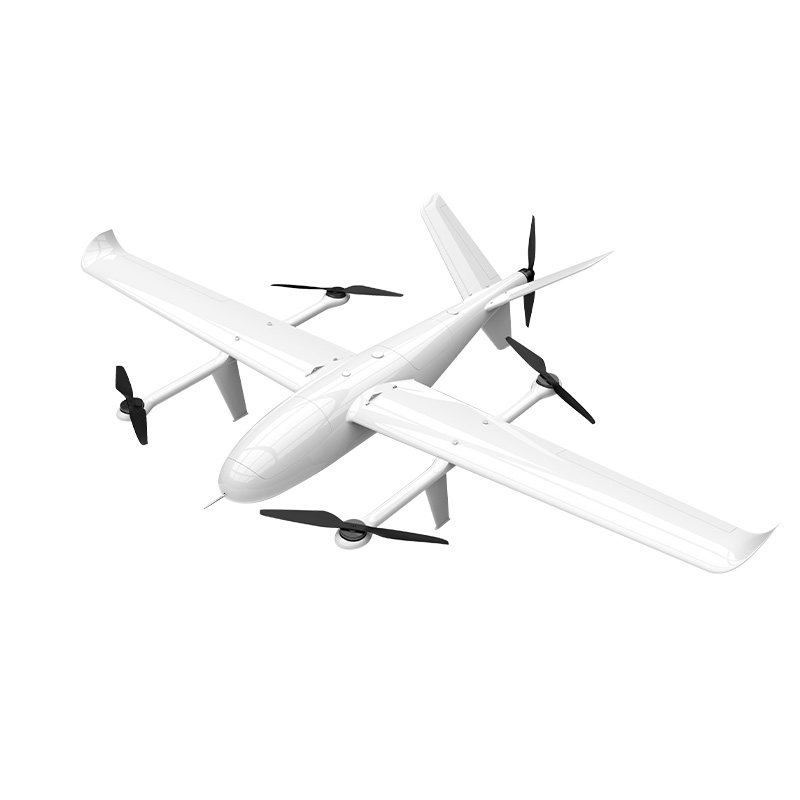
Where the ROC WING MD-25 Sits in This Calculus
Full disclosure: this is our platform, so take the objectivity with the appropriate grain of salt. The MD-25 is designed around 60-minute cruise endurance, with an optional configuration pushing that to 80 minutes. It’s not the longest in its class. There are hydrogen-fuel platforms claiming 3–4 hours. There are purpose-built long-endurance systems with 6+ hour windows targeting border patrol contracts. The MD-25 doesn’t compete there — and it’s not trying to.
What it does is hit a specific operational sweet spot for inspection, surveillance, and mapping professionals who need runway independence without sacrificing transmission range. The 30 km digital HD link matters more than people initially assume. Most competitive platforms in the sub-$20,000 bracket top out at 15–20 km under ideal conditions. That’s fine for agricultural mapping in flat, open terrain. It starts causing mission-abort problems the moment you’re working coastal cliffs, mountain ridge infrastructure, or dense urban periphery where line-of-sight conditions degrade asymmetrically.
The Ardupilot open-source flight controller is a deliberate choice, not a cost-cutting measure. Open-source here means protocol compatibility: MAVLink, support for RTK GPS integration, third-party GCS flexibility. Proprietary stacks lock you into the manufacturer’s update cycle and support infrastructure. When you’re deploying in regions with inconsistent vendor support, that lock-in is a structural risk. EPP composite airframe construction handles field impacts better than equivalent fiberglass builds at this weight class — not because EPP is exotic, but because the foam-composite blend absorbs distributed stress in ways that rigid structures don’t.
The Tradeoff We Actually Made
Look, VTOL hybrid platforms by definition carry a weight penalty. The rotor arms, motors, and ESCs that enable vertical takeoff don’t disappear during fixed-wing cruise — they become dead weight that the wings have to compensate for. This is the fundamental physics compromise of the entire category, and it’s why pure fixed-wing platforms will always win on endurance at equivalent payload weights.
We chose 60–80 minute endurance over 90–120 minutes because extending beyond that threshold, in EPP composite construction at this size class, requires either a heavier airframe (which degrades VTOL performance) or a larger battery (which introduces its own thermal management and transport regulation headaches). The math didn’t work cleanly past 80 minutes without cascading compromises elsewhere in the system.
That’s the actual engineering decision. Not “we optimized for affordability.” We drew a line at the tradeoff boundary where the system remained coherent.
Back to Price
So what does a VTOL fixed wing drone price actually buy you, correctly understood?
It buys you a capability envelope. The relevant question isn’t “what is the unit cost” — it’s “what is the per-square-kilometer mission cost at my operational tempo, with my ground crew size, in my target environment?”
Zhixiang’s training document, despite being written for an entirely different market segment (pilot licensing academies, not industrial operators), accidentally makes this case well. Their emphasis on reducing field equipment burden, simplifying ground station connectivity, and extending airframe durability between maintenance cycles — those aren’t training-market concerns. Those are operational cost concerns dressed in training-market language.
The platforms change. The physics of operational economics don’t.
A VTOL fixed wing drone priced at $8,000 that requires a two-person ground crew and achieves 45-minute effective endurance per sortie has a completely different cost profile than one priced at $14,000 that a single operator can deploy and recover in under 4 minutes with 70 minutes of usable flight time. Run that math over 150 operational days. The cheaper drone costs more.
That’s the counter-intuitive part procurement teams keep getting burned by. Price the capability. Not the hardware.