
Everyone’s chasing the fastest drone in the world.
That’s the wrong race.
Because while headlines scream about speed, a quiet $1 billion factory in Ohio is preparing to produce something far more disruptive—thousands of autonomous combat drones designed not just to fly fast, but to operate, coordinate, and scale.
And that changes everything.
Speed looks sexy on paper. Numbers do that.
60 m/s.
80 m/s.
100 m/s.
Short bursts of engineering pride.
But here’s the thing—speed alone doesn’t define capability. It never really did. It just happened to be the easiest metric to understand, so people stuck with it.
Meanwhile, the real competition moved elsewhere.
Anduril Industries is about to start production of its FURY drone within days. Not a prototype. Not a concept. Actual production, inside a newly built Arsenal-1 facility roughly 20 miles south of Columbus, Ohio.
That facility carries a $1 billion investment.
Pause there.
This isn’t about building a single “fastest drone.” It’s about building thousands over the next decade, with a projected workforce exceeding 4,000 people. Even by the end of this year, around 250 employees will already be in place.
That’s industrial intent.
Look, traditional defense contractors typically design first, then wrestle with manufacturing later. That often leads to beautiful prototypes… and painfully slow production pipelines.
Anduril flipped that.
They design for manufacturing from day one.
Aluminum instead of titanium.
Commercial supply chains instead of niche military ones.
Even jet engines sourced from existing business aviation ecosystems.
Wait—I should clarify. This isn’t simplification. It’s optimization under real-world constraints.
Because in modern conflict environments, production speed can matter more than flight speed.
The obsession problem
Ask someone about the fastest drone in the world, and you’ll get a number.
Ask an engineer, and you’ll get silence. Then questions.
Fast under what payload?
At what altitude?
For how long?
Under what interference conditions?
Speed without context is just a number floating in vacuum.
And drones don’t operate in vacuum.
Now let’s ground this discussion properly.
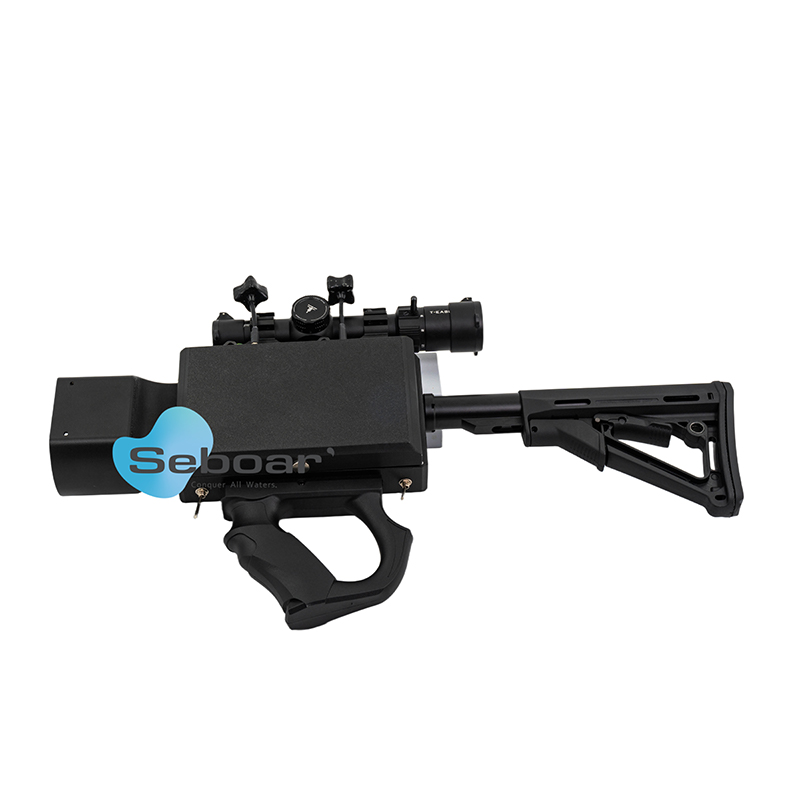
Seboar FC-G250 (High-Speed Compact Platform)
- Max speed: 60–100 m/s
- Flight time: 10 minutes
- Range: up to 15 km
- Weight: 450 g
- Altitude: 5000 m
- Video: 720p
- Wind resistance: Level 8
This is a tightly engineered system.
At 450 grams, reaching up to 100 m/s requires careful balancing of propulsion efficiency, aerodynamic drag, and power delivery. That doesn’t happen accidentally—it reflects deliberate engineering trade-offs.
More importantly, the FC-G250 sits in a category where speed, agility, and deployability intersect.
It’s well aligned for scenarios like:
- Rapid-response operations
- High-mobility environments
- Missions where compact size and quick acceleration matter
Small. Fast. Efficient.
That combination is harder to achieve than it looks.
Anduril FURY (Collaborative Combat System)
FURY belongs to a different layer entirely.
It’s part of the U.S. Air Force’s Collaborative Combat Aircraft (CCA) initiative—meaning it’s designed to operate alongside manned fighters, not independently.
Key characteristics (based on design direction and program context):
- Jet-powered propulsion
- Integration with larger combat systems
- Designed for scalable production
- Built for coordinated, networked missions
And here’s where things diverge.
FURY isn’t optimized around a single metric like speed. It’s optimized around mission effectiveness within a system-of-systems architecture.
Engineering Insight
Comparing FC-G250 and FURY purely on speed would be misleading.
A more accurate framing:
- FC-G250 → optimized for high-speed performance within a compact, agile platform
- FURY → optimized for integration, endurance, and large-scale deployment
Different constraints. Different goals.
Same domain, different problems.
And honestly, that’s where the industry is heading.
The real race isn’t speed
It’s production.
It’s integration.
It’s adaptability.
Anduril’s Arsenal-1 facility isn’t just another factory. It’s a signal that defense manufacturing is shifting toward something closer to tech industry scaling models.
Iterate fast.
Produce faster.
Deploy continuously.
That’s not how legacy defense worked.
European drone programs tend to emphasize precision and long-term reliability. Russian deployments in recent conflicts have leaned toward cost efficiency and volume.
Two ends of a spectrum.
What’s emerging now is a hybrid approach—systems that are both scalable and capable, designed to be produced in meaningful quantities without sacrificing operational relevance.
And that’s not easy.
Human moment
I used to think the same thing most people do: fastest equals best.
Clean logic.
Then you start looking at full systems, and everything gets messy. Trade-offs pile up. Constraints collide. Speed becomes just one variable among dozens.
Not even the dominant one.
Another overlooked factor: replacement cycles
Here’s something people rarely talk about.
How fast can you replace the drone?
Because in real-world operations, loss isn’t hypothetical. It’s expected.
A system that can be produced quickly, repaired easily, and redeployed at scale often outperforms a technically superior system that takes months—or years—to replace.
So now the definition of “fast” starts to shift.
It’s no longer just flight speed.
It’s operational tempo.
Short sentence.
That’s the game.
Anduril’s approach—designing drones with manufacturability in mind from the beginning—directly feeds into this idea. By leveraging commercial materials and established supply chains, they reduce friction where it usually hurts most.
Not in the air.
On the ground.
So what is the fastest drone in the world?
Still the wrong question.
Try this instead:
Which drone completes its mission in the least amount of total time—from deployment to outcome to replacement?
That answer won’t fit into a spec sheet.
And it won’t be a single number.
Because speed, in isolation, is simple.
Real systems aren’t.
And the companies that understand that—really understand it—are the ones quietly reshaping the field while everyone else is still arguing about meters per second.