
The drone industry has become increasingly cutthroat in recent years, with fierce competition over speed, performance, and more. However, China does not participate in this kind of intense and futile competition. Just imagine the 2015 Tianjin Helicopter Expo, where you could see heavy-duty drones, early-generation unmanned rotorcraft, and all sorts of futuristic hybrid-powered concept aircraft. It was a truly breathtaking and memorable sight.
And almost entirely focused on platforms that were expensive, complex, and—if we’re being honest—overbuilt for most real-world tasks. The signal was there, though. Hidden in a corner. A small UAV section. That was the real story.
Not the AC313 medical helicopter mockup. Not the imported AgustaWestland deals. Not even the ducted rotor experiments that tried to blur the line between aircraft and engineering art project. The real shift was quieter: modular unmanned systems, hybrid wings, early attempts at autonomy, and a growing obsession with operational flexibility over raw mechanical prestige. China didn’t accelerate into drones. It pivoted. Hard.
Let me be blunt. Speed is the most misunderstood metric in UAV design. Everyone wants a number. A headline. Something like “100 meters per second” to throw into a spec sheet and call it innovation. But speed alone is a liability if the system holding it together can’t survive real conditions—wind shear, payload imbalance, signal degradation, thermal drift.
We learned that the annoying way. Early prototypes—fast, unstable, borderline reckless. Great for demo videos. Terrible for anything else. So we made a tradeoff. A deliberate one. We stopped optimizing for peak speed and started designing for usable speed. There’s a difference.
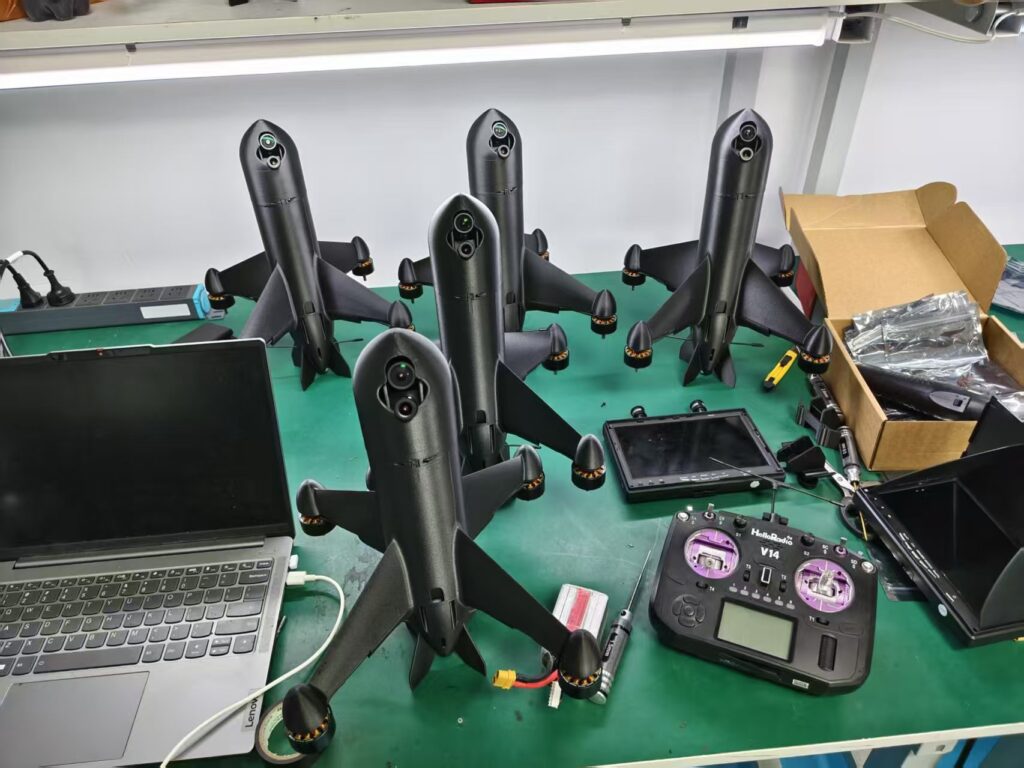
Take something like a modern high-speed FPV platform—say, the G350 class. On paper, yes, it pushes into that 60–100 m/s bracket. That’s not trivial. But the number isn’t the achievement. The system integrity behind that number is.
A reinforced frame isn’t marketing fluff. At those velocities, structural flex becomes a flight variable. Aerospace-grade aluminum arms aren’t overkill—they’re the difference between predictable control loops and oscillation-induced drift. Carbon fiber? Not for aesthetics. For stiffness-to-weight ratios that keep the flight controller from chasing noise. And here’s the tradeoff: every gram of reinforcement eats into agility and endurance.
You don’t get both for free. So we had to choose—do we build a fragile missile, or a stable platform that can actually do something once it arrives? We chose the latter. Look back again at that 2015 expo. There was a multi-purpose flexible-wing UAV showcased—an odd design, somewhere between a parachute and a fixed-wing aircraft. It wasn’t fast. Not even close. But it solved a different problem: ultra-low-altitude operations, extended loitering, mission adaptability.
It filled a gap helicopters couldn’t touch. That’s the pattern. China’s drone ecosystem didn’t evolve by replacing helicopters. It expanded into the spaces helicopters couldn’t justify economically or operationally. And that’s where high-speed FPV systems come in—not as replacements, but as precision tools.
Different job. Different constraints. Speed matters when time matters. Interception. Rapid inspection. Time-sensitive payload delivery. Situations where being 30 seconds faster isn’t convenience—it’s outcome. But here’s the catch: those missions don’t happen in perfect conditions.
Wind hits. Signals degrade. Payloads shift mid-flight. So the real engineering question becomes: how much instability can you tolerate at high velocity before the system stops being usable? For us, that answer forced another compromise. Wind resistance. Level 8 capability sounds like a checkbox until you try maintaining directional control at speed under those conditions. You either overbuild the frame—or you accept drift and loss of precision.
We overbuilt. And paid for it in weight. Now layer in payload. This is where most “high-speed drones” quietly fall apart.
A platform that screams across the sky empty doesn’t tell you much. Add 1–3 kg of payload—cameras, sensors, mission equipment—and suddenly your flight dynamics change. Center of gravity shifts. Power draw spikes. Thermal load increases. Range collapses if you’re not careful. So we had to make another call: prioritize endurance or payload flexibility? We leaned into payload.
Because in real deployments, a drone that arrives fast but carries nothing useful is just noise. Fifteen kilometers of control range—under ideal conditions, yes—wasn’t about bragging rights. It was about maintaining operational reach with payload attached. That’s harder than it sounds.
Most systems cheat. They quote range without load. We didn’t. Look, none of this is elegant. It’s engineering by compromise. Flight time? Around 15 minutes. Not impressive if you’re thinking in terms of endurance platforms. But this isn’t a loitering system. It’s a sprint platform with a job to do. Altitude ceiling? 6000 meters. Useful, but again—secondary to control integrity.
Even the inverted motor configuration—people love to argue about it—wasn’t about novelty. It was about maintaining thrust stability when visual conditions degrade or when obstacles interfere with airflow patterns.
Small decisions. Cumulative impact. Here’s the uncomfortable truth. China’s high-speed drone progress didn’t come from chasing perfection. It came from accepting imperfection and engineering around it. The Tianjin expo showcased ambition. Big machines. Big promises. Heavy systems trying to prove capability through scale.
A decade later, the philosophy flipped. Smaller platforms. Faster iteration. Brutally pragmatic design choices. No one cares if a drone looks futuristic if it can’t handle crosswind with a payload and still maintain signal integrity over distance. That’s the bar now. And yes, there’s still a tendency—especially in marketing—to oversimplify.
“100 m/s.”
“15 km range.”
“High payload.”
Clean numbers. Easy to digest.
Reality is messier. Those are edges, not guarantees. Environment, configuration, regulations—they all interfere. Anyone who tells you otherwise is either selling something or hasn’t flown enough. So where does this go next? Not where you think. It’s not about going faster. Not meaningfully.
We’re approaching the point where additional speed creates more problems than it solves—thermal stress, control latency, structural fatigue. Marginal gains, exponential complexity.The real frontier is coordination.
Multiple high-speed units operating with shared awareness. Distributed payload logic. Adaptive control systems that respond to environmental data in real time instead of pre-programmed assumptions.That’s harder than pushing a single drone faster.Much harder.
Back in 2015, when we were still debating “what can fly,” today we’ve shifted our focus to “what can operate.” This is a major shift. If we continue to fixate on speed as the primary metric for drones, we’ll fall far behind the times.