
Numbers don’t lie.
A 6 kg system trying to stop a $1,000 quadcopter says everything about modern warfare priorities—and contradictions.
Here’s the thing: the industry spent two decades building billion-dollar missile systems, only to panic when hobby-grade drones started rewriting battlefield rules. Now we’re watching a strange reversal. Smaller. Faster. Disposable. Almost… improvised.
At UMEX 2026, Belarusian firm LEMT rolled out something that feels less like a weapon system and more like a philosophical statement: a portable counter-drone launcher that fires another drone to physically ram its target out of the sky.
No fragmentation. No proximity fuse. Just collision.
Brutal simplicity.
The Engineering Philosophy Shift Nobody Talks About
Look, engineers hate inefficiency. Always have.
So when you see a 3 kg warhead strapped to an interceptor drone inside a 6 kg total system, you immediately ask: why so heavy for something designed to hit small UAVs at 200 meters?
Then it clicks.
This isn’t about efficiency. It’s about certainty.
The LEMT system relies on kinetic interception—a direct hit. That eliminates the need for complex detonation logic but introduces another problem: guidance must be precise under chaotic conditions. Wind. Signal noise. Low visibility. Operator stress.
So they compensate with sensors.
Thermal imaging. Video tracking. Neural network classification.
Wait, I should clarify—this isn’t cutting-edge AI in the Silicon Valley sense. It’s constrained, task-specific pattern recognition optimized for identifying drones like Phantom 4 (200 m lock range) or Matrice-class systems (400–500 m).
Still, that’s enough.
And in close-range engagements, “enough” wins fights.
Performance Reality Check
Let’s break it down without marketing gloss:
Range: 6 km max flight distance
Endurance: ~10 minutes
Speed: 200 km/h
Vertical launch: Yes, up to 90°
Payload: 0.5 kg usable
Short bursts. Close fights.
This system lives in the last mile of air defense—the messy zone where traditional systems struggle. It’s designed for low-altitude, low-cost threats that appear suddenly and disappear faster.
And yes, it can hit ground targets autonomously too.
That part should make you pause.
Why Physical Interception Is Back
Because jamming doesn’t always work.
Because GPS denial environments are getting crowded.
Because drones are becoming more autonomous, less reliant on remote control links.
So instead of hacking or confusing the drone, you just… remove it.
Physically.
It’s almost primitive. Almost elegant.
And kind of terrifying in its implications—because once both sides adopt interceptor drones, you get layered aerial dogfights at micro scale.
Swarm vs swarm.
Cheap vs cheaper.
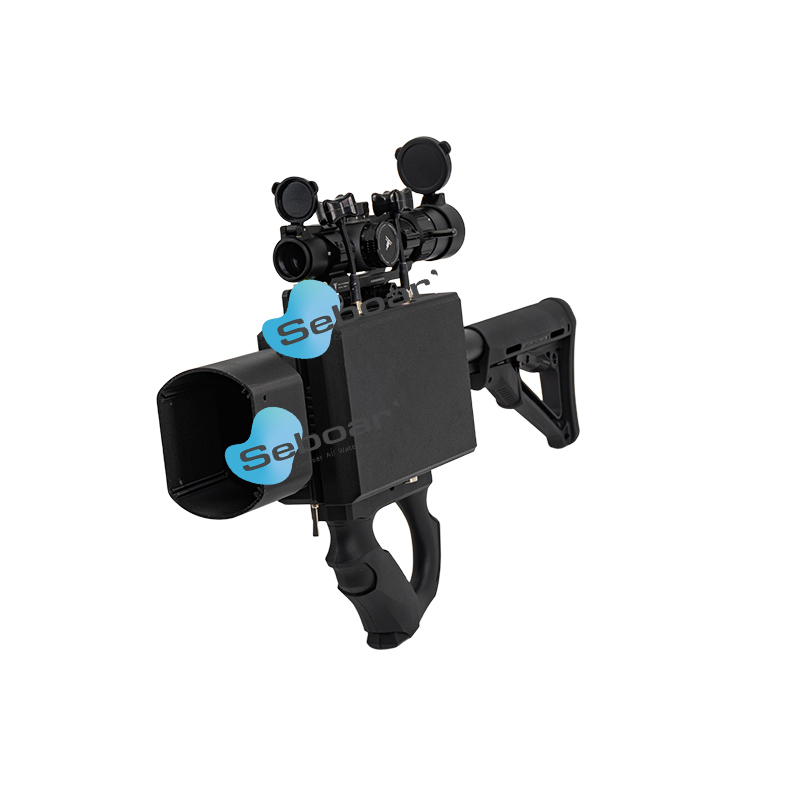
Now let’s talk about Seboar’s system—because this is where things get interesting.
At first glance, both solutions target the same problem: portable counter-drone defense. But the engineering philosophies diverge sharply.
Detection & Reaction Time
Seboar: 5-second detect-lock-launch workflow
Speed matters. In a real engagement, 5 seconds isn’t fast—it’s barely acceptable. But it’s predictable. And predictability matters more than peak performance.
Interceptor Speed
Seboar: Up to 350 km/h
That’s not a small gap. That’s a doctrinal difference.
Seboar is betting on high-speed interception, reducing time-to-impact and increasing hit probability against maneuvering targets.
LEMT, on the other hand, relies more on tracking accuracy than raw velocity.
Depends. Fast drones are harder to control. Slower drones are easier to guide but may miss agile targets.
Pick your failure mode.
Operational Radius
Seboar: 3 km
Here’s the tradeoff in plain sight.
Seboar optimizes for urban, mobile defense bubbles—tight, responsive, localized protection.
LEMT stretches further, doubling the reach, which suggests use in semi-static or perimeter defense scenarios.
Different battlefields. Different assumptions.
Latency & Control Architecture
Seboar: <40 ms video latency with dual-channel 5.8G
Low latency isn’t sexy, but it’s everything in manual or semi-autonomous interception. A 40 ms delay feels almost real-time.
Anything higher? You start chasing ghosts.
Autonomy Layer
Both systems claim AI-assisted targeting, but again—subtle difference.
Seboar emphasizes rapid decision loops
One is reactive. The other is cautious.
Neither is wrong.
The Hidden Constraint: Human Operators
Here’s something brochures won’t tell you.
These systems are only as good as the person holding them.
A rifle-style launcher sounds intuitive—until you realize you’re asking a human to:
Detect a small aerial target
Lock it
Decide engagement timing
Trust an autonomous drone to finish the job
All under pressure.
That’s not trivial.
It’s cognitive overload disguised as simplicity.
And this is where Seboar’s 5-second workflow might actually matter more than raw specs. Reducing operator decision time isn’t just a feature—it’s survival.
The Real Trend: Weapon Systems Are Becoming Disposable
Not officially. Not yet.
But look closer.
A 10-minute flight time. A drone that literally crashes into its target. A portable launcher designed for repeated deployment.
These are not legacy systems built to last decades.
They’re consumables.
Like ammunition.
And that changes procurement logic, training doctrine, and battlefield economics in ways most analysts still underestimate.
Where This Is Heading
Small drones broke air defense.
Portable counter-drone launchers are trying to fix it—but they’re also accelerating the problem.
Because every interceptor drone adds more objects into contested airspace.
More signals. More confusion. More opportunities for failure.
And honestly? We’re just getting started.
Final Thought (Not a Conclusion)
Look, neither system is “better” in a vacuum.
LEMT’s approach feels rugged, slightly heavier, maybe more adaptable across conditions.
Seboar’s system feels faster, tighter, more optimized for rapid-response scenarios.
But the bigger story isn’t about specs.
It’s about direction.
We’re watching air defense shrink—literally—into something a single soldier can carry, deploy, and trust (or hope) to work in seconds.
That’s not evolution.
That’s compression.
And compressed systems tend to fail in very interesting ways.