
The global drone market hits $69 billion in 2026 and is forecast to reach $147.8 billion by 2036, growing at a CAGR of 7.9% . Everyone’s arguing about autonomy stacks, swarm AI, and BVLOS regulations. Fine. But here’s the thing — none of that matters if the video feed turns to pixelated garbage the moment your drone climbs above a tree line.
HD image transmission is the quiet bottleneck. It’s the thing that separates a drone that’s commercially deployable from an expensive paperweight with rotors.
Nobody writes enough about it.
The Problem Nobody Wants to Admit
Drone engineers love talking about flight controllers, gimbal stabilization, and battery endurance. Those are the sexy specs. Slap them on a brochure, impress a procurement officer, done.
Video transmission is different. It’s messy, physics-constrained, deeply unforgiving, and — critically — it’s the thing that actually fails in the field when conditions get real. RF interference from urban environments, multipath signal degradation over water, latency spikes during frequency congestion. These aren’t edge cases. They’re Tuesday.
Back in 2015-2016, the Chinese drone component market was already grappling with this gap. A missile-research student named He Wei at Northwestern Polytechnical University noticed something sharp: DJI’s explosion had spawned nearly 1,000 drone companies in China almost overnight, and every single one of them needed HD transmission modules. The market for the modules existed. The good solutions didn’t. He clocked that HD image transmission represented 20–25% of total drone cost — and that units capable of transmitting clean 720P at 800 meters with under 200ms latency were either nonexistent at accessible price points or priced in the thousands to tens of thousands of yuan per unit. His company, Weiful Intelligent, started selling equivalent modules for around 600 yuan a set. That’s not a small delta. That’s a structural pricing failure in the supply chain.
The yield rate started at 50%. He shipped nothing until it hit 90%. That’s the right call, and most hardware startups don’t make it.
What “Digital HD” Actually Demands Technically
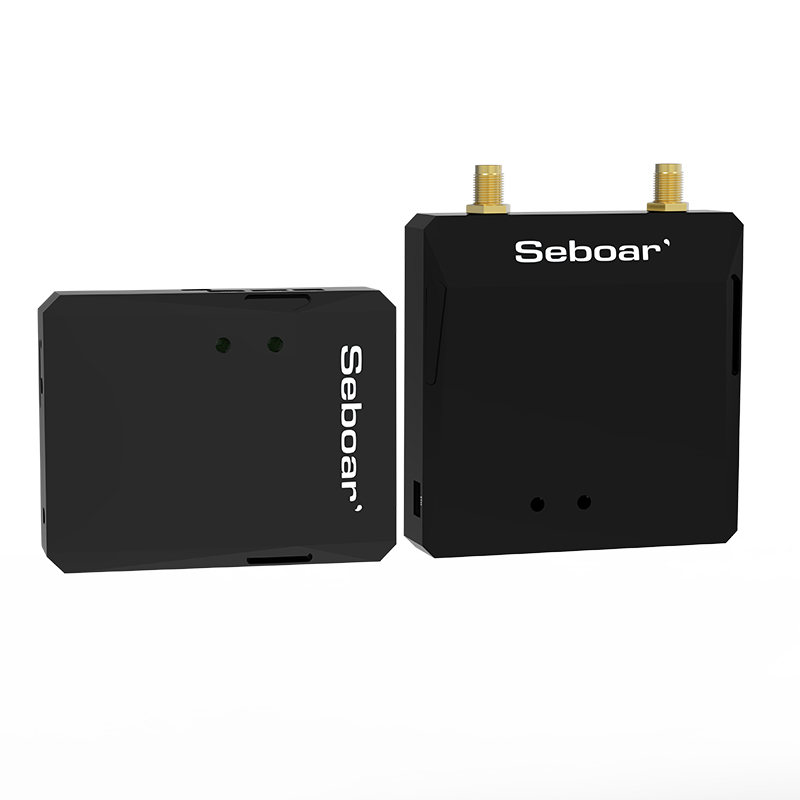
Let’s be precise here. When people say “Seboar A-WI Digital HD Image Transmission” or any comparable digital HD link system, they’re describing a solution to three simultaneous hard problems: transmission range, latency, and image fidelity — under RF-contested, dynamically changing channel conditions.
Getting one right is straightforward. Getting all three right at scale, consistently, across different regulatory frequency bands in different countries, in hardware small and cheap enough to embed in a commercial UAV frame — that’s where most teams wash out.
Range isn’t purely a power problem. Cranking transmit power into regulatory limits doesn’t linearly solve range; you hit interference floors, you upset neighbors in the spectrum, and in BVLOS contexts you may be legally constrained anyway. The real engineering work is in antenna design, adaptive modulation, and interference rejection algorithms — exactly what He Wei’s team was grinding through in 2015, running seven-day weeks to move from “a few dozen meters, mosaic artifacts” to 800 meters of clean feed.
Latency is the cruelty. 200ms is generally accepted as the upper threshold for usable real-time control feedback. Go above that and pilots — human or algorithmic — are reacting to a past state of the world. In inspection applications, that’s uncomfortable. In autonomous BVLOS operations over populated areas, that’s a safety-critical failure mode.
Image quality at transmission is distinct from sensor capture quality. You can bolt a 4K camera on your drone (He Wei’s underwater robot prototype did exactly this) and still transmit at 720P because the link budget simply doesn’t support full-bandwidth 4K downlink at range. Managing that compression pipeline — what you throw away, what you preserve, how you handle packet loss gracefully — is a distinct engineering discipline that lives between the camera and the RF stack.
Why This Market Is About to Get Much More Demanding
Sensor proliferation is accelerating. IDTechEx projects that commercial drone shipments will grow 2.3× between 2026 and 2036, but sensor shipments will grow 4× over the same period . By 2036, industrial and BVLOS drones are expected to carry 10–15 sensors per airframe.
Read that again. Ten to fifteen sensors. Per drone.
Every additional sensor is another data stream. Every additional data stream is either a local-processing burden, a transmission burden, or both. The inspection and maintenance segment — projected to exceed 25% of all commercial drone revenue by 2030, surpassing agriculture as the leading segment — is driving this directly. LiDAR point clouds, thermal overlays, optical defect imaging, and ultrasonic proximity data don’t compress into a single tidy stream. Managing multi-sensor downlinks without link saturation or latency degradation is the next genuine hard problem.
The 2025 baseline isn’t comfortable: over 30% of large farms globally are already using drones for field operations. Agriculture customers are actually relatively forgiving on latency tolerances compared to, say, a wind turbine blade inspection drone hovering 80 meters up in variable wind with a technician on the ground needing real-time thermal data.
Regulatory Friction Is a Transmission Problem in Disguise
The US Part 107, EU C0-C6, and UK CAP722 frameworks all establish frequency and power emission constraints that directly constrain what HD transmission hardware can legally do in each jurisdiction. North America and the EU have the clearest frameworks; Asia-Pacific, Latin America, and MENA remain fragmented.
A drone system designed for US operations at 5.8GHz may be practically unusable in markets with stricter ISM band congestion rules. BVLOS approvals — which multiple major delivery operators are now actively pursuing across the US, Europe, and China — come with additional RF requirements around C2 link reliability that standard HD video links weren’t designed to satisfy simultaneously.
This is why purpose-built digital HD transmission systems that handle multi-band operation and adaptive power management aren’t a luxury feature. They’re a market access requirement.
The Underwater Angle Nobody Sees Coming
He Wei’s 2016 pivot to underwater robotics — a machine running 6 motors, sealed against dynamic water ingress, transmitting 720P video via neutrally buoyant tether cable because RF simply doesn’t propagate underwater — is a useful edge case for understanding transmission constraints in extreme form.
No wireless. Zero. The physics are absolute.
The tether isn’t a workaround; it’s the only physics-compliant solution. That constraint forced extreme miniaturization (final dimensions: 208mm × 203mm × 130mm), careful motor-to-weight budgeting, and rigid latency discipline (~200ms) on a wired link. The lessons from solving transmission in an environment where wireless is impossible translate directly back to above-water systems under heavy RF interference — which is increasingly the operating environment for urban drone delivery and dense infrastructure inspection.
The delivery drone sector is maturing from pilots to regional commercialization across the US, Europe, and China right now. Urban RF environments are not forgiving. The transmission engineers who spent time thinking about constrained-physics link design are, quietly, ahead.
Bottom Line
Drone markets grow. Sensor counts grow. Regulatory frameworks mature. None of that value gets captured if the HD link between the drone and the operator is the weakest component in the chain.
It was the weak component in 2016. In many deployments, it still is.
That’s a solvable engineering problem. The market — $147.8 billion by 2036—is large enough to reward whoever solves it properly, repeatedly, at scale.
Solve the transmission. Everything else follows.