
The fixed wing VTOL UAV market has a strange problem: the industry spent years celebrating aircraft that looked impressive on a specification sheet but collapsed when engineers asked one simple question — can this machine actually survive repeated missions outside a perfect demo environment?
The answer was often uncomfortable. A drone that can hover is not automatically a VTOL aircraft. A drone that can fly far is not automatically an industrial platform.
The hard engineering challenge is making vertical lift, aerodynamic efficiency, payload capacity, reliability, and field maintenance exist in the same airframe.
That is where modern VTOL fixed-wing designs are moving. The unexpected conclusion is this: the future of cargo and industrial UAVs may not belong to the aircraft with the longest endurance number. It may belong to the aircraft that wastes the least energy during the entire mission cycle.
A runway is a luxury. Industrial operations rarely have one. The Real Engineering Shift Behind Large VTOL Fixed-Wing UAVs. Large platforms such as DJI’s EV50 represent a change in how manufacturers approach unmanned aircraft architecture. Instead of treating VTOL as an additional feature, the aircraft is designed around a hybrid propulsion system from the beginning.
The EV50 combines eight vertical lift rotors with three forward propulsion motors. During takeoff and landing, the aircraft behaves like a multicopter. Once airborne, it transitions into fixed-wing cruise flight to reduce power consumption.
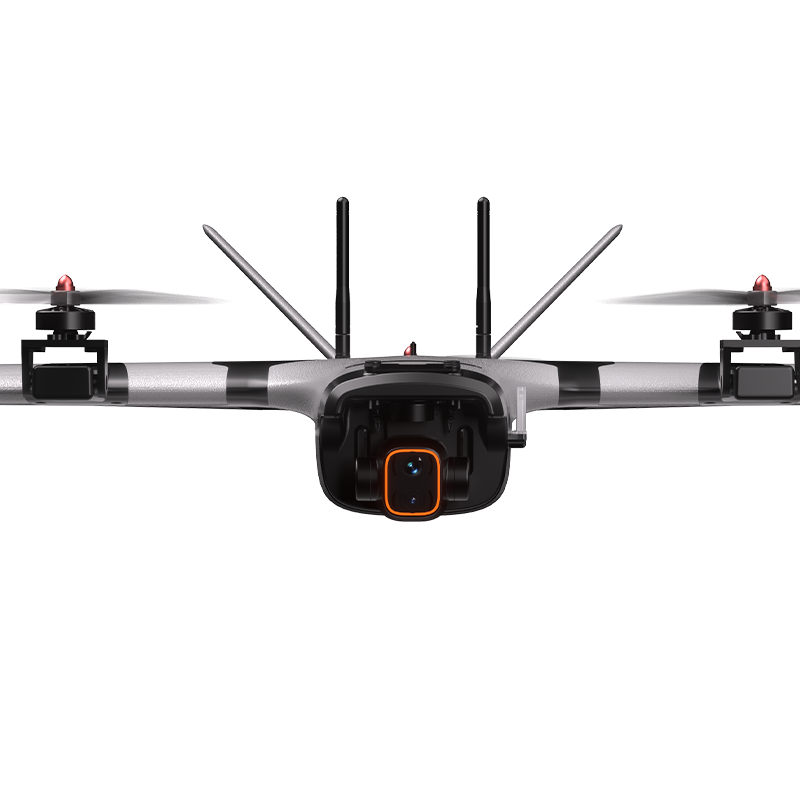
That sounds obvious. It was not. The engineering difficulty is not adding motors. Anyone can attach more motors. The difficulty is managing the energy penalty, structural reinforcement, flight-control complexity, and failure scenarios created by those additional systems.
Wait, let me look at that assumption again — adding vertical rotors is actually the easy part. The ugly problem is what happens when one motor, one sensor, or one control surface starts behaving differently after hundreds of hours of operation.
The EV50 development data highlights this industrial approach. The aircraft reportedly went through five years of development, 875 test flights, and 254 flight hours before large-scale operational validation. Its full-scale testing included high-altitude environments above 4,500 meters and cold conditions down to -20°C.
Those numbers matter because VTOL aircraft are not defeated by the first flight. They are defeated by the 500th flight.
Architectural Benchmarks: Market Standards vs Modern Engineering. Comparing current VTOL fixed-wing UAV platforms requires looking beyond maximum range claims. The architecture tells the real story.
A typical commercial fixed-wing UAV focuses on endurance. A typical multicopter focuses on vertical mobility. The modern industrial VTOL platform has to combine both without creating a maintenance nightmare. The DJI EV50 represents a large-scale logistics approach:
– 7-meter wingspan for aerodynamic efficiency
– 270-liter internal cargo compartment
– Four independent battery packs
– Redundant flight-control surfaces with four elevators and four ailerons
– Up to 150 km range in unloaded conditions
– Around 70 km horizontal routes under standard payload conditions
Those specifications indicate an aircraft designed around transportation rather than observation. The engineering priority is volume, redundancy, and operational altitude.
Now compare that philosophy with a smaller industrial VTOL platform such as the ROC WING MD-25 VTOL Fixed Wing UAV. The MD-25 is built around a different mission requirement.
It uses an industrial-grade EPP composite airframe designed for field deployment where impact resistance and rapid operation matter more than carrying hundreds of liters of cargo.
The platform uses a VTOL plus fixed-wing hybrid configuration, allowing runway-independent deployment. It provides approximately 20 minutes of hover capability, up to 60 minutes of standard cruise endurance, and up to 80 minutes with an extended endurance configuration.
That difference reveals an important engineering divide. Large VTOL aircraft solve logistics problems. Compact VTOL aircraft solve access problems.
Here’s the thing: comparing these aircraft only by range is like comparing trucks and helicopters by fuel tank size. The mission profile decides the correct architecture.
The MD-25’s Ardupilot-based flight-control system, GPS positioning accuracy of approximately ±1 meter, and SBUS/CRSF communication support reflect a modular engineering approach. Instead of locking operators into one sensor package, the platform supports cameras, gimbals, and different payload configurations.
Its 1080P HD digital transmission system provides up to 30 km control and video transmission distance under ideal FCC interference-free testing conditions.
Not every mission needs a 7-meter aircraft. Some missions need a machine that can be transported, launched quickly, repaired easily, and sent back into the field.
Why Altitude Testing Changes the Fixed Wing VTOL UAV Market. High-altitude operation exposes weaknesses that normal flight tests hide.
At extreme altitude, air density decreases. Propellers lose efficiency. Motors operate under different thermal conditions. Battery performance changes. Flight-control systems have less aerodynamic margin.
The EV50’s Everest expedition testing demonstrated this challenge. During the 2026 scientific expedition season, the aircraft completed 32 research flights and reached 8,861 meters altitude, exceeding the height of Mount Everest twice.
That is not just a marketing milestone. It is a stress test for propulsion, control algorithms, and environmental reliability.
The aircraft climbed from 5,200 meters to 8,861 meters while collecting atmospheric data above 8,000 meters. The research flights also identified regional atmospheric effects related to South Asian pollutants and ozone concentration changes.
The larger lesson is not about one aircraft. It is about validation. A UAV designed for industrial work must prove itself where the environment removes all unnecessary advantages. The Next Battle Is Not Speed. It Is Reliability.
The fixed wing VTOL UAV market is entering a stage where basic hybrid designs are becoming common. The differentiation will move toward engineering maturity.
A 30 km transmission system means little if communication reliability drops in complex terrain. An 80-minute endurance figure means little if payload installation requires half a day of preparation. A high-altitude record means little if the aircraft cannot be maintained by operators outside a factory environment.
Look, the drone industry has a habit of chasing impressive numbers because numbers are easy to advertise. Reliability is harder to photograph.
The next generation of VTOL aircraft will likely be judged by mission completion rates, maintenance cycles, modular payload systems, and predictable performance under imperfect conditions. The aircraft that wins will not necessarily be the one with the biggest battery or the largest wings. It will be the one engineered around reality.
Because real operations are messy. The wind changes. Batteries age. Sensors fail. Operators work under pressure. That is where good aerospace engineering separates itself from a flying prototype.