
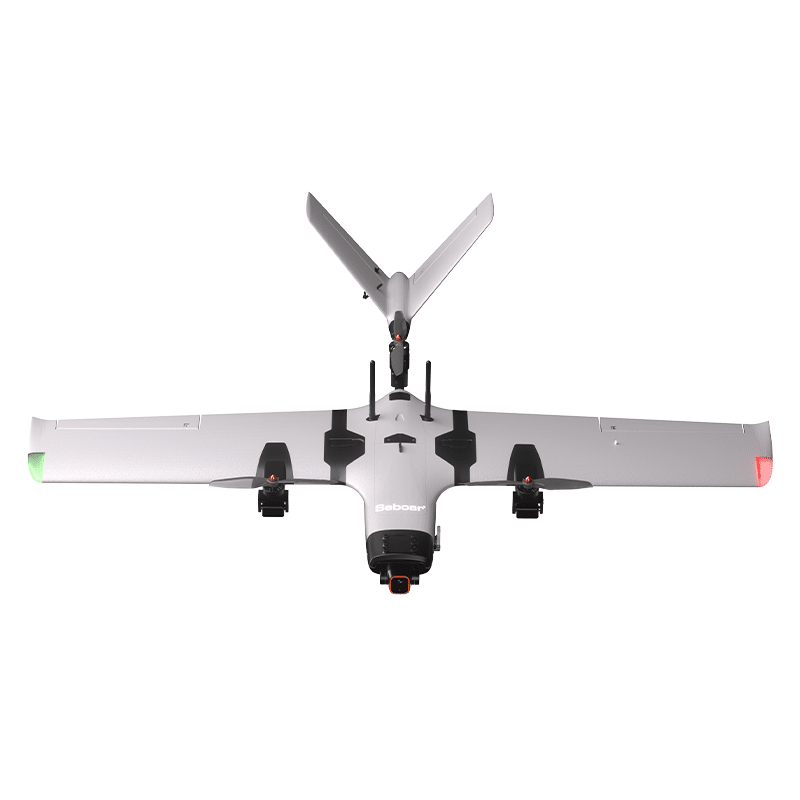
For a civil inspection team buying fixed wing VTOL drones, the camera specification is only part of the image requirement. The team should separately define what the camera captures, what the operator receives live, and what the reviewer can open after the aircraft returns. A single resolution label cannot answer all three questions.
Seboar’s RTF-6 specifications illustrate the distinction. The visible-camera table lists 2560 × 1440 resolution and, on a separate row, 1280 × 720 RTSP resolution. The thermal-camera table lists 384 × 288. Those are different labeled quantities within one product description, not three interchangeable promises about the final inspection file.
Start the purchase specification with the deliverable. If the reviewer needs to examine a visible-light recording after an inspection, request a sample of that recording. If the operator needs a live network stream, request a demonstration of that stream on the intended receiving device. Keep the two acceptance requirements separate.
Read Each Resolution at Its Stated Output
The RTF-6 visible-camera and RTSP specification rows name the visible resolution and the RTSP resolution separately. The product description also lists onboard video recording and RTSP network video output. These statements support asking about distinct capture, streaming, and recording functions. They do not establish every detail of how those functions work together in a delivered package.
In particular, the visible-camera resolution should not be copied into a quotation as the guaranteed resolution of every live display, downloaded clip, or exported report. Likewise, the listed RTSP resolution should not be treated as a complete description of onboard recording. The supplier needs to identify which specification applies to each requested output.
Ask for the exact configuration used to produce the samples: camera, transmission equipment, receiving device, software version, and selected image mode. This is a request for evidence, not a claim that any particular component is incompatible. A product-page feature list alone cannot confirm the customer’s complete viewing and review workflow.
There is no need to turn the two visible-resolution rows into an image-quality score. Their pixel dimensions do not, by themselves, provide compression settings, actual detail on an inspection subject, or measured end-to-end delay. Leave those questions open until the relevant settings and samples are available.
Give the Thermal Channel Its Own Acceptance Requirement
The RTF-6 thermal-camera specification lists 384 × 288 resolution. Keep that figure attached to the thermal channel; the visible-camera figure does not describe the thermal image.
For an inspection involving thermal imagery, first state what the reviewer must do with the result. Viewing a thermal image and producing a quantitative temperature report are different requested deliverables. The published resolution row is not evidence that the package provides calibrated temperature measurements, a particular temperature accuracy, or files compatible with the buyer’s analysis software.
If the task requires quantitative reporting, ask whether the delivered files contain the necessary measurement information, what calibration and accuracy documentation applies, and which software can read them. If the task only requires a visual record, ask for an example of that record and its available export options. Neither request should be interpreted as proof that an undocumented function is present or absent.
Also ask how the visible and thermal records can be associated during review. Request a demonstration using the actual files and any available timestamps or identifiers. Do not assume synchronized records simply because both sensors appear in the same product description.
Follow the Data Through the Handover
An acceptance demonstration should follow the route the customer’s data will take. Ask the supplier to show the live output on the intended receiver, retrieve the saved recording, and open the delivered file in the software the reviewer plans to use.
Record the settings used for that demonstration alongside the sample files. The evidence should identify the output resolution, file format, available frame-rate setting, and any export step that changes the delivered image. Where a setting or capability has not been confirmed, keep it as an unresolved item rather than filling it from another aircraft or camera package.
A screenshot of the operator’s display can document that display. It does not replace the original file when file delivery is the acceptance requirement. Similarly, a product photograph establishes what is illustrated; it cannot demonstrate the quality of an inspection recording.
If continued recording during a live-stream interruption matters to the buyer, include that behavior as a specific verification request. The existence of onboard recording and a network stream does not establish their behavior during an interruption. No interruption tolerance or recovery performance is claimed here.
Put the Image Deliverable in the Quotation
Write the requirement in terms the supplier can answer: identify the exact RTF-6 configuration, the required visible and thermal outputs, the receiving device, the saved-file requirements, and the review software. Ask for representative files and a demonstration that matches those requirements before accepting a statement that the package meets them.
The useful distinction is between a listed capability and a confirmed deliverable. The RTF-6 page provides separate visible, RTSP, and thermal resolution labels. The purchase response should preserve those boundaries and explain what the customer receives at each stage. That gives the inspection team a concrete basis for accepting its image workflow without treating a camera headline as a promise about every downstream output.