
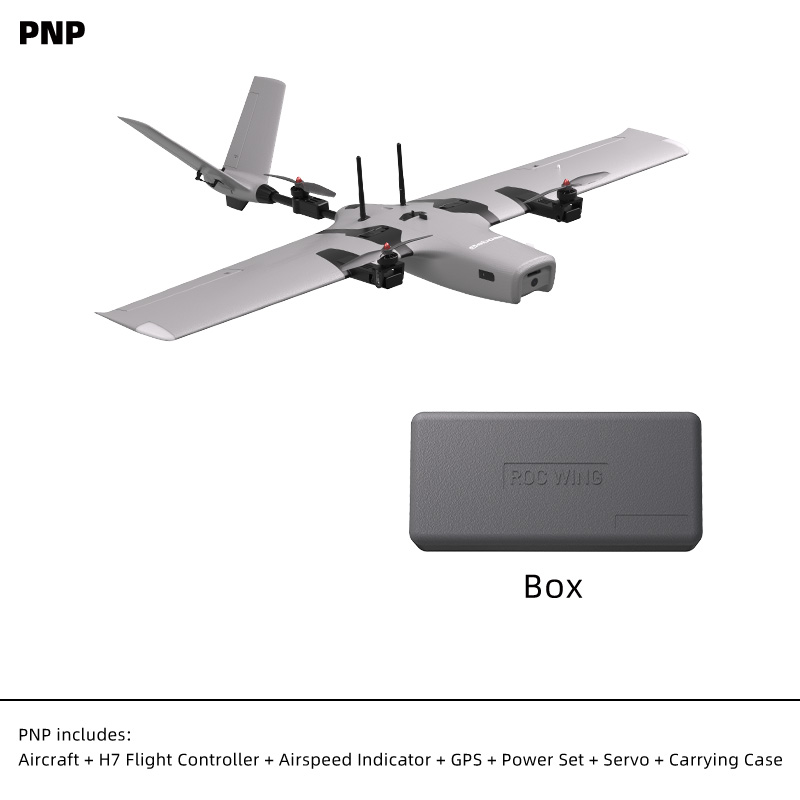
A long range VTOL drone order needs more than an airframe description. Before comparing a PNP quotation with a complete system, separate the equipment explicitly included, the equipment offered as an option, and the equipment whose supply still needs confirmation. Those three categories determine what the buyer must obtain or integrate after delivery.
The Y3 PNP product page provides a useful example. Its package list names the aircraft, H7 flight controller, airspeed indicator, GPS module, power set, servo, and carrying case. Elsewhere, the same page describes optional equipment and a ground-station requirement. Read those statements together, but do not turn them into a larger included package than the list actually defines.
Start With the Named Package
The Y3 PNP included-component list is the starting point for a quotation. Ask the supplier to retain those component names and identify the exact delivered versions. A line labeled “power set,” for example, should be expanded in the order confirmation rather than interpreted as a promise about every power-related accessory.
There are three distinct supply questions:
- Explicitly listed: The aircraft, controller, airspeed indicator, GPS module, power set, servo, and case appear in the PNP list. Confirm quantities, versions, installation state, and the documentation supplied with them.
- Optional or excluded: The specification table labels PTZ and digital VTX as optional. The camera-options text expressly excludes the DJI O3/O4 image-transmission camera and gimbal. A statement about supporting an option does not include it in the shipment.
- Still to confirm: The table lists a 6S 6000 mAh battery, but the battery is not separately named in the seven-item PNP list. That difference calls for a written supply clarification; it is not proof that a battery is absent or included.
Use the same approach for a receiver, transmitter, charger, antennas, and ground equipment. Ask which items the quoted seller supplies and which the buyer supplies. Where the page does not establish the answer, leave the question open until the quotation does.
Separate Interface Support From an Integrated System
The Y3 page lists SBUS and CRSF receiver support, along with CAN and serial expansion. These are useful interface statements. They do not identify every receiver model, software version, connector arrangement, or completed configuration that will arrive in a particular order.
For a buyer bringing existing equipment, the practical next step is a configuration review. Provide the exact receiver and ground equipment proposed for the project, then request confirmation of the intended connections and required setup. Do not treat a matching protocol name as the entire acceptance result.
The response should distinguish a supported interface from a supplied component and from work already completed. For example, ask whether the selected receiver is included, installed, configured, and checked, or whether one or more of those tasks belongs to the buyer. These are confirmation questions, not claims that the PNP aircraft has an interface fault.
Avoid making the quotation responsible for an unspecified future combination. Name the equipment being reviewed. If a component changes before shipment, request an updated configuration record rather than assuming that the earlier confirmation covers the substitution.
Confirm the Ground-Station Dependency
The product description’s Mission Route Mode includes the qualification “Ground station required.” That requirement belongs in the supply discussion even when the airframe and flight controller are already included.
Ask what ground station is intended for the delivered configuration, who supplies it, and which setup work remains. The product page’s mission-mode description is not, by itself, a complete list of ground hardware, software, licenses, or configuration services included in the PNP price.
The same distinction applies to the H7 controller name. Request the actual firmware identification, configuration record, and available recovery instructions for the shipment. Do not assign a firmware family, release, or recovery procedure from the controller label alone; the selected product text does not settle those details.
A supplier can answer these questions without promising every possible integration. A useful response states the configuration being delivered, the assumptions behind it, and the tasks that remain with the buyer or integrator.
Make Handover a Separate Line Item
Receiving the listed hardware and accepting the integrated package are different checkpoints. Define both in the purchase record.
For supply acceptance, request an itemized packing list tied to the ordered configuration, with the agreed quantities and identifiers where available. Check the delivered items against that list. A product photograph is helpful for identifying the advertised package, but it does not replace the shipment’s own record.
For integration handover, ask for the configuration documentation and evidence of the checks agreed for the supplied components. State which checks the supplier performs and which the buyer completes after adding buyer-supplied equipment. Keep the agreed checks specific to the delivered configuration; the product description does not establish which checks have already been performed.
If the order includes integration services, describe their scope separately from the component list. Likewise, identify what support and documentation will be provided if a component or configuration needs correction. Do not assume an unlisted service is included simply because the aircraft supports an operating mode.
Keep the Quotation Specific
For a civil inspection project, a clear Y3 PNP response should connect each required function to named equipment and an assigned integration task. It should also distinguish the base shipment from selected options and buyer-supplied items.
Keep advertised range outside that supply decision until the exact radio, battery, payload, and operating conditions have been separately confirmed. This package review establishes neither a guaranteed communications distance nor a permitted operating radius.
The immediate purchasing decision is narrower: does the quotation define what arrives, what remains to be supplied, and how the agreed configuration will be handed over? Resolve those points before treating a PNP package as a complete project system.