
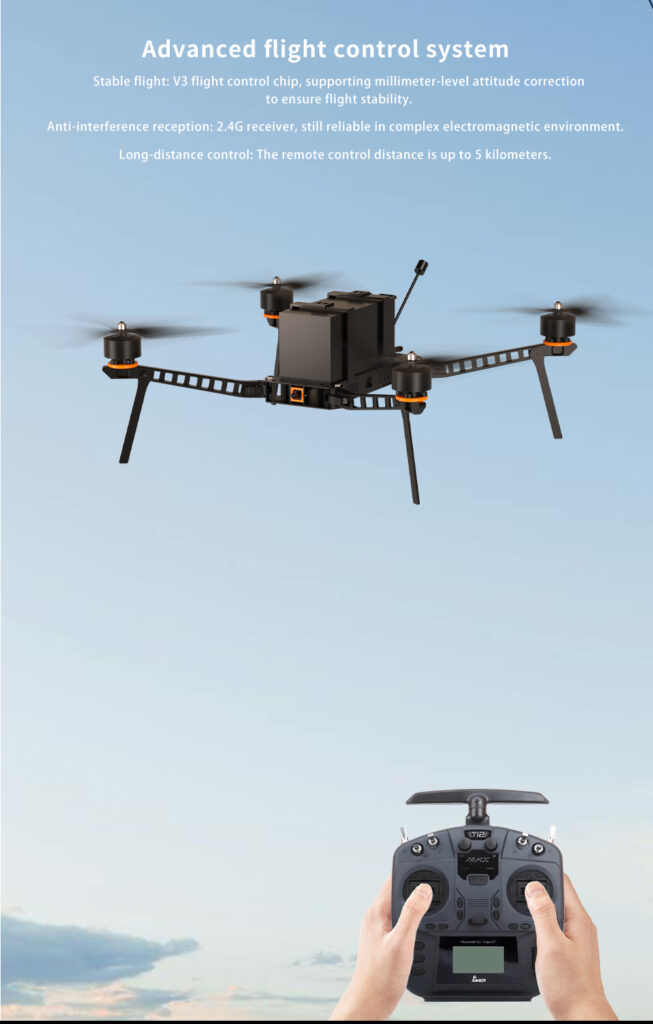
The most interesting thing about the 2026 Drone Racing World Cup in Changchun was not who crossed the finish line first.It was what the event quietly revealed about where folding FPV drones may be headed next.
On September 28, the Changchun round of the 2026 Drone Racing World Cup wrapped up after multiple rounds of competition across open, youth, and women’s divisions. South Korea’s Kim Min-jae and China’s Wang Siqing took first and second in the open division, with South Korea’s Kim Min-chan and China’s Su Keming finishing third and fourth. Wang Siqing also won the youth division, while Li Ke’er, Yu Enning, and Li Tianxing occupied the top three positions in the women’s division.
The results are useful.But they are not the story.The more consequential signal is that competitive FPV is being pulled into a much larger ecosystem involving youth training, aviation sports, public education, industrial networking, and China’s broader low-altitude-economy push.That changes how we should think about folding FPV drones.
The Folding Part Is Not the Interesting Part.A folding FPV drone sounds like a mechanical packaging problem: make the arms fold, reduce the footprint, throw the aircraft into a case, and unfold it before flight.
That’s the brochure version.The engineering reality is less tidy.Every folding mechanism introduces another interface into a structure that is normally expected to remain rigid under high-frequency motor vibration, rapid attitude changes, hard acceleration, and occasional impacts. The frame has to remain sufficiently stiff when locked, yet mechanically practical enough to fold repeatedly without developing play at the joints.
That tradeoff becomes particularly nasty in FPV racing.
A tiny amount of structural flex can alter motor geometry. Motor geometry affects thrust direction. Thrust-direction errors show up as control corrections, vibration, or unwanted attitude behavior. The flight controller then compensates for something that is partly mechanical rather than aerodynamic.
And now the software gets blamed for a hardware problem.This is where folding FPV platforms deserve more scrutiny. The question isn’t simply whether a drone can fold. The question is whether the folding architecture preserves enough structural consistency that the flight-control system sees essentially the same aircraft before and after hundreds of deployment cycles.That durability data was not provided in the Changchun reporting.Neither was frame stiffness.Neither was deployment-cycle testing.Those omissions matter.
Racing Is Becoming a Talent Pipeline.The Changchun event included open, youth, and women’s divisions rather than treating FPV racing as a single elite competition. At the same time, the surrounding 2026 China·Changchun Aviation Sports Season included activities such as aviation-model competitions, drone-related public activities, and youth science workshops.Look, that’s a different proposition from simply hosting a race.
A racing event creates a relatively controlled environment in which people have to understand flight controllers, radio links, video transmission, batteries, motors, propellers, tuning, navigation, and failure recovery. A teenager who starts by learning to fly an FPV machine is potentially being exposed to a surprisingly dense stack of engineering disciplines.
The aircraft becomes the interface.The broader implication is that drone racing can function as an informal technical screening and training environment for the low-altitude industry. Not because every racing pilot becomes an aerospace engineer, obviously, but because competitive FPV forces participants to interact with hardware in a way that passive classroom instruction does not.
That’s particularly relevant as the industry searches for people who understand both software and physical flight systems.The youth division, therefore, is more than another podium.It is a data point about where future operators, technicians, designers, and flight-control specialists might come from.
But There Is a Giant Technical Hole in the Story.Here is the thing: the public reporting tells us almost nothing about the actual aircraft technology used at the competition.We don’t get the track dimensions.We don’t get maximum or average speeds.We don’t get lap times.We don’t get aircraft weight.We don’t get motor specifications.We don’t get battery configuration.We don’t get video-link latency.We don’t get operating frequencies.We don’t get radio-link architecture.We don’t get interference-management procedures.We don’t get crash rates or technical failure rates.
And we don’t get the most interesting number for a folding FPV platform: how much mechanical compromise is introduced by the folding architecture compared with a rigid frame?Without those measurements, it is impossible to turn the event into a meaningful engineering benchmark.
Wait, let me correct one assumption here. A large international racing event does not automatically prove that a particular aircraft architecture is technically superior. Competition validates performance under a specific rule set and operating environment; it does not magically validate every mechanical decision inside the aircraft.That distinction gets lost surprisingly often.
Why Folding FPV Platforms Still Matter.The appeal of folding FPV drones becomes clearer outside the race course.A conventional racing frame is optimized around structural rigidity, minimum mass, serviceability, and predictable geometry. Portability is usually secondary. A folding platform reverses some of those priorities.The aircraft has to become smaller without becoming mechanically unreliable.That creates a different design problem.
For operators moving equipment between training sites, field-test locations, inspection areas, or temporary launch points, reduced transport volume can have practical value. A drone that occupies less space is easier to carry, store, deploy, and protect during transportation.But the advantage disappears if deployment becomes a maintenance ritual.
A useful folding system should make the aircraft faster to prepare without creating new inspection requirements every time the arms are locked into position. The hinge, locking mechanism, wiring path, and mechanical stops all become potential failure points.
This is why a serious folding FPV design should be evaluated across more than flight performance.Deployment consistency matters.Locking repeatability matters.Cable fatigue matters.Frame stiffness matters.And so does what happens after the first hard landing.
Racing May Become the Test Bench.This is where Changchun becomes technically interesting.The event was positioned alongside aviation sports, aviation-model activities, public engagement, and industrial discussions connected to low-altitude development. That creates an environment in which competitive aircraft can become more than sporting equipment.They become demonstration platforms.
A racing FPV drone puts extreme demands on several subsystems simultaneously. High instantaneous power loads stress the battery and powertrain. Aggressive attitude changes expose weaknesses in the flight-control loop. High-speed maneuvering makes video latency and pilot response more consequential. Dense competition environments place additional demands on radio and video-link management.A folding architecture adds another layer: mechanical repeatability.That’s a useful combination.
If future events publish engineering data, the value of these competitions could increase dramatically. Track geometry, aircraft mass, propulsion configuration, transmission latency, failure rates, battery cycles, environmental conditions, and deployment-cycle results would allow engineers to compare architectures rather than merely watching podium ceremonies.That would turn racing from entertainment into a much more useful field laboratory.
The Missing Numbers Are the Real Story.The Changchun results show that international drone racing is expanding into a broader ecosystem in northeastern China, while youth and women’s divisions demonstrate that participation is being structured beyond the traditional elite racing category.But the current public data stops short of answering the questions engineers actually care about.
How fast were the aircraft?How much did they weigh?What transmission systems were used?How tightly was the airspace controlled?How often did aircraft fail?How much maintenance did each platform require?And for folding FPV drones specifically, how many times could a frame be deployed before mechanical tolerances began affecting flight behavior?Those are not minor details.
They determine whether folding FPV technology is merely a convenient packaging solution or a genuinely robust aircraft architecture.The next stage of this industry won’t be defined by another podium photo.It will be defined by the numbers behind the aircraft.