
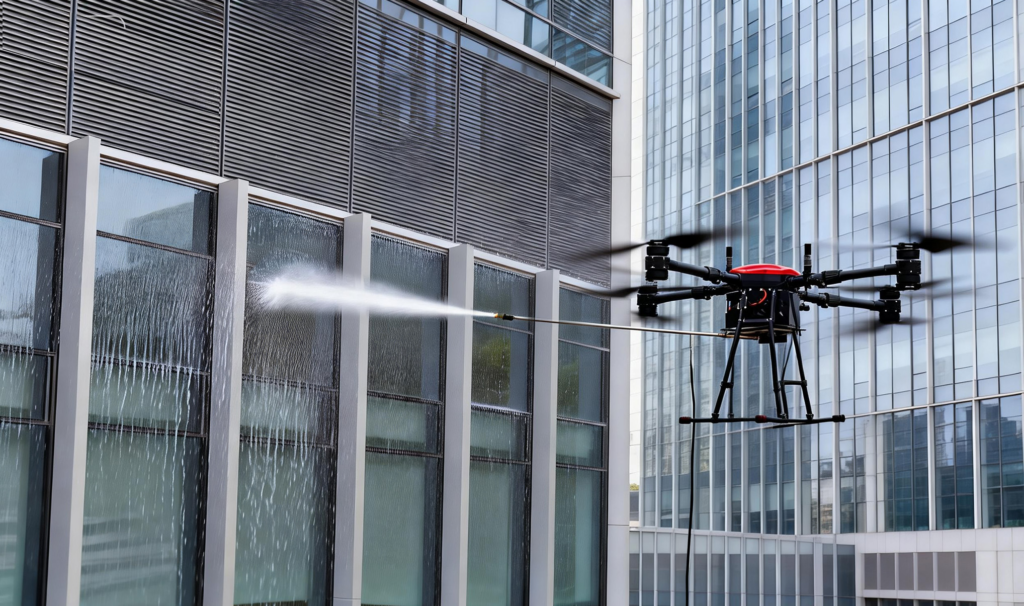
The most dangerous assumption in cleaning robotics is not that autonomy is easy.
It is that a machine becomes technically credible because someone attached a camera, an AI label, and a navigation system to it.
The 2026 Guangzhou International Smart Sanitation and Cleaning Equipment Exhibition exposes the problem rather neatly. The event covered 25,000 square meters and brought more than 400 exhibitors, with products ranging from 12-ton battery-electric refuse compactors and 32-ton fuel-cell refuse trucks to low-entry sweepers, AI patrol robots, street-sweeping robots, and cleaning robots. The technology stack on display included battery-electric drivetrains, fuel cells, autonomous sweeping, AI patrol, big-data dispatch, intelligent operation, and noise-control systems.
That sounds like a mature industry. The engineering data says otherwise. The source material provides almost none of the parameters required to determine whether a cleaning robot—or a cleaning drone—is actually capable of doing the job efficiently.
No gross vehicle mass. No dimensions. No battery capacity. No operating voltage. No motor power. No endurance. No operating speed. No wind-resistance rating. No positioning accuracy. No obstacle-detection distance. No sensor specifications. No AI recognition accuracy. No cleaning width. No energy consumption per unit of cleaned area. Those omissions are not cosmetic. They prevent an engineer from calculating whether the machine is useful.
A Cleaning Machine Is Not Defined by Its Autonomy. Here is where the industry keeps confusing system architecture with system performance.
An autonomous cleaning machine can detect objects, plan routes, communicate with a dispatch platform, and operate without a driver. None of those facts tell you how much pavement it can actually clean before the battery is depleted, how its cleaning performance changes as debris density increases, or how much operator intervention is required when the environment stops looking like the test route.
The Guangzhou exhibition material explicitly describes a hybrid operating model: automated equipment performs routine work while personnel handle fine cleaning, standardized operation, and intervention in complicated field conditions.
That distinction matters. A robot that operates autonomously for 90 percent of a predictable route but requires an operator to resolve the remaining 10 percent may have a completely different labor requirement from a machine that genuinely operates unattended.
The percentage alone still isn’t enough. You need the intervention frequency, intervention duration, distance between interventions, and consequences of failure. One intervention every 30 minutes is not equivalent to one intervention every three hours.
That is basic fleet engineering. Yet marketing literature routinely compresses all of this into one word: Autonomous. That word is almost useless without a workload definition. The Payload-to-Machine Problem Is Different for Cleaning Equipment
A cleaning drone has an even nastier problem. A conventional inspection UAV can spend most of its mass budget on propulsion, batteries, structure, avionics, and sensors. A cleaning platform must also carry the equipment that actually performs the cleaning operation.
Water. Detergent. Brushes. Sprayers. Pumps. Collection equipment. Or, depending on the application, a mechanical tool capable of removing material from the target surface.
The payload does not simply add static weight. It changes the entire operating envelope. Consider a hypothetical multirotor cleaning drone carrying a liquid payload.
As liquid is consumed, aircraft mass decreases. That changes required thrust, power consumption, acceleration characteristics, and potentially flight endurance. But the cleaning system itself may impose a relatively constant electrical load through pumps, valves, motors, or other actuators.
So the aircraft is not operating against one power requirement. It is operating against a coupled load profile: propulsion power + cleaning-system power + avionics + communications + environmental losses.
This is where simplistic “flight time” figures become almost meaningless. A drone that flies for 30 minutes with no cleaning load is not demonstrating 30 minutes of cleaning endurance. It is demonstrating 30 minutes of flight under unspecified conditions. Those are different tests.
The Missing Metric Is Usually Area per Energy. For cleaning equipment, endurance should not be treated as the primary productivity metric. Coverage is. Suppose two machines both claim 40 minutes of operating time. Machine A cleans a narrow 0.8-meter path. Machine B cleans a 2-meter path.
Even before considering speed, water consumption, overlap, turning losses, or cleaning effectiveness, their theoretical area throughput is radically different. The useful relationship begins with: cleaned area = effective cleaning width × ground speed × productive operating time. But “productive operating time” is not simply battery runtime.
Subtract turning, repositioning, obstacle avoidance, refilling, battery exchange, inspection, operator intervention, and other non-cleaning periods. Then the more meaningful engineering quantity becomes something like: Wh per m² cleaned or, depending on the application: m² cleaned per battery cycle
Now you have a metric that can be compared against a human crew, a conventional machine, or another autonomous platform. That is information the exhibition data does not provide. And without it, claims about efficiency remain largely untestable.
The Low-Entry Sweeper Reveals the Real Engineering Problem. The low-entry washing and sweeping vehicle described in the exhibition material is actually more interesting than the usual AI discussion. Its design targets several physical constraints at once: driver workspace, operator workload, road access in older urban districts, and nighttime operation.
That is engineering. The machine is being shaped around the environment in which it has to work.
Old urban districts create constraints that have little to do with whether the vehicle has an AI processor. Narrow roads, irregular geometry, parked vehicles, pedestrians, restricted turning areas, and nighttime visibility can dominate actual productivity. A theoretically capable autonomous machine can still become operationally inefficient if it spends too much time negotiating its environment. This is the same problem cleaning drones face around buildings.
A drone operating around façades, roofs, bridges, solar panels, or industrial structures does not live in a clean Cartesian coordinate system.
Wind changes. Surfaces change. Obstacles appear. GNSS quality varies. Water or cleaning chemicals can alter sensor visibility. The aircraft’s own spray can contaminate optical sensors. And the cleaning tool can generate forces that the flight controller never encounters during ordinary inspection. That last part gets ignored far too often.
A Brush Is Not a Camera. A cleaning drone is fundamentally different from a camera drone because the tool interacts mechanically with the environment. If a rotating brush touches a surface, the contact force creates a reaction force. That reaction force becomes an aircraft-control problem.
If the brush pushes against a vertical façade, the drone has to generate an opposing force to maintain position. If the surface is uneven, that force changes continuously. If the aircraft tilts to generate lateral force, the available vertical thrust margin changes.
Now the cleaning tool is part of the flight-control loop. Seriously, if someone claims a cleaning UAV is simply an inspection drone with a brush attached, ask them for the contact-force test data. If they don’t have it, they have not finished the engineering.
The same applies to spray systems. A pump introduces electrical load. A hose introduces drag or reaction forces. Fluid mass changes over time. Droplet distribution affects cleaning performance. Wind can move the spray away from the target and potentially back toward the aircraft.
A cleaning system therefore has to be evaluated as an integrated propulsion-fluidics-tool-control system. Not as a drone plus an accessory. AI Recognition Accuracy Is Not Cleaning Accuracy. This distinction is another industry trap. Suppose an AI system identifies a dirty region with 95 percent recognition accuracy.
That does not mean the machine cleans 95 percent of the dirt. The actual chain looks more like: detect → classify → localize → approach → maintain standoff → activate tool → cover target → verify result.
An error anywhere in that chain can reduce final cleaning performance. A camera can correctly identify contamination while the positioning system places the cleaning tool 20 centimeters away from the target. The AI can be correct. The machine can still fail.
This is why reporting sensor specifications alone is insufficient. A thermal camera, RGB camera, LiDAR, ultrasonic sensor, or depth camera tells you what hardware exists. It does not establish whether the complete system can maintain the required spatial relationship with the cleaning surface.
For a cleaning drone, that relationship may matter more than object recognition.
Positioning Accuracy Needs an Operating Context. “Centimeter-level positioning” sounds impressive until the application is specified. Centimeter-level relative positioning against what? A satellite coordinate? A visual landmark? A façade? A moving platform? A local map? A sensor fusion estimate? And under what conditions? Static outdoor positioning and precise relative positioning against a vertical structure are completely different engineering problems.
A cleaning UAV may need to maintain not merely an X/Y coordinate but a three-dimensional standoff distance and orientation relative to the surface. Imagine cleaning a building façade. The useful control variables might be: lateral position relative to the wall, vertical position, standoff distance, aircraft attitude, tool angle, tool contact force, spray trajectory.
That is a six-degree-of-freedom control problem complicated by environmental disturbances. A single positioning-accuracy number cannot describe it. Wind Resistance Is Another Metric That Gets Mangled. The exhibition material identifies wind resistance as one of the missing parameters for the displayed robotic systems. That omission is particularly serious for cleaning drones.
Wind resistance cannot be reduced to a convenient headline such as “Level 6 wind resistance” without explaining the test conditions and operational state.
A drone carrying no tool and no liquid load behaves differently from one carrying a full tank and an extended cleaning mechanism. A drone hovering in free air behaves differently from one operating near a wall. And a drone moving forward at 5 m/s has a different aerodynamic condition from a stationary hover in a crosswind.
The correct question is not: How much wind can it survive? The better question is: Under what wind condition can it maintain the required cleaning geometry while preserving acceptable power consumption and control margin? That is a much harder question. It is also the one that matters.
The Battery Number Alone Is Almost Worthless. Cleaning robotics needs a more disciplined energy model. Battery capacity should be reported in watt-hours, not merely amp-hours. A 22.2 V, 20 Ah battery represents approximately: 444 Wh nominal energy. But the aircraft cannot necessarily turn all 444 Wh into useful cleaning work.
There are conversion losses, battery discharge limitations, reserve margins, motor and ESC losses, pump consumption, avionics consumption, and environmental effects.
The useful calculation becomes: usable energy × system efficiency ÷ total operating power and even that only gives an endurance estimate.
For cleaning operations, the final KPI should return to productivity. If the machine consumes 1 kWh to clean 1,000 m², the energy intensity is 1 Wh/m². If it consumes 2 kWh for the same area, the system has a completely different operating cost profile. That is the benchmark fleet operators should care about. Not a large battery number printed on a brochure. The Exhibition Data Shows a Larger Industry Problem
The 2026 Guangzhou exhibition demonstrates that autonomous sanitation is moving toward a combination of electrification, robotics, AI patrol, dispatch platforms, and intelligent operation.
But the available technical descriptions still stop mostly at architecture. Electric. Autonomous. AI-enabled. Connected. Intelligent. Those are system categories, not performance measurements.
A serious engineering specification needs to cross the boundary from describing what the machine contains to measuring what the machine accomplishes.
For cleaning robots, that means publishing the operating envelope. For cleaning drones, the benchmark should go further. Report aircraft mass. Report maximum takeoff mass. Report payload mass separately. Report battery voltage and usable energy.Report propulsion power at defined loads.Report cleaning-system power.Report effective cleaning width.eport ground or flight speed during cleaning.
Report actual productive area per battery cycle. Report water or consumable usage per square meter where applicable. Report operator intervention frequency.Report positioning accuracy under the actual cleaning scenario.Report obstacle-detection performance.Report wind conditions.Report surface type.Report cleaning effectiveness using a defined contamination test.Without those numbers, the industry is asking customers to compare product categories instead of engineering performance.
That’s not benchmarking.That’s catalog shopping.The Hard Truth About “Unmanned” Cleaning. The source material makes one point that should be taken much more seriously: personnel remain necessary for fine cleaning, standardized operation, and complex field intervention. That is not evidence that automation has failed.It is evidence that the boundary between autonomous machine operation and human supervision needs to be measured instead of marketed away.
A practical cleaning system may ultimately consist of an autonomous machine doing repetitive coverage while a smaller human team handles exceptions.That can still produce substantial productivity gains.But the gain has to be calculated.If one operator supervises ten machines, that is a measurable operational architecture.If one operator must physically intervene with every machine every 20 minutes, the system has a very different labor model. The word “unmanned” tells you almost nothing. Intervention rate does.
Cleaning Drones Need a Different Benchmark. The next generation of cleaning UAV specifications should stop leading with autonomy and start with measurable work output. The engineering hierarchy should look more like this: surface coverage → cleaning effectiveness → energy consumed → consumables consumed → intervention frequency → environmental operating envelope → maintenance burden. Flight time comes somewhere inside that chain. It is not the final answer.
A 60-minute aircraft that spends half its operating period repositioning, refilling, stabilizing against wind, or waiting for human intervention may produce less useful work than a shorter-endurance platform designed around faster tool operation and rapid battery exchange.
That is why the missing numbers in the Guangzhou exhibition material matter. They do not prove that the machines are ineffective. They reveal that the available data is insufficient to determine their real-world productivity. And that distinction is exactly where serious hardware analysis should begin.
The industry does not need another specification sheet full of AI processors and autonomous navigation. It needs a test protocol that answers a much less glamorous question:
How many square meters of actual cleaning work does the machine complete per unit of energy, consumable, and human supervision under defined environmental conditions? Everything else is secondary.