
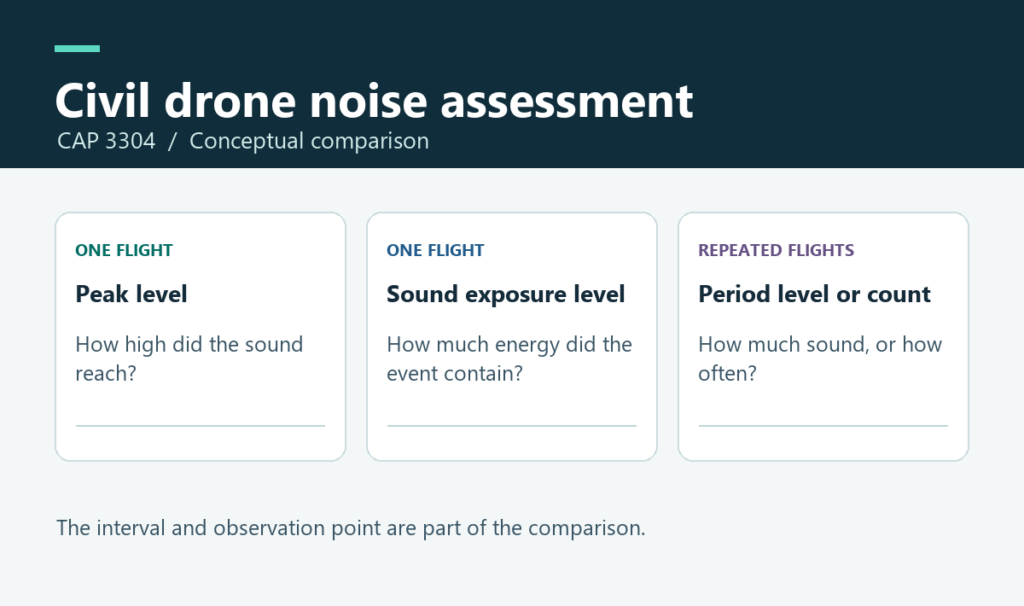
A civil drone noise assessment should start with the operational decision the trial needs to support. If the question is whether a hover takes longer and changes sound exposure, examine an individual flight event. If the question is whether repeated departures affect the same listeners, look across a defined period. The UK Civil Aviation Authority’s September 2026 report CAP 3304 discusses both types of evidence and explains why the effort spent measuring or modelling should reflect the operation and its surroundings.
Separate the sound of one manoeuvre from its duration
The UK Civil Aviation Authority’s CAP 3304 report distinguishes single-event measures such as maximum sound level and sound exposure level. The first gives the highest level during the selected event. The second represents the sound energy associated with the event, including its duration. Those measures can lead to different observations when two manoeuvres have similar peaks but one lasts longer.
Imagine a crew inspecting cladding. On one pass it moves past a panel continuously. On another it briefly stops to examine a joint. At the same observation point, a longer hover can extend the time during which the aircraft is audible even if the highest sound level barely changes. That is a reason to examine the event duration and exposure alongside the maximum. It is an illustration of the measurement choice, not a prediction about a particular aircraft or building.
A flight log can show when each pass, hover and departure occurred. Linking the record to the observation window makes it easier to see which phase could explain a result and when traffic, wind or unrelated site activity might have influenced it. Where the observation cannot be attributed reliably, preserve that uncertainty when comparing the manoeuvres.
Choose a period measure when repeated flights are the concern
CAP 3304 also discusses measures that describe many events over time. The equivalent continuous sound level represents sound energy over a stated period. A count of events above a specified level describes how often the selected criterion was exceeded. A period measure needs its time window, and a count needs its threshold. Neither number is as useful without those definitions.
| Question for the inspection team | Evidence to compare |
|---|---|
| Does a longer hover change the sound exposure of one operation? | Compare the relevant flight events at the same observation point. Keep their duration and maximum level beside the event exposure. |
| Does moving the staging point change repeated exposure near occupied buildings? | Compare equivalent periods at relevant observation points. Record the number and timing of movements, and state any threshold used for event counts. |
Moving a staging point can change which people hear each take-off and landing, even if the aircraft behaves similarly on each departure. The CAA’s discussion of aggregate measures is useful here because it keeps repeated exposure visible. For related examples of why operating profiles matter, see the industry news archive on civil drone operations.
Match the depth of assessment to the site and decision
The CAA report says detailed modelling may be disproportionate for infrequent, short, localised inspections where sensitive receptors are unlikely to be affected. It also points to circumstances that may call for closer assessment. Repeated movements near occupied buildings are one example. Quiet areas, wildlife and other sensitive surroundings can matter even where few people live nearby.
For a hypothetical short visit to a remote structure, the immediate decision may concern a particular manoeuvre. For a recurring survey that launches beside the same occupied building, the order and frequency of movements deserve attention as well. A shareable record can set out the flight pattern tested, the observation locations and conditions, and the result tied to the team’s next operational decision. The evidence describes that operation and setting.
Keep a single event comparable with another single event, and an operating period comparable with an equivalent operating period. If a proposed change affects time in one flight phase, keep the event’s duration with its exposure result. If it affects how often a site hears the aircraft, keep the observation windows and movement counts with the aggregate results. Those conditions make the comparison useful when the inspection layout changes.