
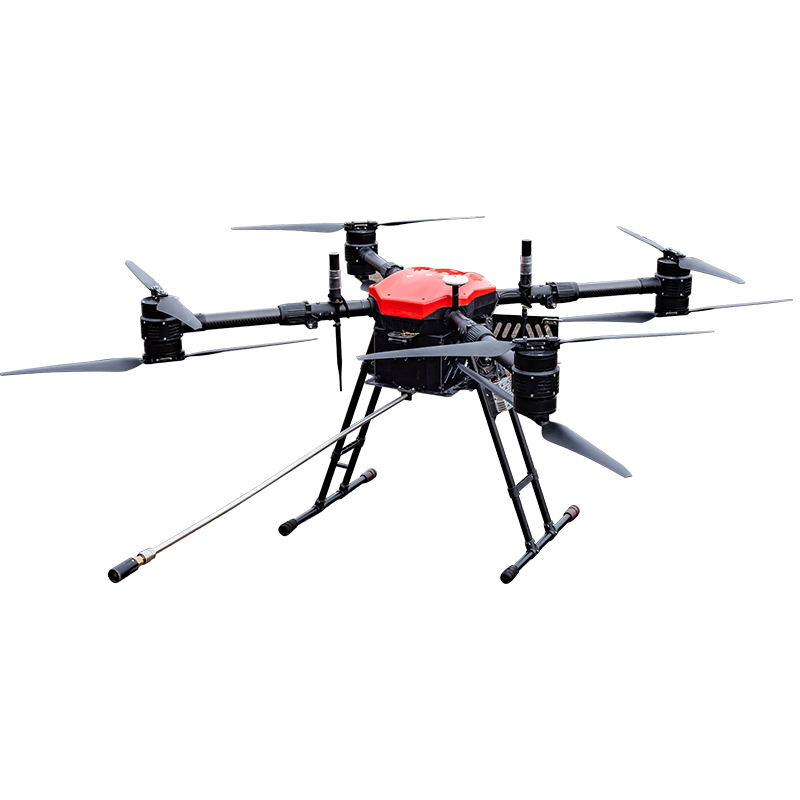
Cleaning drone water pressure becomes useful when it is paired with flow, nozzle configuration and the point where pressure is specified. The QX140-X8 lists 10 MPa rated water pressure and a 20 MPa instantaneous maximum, alongside a 16 L/min spray-flow entry. Use the rated value to frame a continuous-duty discussion, while keeping the instantaneous figure separate from a sustained cleaning condition.
The QX140-X8 distinguishes rated pressure from an instantaneous maximum
The QX140-X8 parameter list identifies 10 MPa as rated water pressure and 20 MPa as an instantaneous maximum. Those descriptions give the two numbers different jobs. A supply-and-spray plan should therefore identify its intended operating point rather than using the largest pressure as the default throughout a job.
The QX140-X8 pressure, flow and nozzle specifications describe tethered water supply and fixed or oscillating cleaning mounts. In that arrangement, water has a supply path, a hose path and a discharge point. Pressure associated with one point belongs to that point; the pressure required upstream also depends on the actual flow path and installation.
Separate the intended spray condition from the equipment’s pressure limits. Nozzle choice, the material being cleaned and its surface condition determine the process that needs assessment. A higher permitted maximum alone does not identify a suitable cleaning pressure for every façade, coating or photovoltaic surface.
The stated flow supports conditional water and hydraulic-power calculations
The QX140-X8’s listed 16 L/min flow equals approximately 0.000267 m³/s. If that flow and a 10 MPa pressure difference apply at the same operating point, multiplying pressure difference by volumetric flow gives approximately 2.67 kW of hydraulic power. This is an explicitly conditional fluid-power calculation, not an electrical-input or aircraft-consumption measurement.
The US Department of Energy’s pumping-system performance sourcebook separates fluid power, shaft power and motor input when assessing pumping efficiency. That distinction is useful here: the calculated hydraulic value describes energy transferred to the fluid at the defined boundary. An actual supply-system assessment additionally needs its applicable operating curve, losses and efficiency.
The 20 MPa instantaneous entry remains a different operating description. Combining it with the separate 16 L/min listing would first require evidence that the two occur together, and would still describe an instantaneous rather than continuous condition. Carry the pressure and flow as a pair throughout the design discussion instead of assembling a duty point from independent maxima.
Water demand is a separate calculation. At a steady 16 L/min, ten minutes of active spraying uses 160 L. Pauses and repositioning alter elapsed job time, while a changed flow alters water use; neither relationship establishes flight endurance. This distinction lets the team size the water-supply workflow without turning a spray-rate entry into a promise about the whole mission.
Nozzle angle and stand-off connect the supply to the cleaning task
The QX140-X8 lists 0°, 15°, 25° and 40° nozzle options, a 1500 mm spray pipe and a 2–3 m nozzle-to-surface distance that is adjusted to the environment. These describe different parts of the process geometry. Nozzle angle affects the spray pattern, the pipe positions the outlet relative to the aircraft, and stand-off locates the outlet relative to the surface.
The product description associates the narrow option with crevices and stubborn deposits and the wider options with fan-shaped rinsing tasks. Treat those descriptions as application starting points. The actual surface, deposit and permitted treatment determine the suitable nozzle-and-pressure combination, while fixed versus oscillating mounting changes how the pattern is applied across the work area.
For this system, the useful planning sequence is a defined cleaning task, an appropriate nozzle arrangement and an operating pressure-flow pair connected to the actual supply path. Keep the 10 MPa rated value, the instantaneous 20 MPa limit and the chosen flow visible as distinct conditions. That produces a clearer engineering decision than selecting a pump or a cleaning method from the highest pressure alone.