
Under the influence of economic globalization, the low-altitude economy is evolving from an abstract theoretical concept into a technological reality, becoming the core force driving economic transformation and industrial upgrading.
With the more and more advancement of technology, people’s demand for logistics and transportation is growing. Traditional transportation methods no longer meet people’s needs in terms of efficiency, flexibility, or cost. Especially in remote areas, complex terrains, and special scenarios such as emergency transportation following disasters.
Cargo Drones, as the name suggests, a type of drone capable of transporting large-weight cargo. Its payload capacity exceeds 20 kilograms. Compared to ordinary small drones, they possess more powerful powertrain、robust chassis construction、enhanced flight stability and greater load capacity. Specifically designed to carry heavy cargo weighing close to 100 kilograms or more, cargo drones capable of transporting goods and performing logistics distribution in complex environments. It can capable of performing tasks in a variety of complex environments.
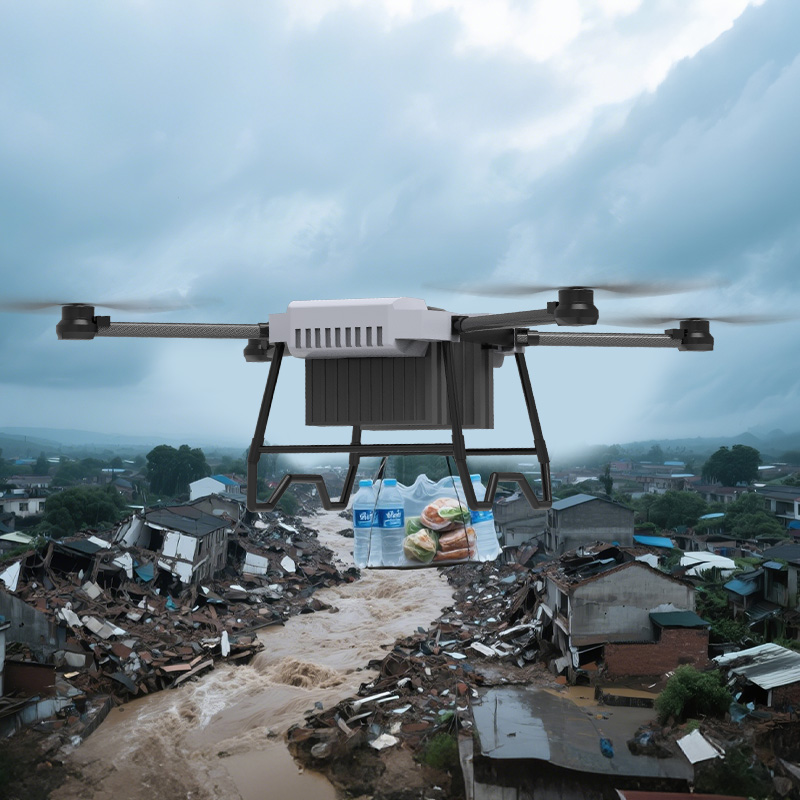
Applications of Cargo Drones Across Various Industries:
Construction and Mining:
In the fields of construction and mining, cargo drones can easily transport large, heavy materials. Especially in high buildings or hard-to-reach areas, it can significantly improved work efficiency.
Logistics and Transportation:
Delivery of goods to remote areas such as mountainous areas, islands, and other regions with limited transportation access, cargo drones can fly directly over them to deliver to the destination. Moreover, drones can avoid ground traffic congestion to achieve efficient express delivery.
Agricultural Transportation:
Cargo Drones can be used to transport large quantities of pesticides, fertilizers, and agricultural products. Even large farm fields and terraced fields can be easily sprayed and seeded with precision.
Medical Rescue:
During disasters or emergency rescue operations,cargo drones can promptly deliver medical supplies, food, and drinking water to disaster areas. Besides, for medical emergency needs in mountainous areas or remote regions, drones can also efficiently transport emergency medical equipment.
At present, despite the immense potential of cargo drones, there are still many challenges. However, Seboar believes that, with the continuous growth of market demand and the constant advancement of technology, it not only boosts work efficiency but also reduces costs. It can also deliver higher precision and greater environmental benefits. Its future prospects remain promising.