
These days, most remote control reviews are like reviews of fashion accessories: if the casing is just a little lighter, a whole bunch of people call it a major breakthrough, and immediately afterward, the entire discussion shifts to how portable the remote is.
That is not how hardware survives. A transmitter is not a smartphone. It is a control instrument sitting between a pilot’s hand and an aircraft moving through unstable air, vibration, electromagnetic noise, and unpredictable range conditions. Treating it like a lightweight consumer gadget is how engineers create impressive specifications that fail when the environment stops being friendly.
Look, here’s the uncomfortable part: the obsession with ultra-light FPV hardware has pushed many designs toward the wrong optimization target. Weight matters, but not when it compromises the things that actually keep a UAV controllable.
The Jumper T14 remote controller represents a different engineering trade-off. The design was not built around the idea of creating the lightest possible transmitter. It was developed around maintaining reliable control performance across FPV flying and longer-range UAV applications.
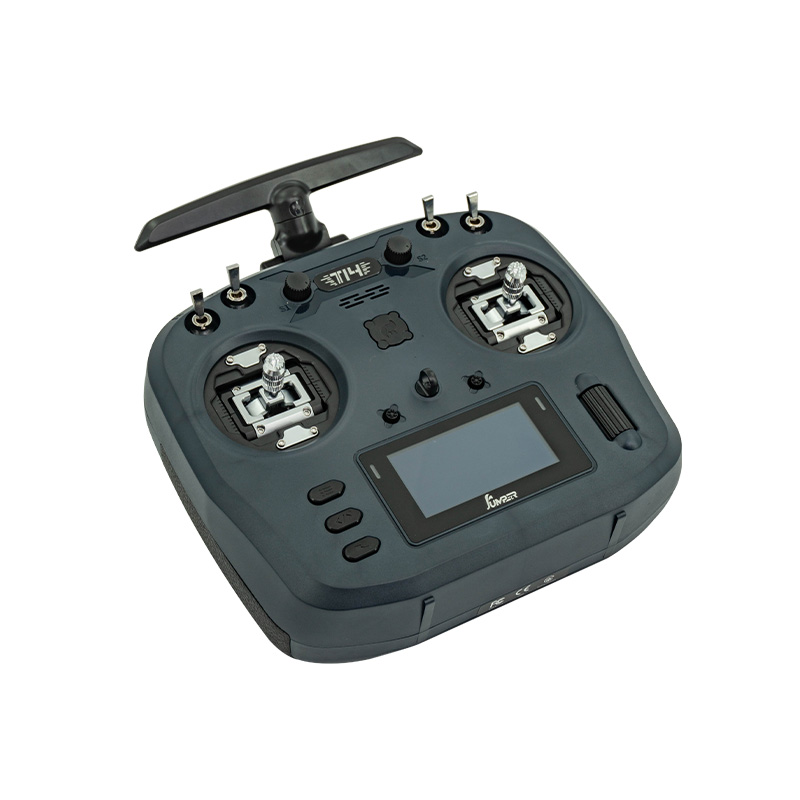
That distinction changes almost every internal decision. The original discussions around T14 often focused on visible elements: the full-size controller layout, ergonomic shell shape, OLED display, configurable switches, and modular expansion options. Those details matter because pilots physically interact with the device for long periods.
But the less obvious engineering decisions are where the real story sits. A 1000 mW ExpressLRS 2.4 GHz RF system sounds simple when written on a specification sheet. It is not.
High transmission power creates a chain of engineering problems. More RF output means more heat generation. More heat affects component stability. Higher power consumption reduces operating time. Reducing battery capacity makes the transmitter lighter but also removes operational margin.
Wait, let me rephrase that—engineers often confuse peak performance with sustainable performance, and those two things are not the same.
The T14 architecture uses a dual 21700 Li-ion battery configuration operating within a 6–8.4 V range. This was not chosen because large batteries look impressive. The decision exists because a long-range transmitter needs enough power reserve to maintain consistent operation without forcing the user to constantly manage battery limitations.
A smaller battery would have reduced weight. It also would have reduced flexibility. That is the part many hardware discussions skip. Every gram removed from a product comes from somewhere. The question is not whether you can make a lighter controller. Almost anyone can do that.
The question is what performance you are willing to sacrifice. The same thinking applies to the control interface. Traditional potentiometer-based gimbals have been used in radio controllers for decades. They work. They are familiar. They are also mechanical systems where physical wear, contact variation, and long-term consistency become concerns.
For a casual model aircraft, small deviations may not matter much. For FPV flight, they can. The T14 development selected Hall sensor gimbals instead of relying purely on traditional mechanical potentiometer input. That decision increased manufacturing complexity and required tighter hardware integration, but it provided more consistent signal feedback and reduced wear-related degradation.
Here’s the thing: precision is not only about the first day a product leaves the factory. A transmitter is handled thousands of times. The sticks are moved constantly. Tiny variations accumulate. A control system that feels identical after extended use is often the result of boring engineering decisions nobody notices.
And boring engineering is usually where reliable hardware comes from. The earlier approach across many radio controllers was often centered around delivering the required functions with the lowest possible cost and weight. That methodology produced capable equipment, but modern UAV applications have changed the pressure points.
Longer-range flights demand better RF stability. More aggressive aircraft demand more predictable control input. Higher-power transmitters demand better thermal planning. The T14’s internal design reflects these competing requirements instead of treating each specification as an isolated number.
Even the final 471 g structure tells a story. It is not a record-breaking lightweight enclosure, and that is intentional. The mass represents the combined requirements of RF performance, battery capacity, control hardware, thermal considerations, and modular expansion capability.
A transmitter is a system. Cutting one part of the system rarely creates a free improvement. A lighter controller with weaker power management is not an upgrade. A cheaper gimbal system with inconsistent feedback is not an upgrade. A high-output RF module without proper thermal planning is not an upgrade.
It is just a different compromise. Let’s be real for a second: engineers are often forced to fight against marketing measurements because numbers are easier to advertise than reliability. Weight can be displayed in a single line. Long-term control consistency cannot.
The Jumper T14 remote controller shows a more practical engineering philosophy. Instead of asking, “How do we remove another 50 grams?” the more important question becomes, “What does the pilot actually need when the aircraft is hundreds or thousands of meters away?” The answer is not the smallest box.
Its success is not limited to its performance on paper; rather, it lies in its reliable communication, predictable input, and consistent performance even after repeated use. This is the difference between designing to specifications and designing for real-world applications.