
Lightweight does not automatically mean well engineered. That sounds obvious, but frame design still gets discussed as if removing every possible gram is the natural path to a better FPV drone. The logic usually goes like this: use a stronger material, make the structure thinner, reduce the frame weight, and let the propulsion system do the rest. It works on paper. Real hardware is less cooperative.
A drone frame is not carrying a static load on a laboratory stand. Its arms see bending, torsion, vibration, motor-induced loads, landing shocks, and transient forces while the aircraft changes attitude. Folding mechanisms add another complication because the structure must remain compact during transport without turning the unfolded configuration into a collection of mechanically compromised joints. That is where material selection stops being a simple strength comparison.
Carbon fiber is an obvious example. Modern high-performance carbon fiber can deliver extremely high tensile strength at low mass, and recent domestic production has pushed high-strength grades into engineering-scale manufacturing. The reported SYT80 T1200 material, for example, has an engineering tensile strength above 8,000 MPa. Those numbers are impressive. They are also easy to misuse.
A fiber’s tensile strength is not the same thing as the stiffness, joint strength, impact resistance, fatigue behavior, manufacturing consistency, or load-path performance of a finished drone frame. A frame is a structure, not a datasheet value. The moment those fibers are turned into plates, arms, fasteners, hinges, motor mounts, and interfaces, the engineering problem changes.
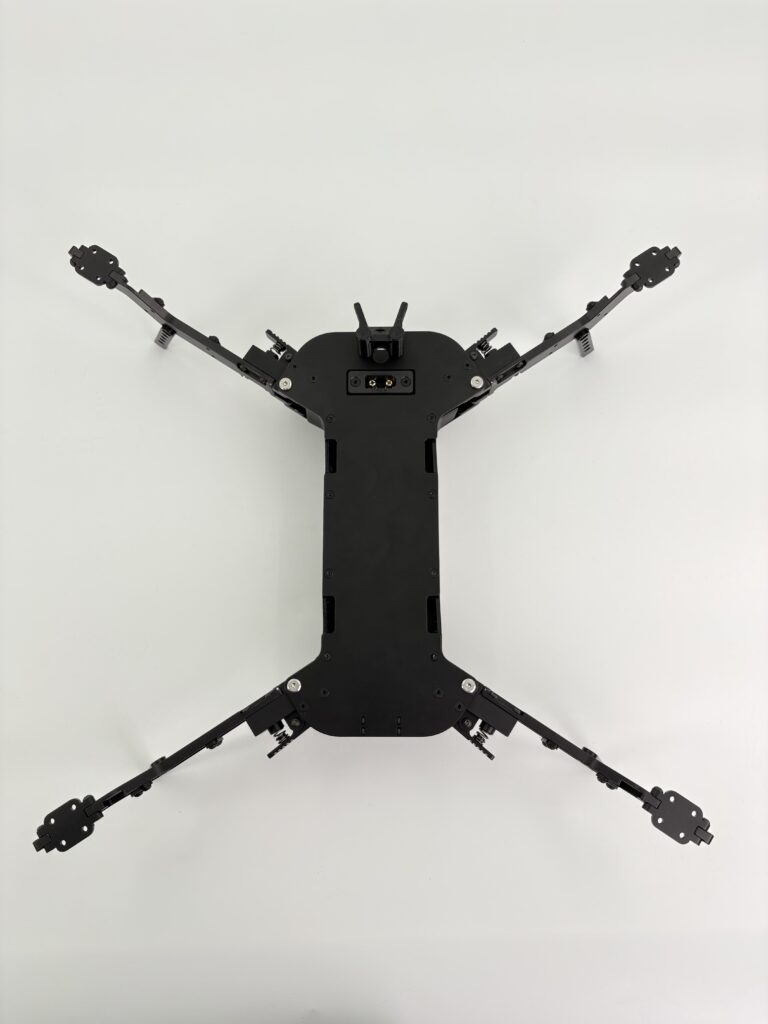
This is why our foldable FPV drone frame architecture uses 6063 aluminum with CNC-machined structural components rather than treating minimum mass as the only target.
The decision is not about claiming that aluminum is universally superior to carbon fiber. It isn’t. The relevant question is narrower: what combination of stiffness, geometry, manufacturability, integration, and folding behavior produces a frame that remains mechanically predictable across different platform sizes? That distinction matters.
Our 10-inch configuration uses 6 mm arms and a 480 mm wheelbase, with the frame weighing about 490 g. Move to the 13-inch and 15-inch configurations, and the arm thickness increases to 8 mm while the wheelbase expands to 520 mm and 580 mm respectively. That change is not cosmetic.
As the wheelbase grows, the arms become longer structural members. Longer members are more sensitive to bending and torsional deformation under comparable loads. Simply keeping the same arm thickness to save material would shift the design toward lower stiffness, even if the resulting mass figure looked better.
Wait, let me rephrase that—the problem is not whether a larger arm can survive a single load. The problem is how much it deflects while carrying that load, and what that deformation does to the rest of the aircraft.
Motor alignment is part of that chain. So is flight-controller stability. So are vibration characteristics. A flexible structure can survive without immediately breaking and still create a worse aircraft. This is the less glamorous side of lightweight design.
The 6063 aluminum arms are hollow rather than fully solid. That allows material to remain around the regions where structural support is needed while removing material that contributes less to the load path. It is a fairly conventional structural principle, but the important part is how it is applied to the actual dimensions of each platform.
The three versions do not simply scale everything proportionally. They retain 1.5 mm top and bottom plates, while using 30.5 × 30.5 mm motor mounting and both 20 × 20 mm and 30.5 × 30.5 mm stack mounting patterns. Internal height remains at 26 mm.
That consistency creates a useful integration envelope even though the external structural dimensions change. Look, this is where frame design becomes a systems problem rather than a material-shopping exercise.
A larger drone needs more structural stiffness, but the electronics do not necessarily become larger at the same rate. Keeping the mounting interfaces consistent means the same basic component envelope can be carried across the 10-, 13-, and 15-inch platforms while the load-bearing structure changes where it actually needs reinforcement. The folding requirement adds another constraint.
A 15-inch platform has a 580 mm wheelbase when deployed, yet the folded package remains around 265 × 175/185 × 100 mm. That difference is not achieved by simply making the entire aircraft smaller. The geometry has to change between the deployed and transport configurations while preserving a mechanically useful unfolded structure.
That is why the folding architecture should be considered part of the frame’s structural design from the beginning. A hinge or folding joint is not free.
It introduces interfaces, tolerances, contact surfaces, fasteners, and potential sources of movement. If those interfaces are poorly controlled, the theoretical stiffness of the arm material becomes almost irrelevant because the compliance may come from the joint instead. Here’s the thing: a frame can have an extremely strong material and still behave like a poor structure.
The same principle applies to the current discussion around advanced carbon fiber. High-performance fibers can provide exceptional material properties, and manufacturing advances are making stronger grades increasingly practical. But replacing an aluminum structural component with a carbon composite component is not automatically an engineering upgrade.
The load direction matters. Fiber orientation matters. Laminate thickness matters. Joint design matters. Manufacturing tolerances matter. And the folding mechanism matters even more because the structure has to repeatedly transition between two geometric states.
For an FPV platform, the useful target is therefore not simply the lowest frame weight. It is a workable balance between structural stiffness, mass, component compatibility, folding volume, and manufacturing control.
That balance explains the size-specific arm progression in this architecture: 6 mm arms on the 10-inch version, then 8 mm arms on the larger 13-inch and 15-inch platforms. The larger wheelbases increase the structural demand, so the design accepts additional material where it contributes to stiffness rather than forcing every version toward the same lightweight target.
This is not an argument against lightweighting. It is an argument against lightweighting without a load path.
The 490 g frame figure on the 10-inch version is useful only when understood alongside its 480 mm wheelbase, 6 mm arm structure, mounting interfaces, plate thickness, and folding geometry. A frame weight displayed by itself tells you almost nothing about how the structure will behave once motors, batteries, electronics, and payload-related loads are attached.
That is one of the persistent problems with simplistic hardware comparisons. Two frames can weigh the same and behave very differently. Two frames can use the same material and behave very differently. Even two frames with apparently similar dimensions can produce different results because stiffness depends on geometry and load distribution, not just the material printed on the specification sheet.
Engineering is annoyingly specific that way. For a foldable FPV drone frame, transport volume is another measurable design parameter. The approximately 265 × 175/185 × 100 mm folded envelope shows that portability was treated as a system-level constraint rather than something added after the flight configuration had already been finalized.
That changes the design priorities. The frame has to be large enough when deployed to support the intended propulsion geometry, rigid enough to control structural deformation, compatible with standard mounting patterns, and compact enough when folded to make transportation practical. Improving one parameter can easily damage another.
Make the arms thinner and mass decreases, but stiffness can fall. Increase structural thickness and stiffness improves, but mass rises.
Increase the wheelbase and the aircraft gains room for larger propulsion components, but the longer arms impose greater structural demands. Add a folding joint and transport volume improves, but the joint becomes another part of the mechanical load path. There is no magic material that makes these trade-offs disappear.
The more useful way to evaluate a Foldable FPV Drone frame is therefore to ask a much less marketable set of questions: Where does the load travel? Which parts are expected to bend? Which parts are expected not to move? How does the structure change with wheelbase? What happens at the folding interface? Which mounting dimensions remain fixed? And how much mass is being removed from regions that actually contribute to stiffness?
Those questions produce engineering decisions. A headline material specification does not. Carbon fiber will continue to matter in lightweight UAV structures. High-strength grades will expand what designers can achieve, particularly where very high specific strength or stiffness is valuable. But the material itself is only one layer of the design.
The finished aircraft still has to deal with geometry, joints, vibration, manufacturing, and the ugly reality of repeated loads. That is why our frame architecture does not chase the smallest possible number on the scale. The 10-inch, 13-inch, and 15-inch configurations deliberately use different arm dimensions as the structural requirements increase, while keeping the main component-integration envelope consistent and maintaining a compact folded package.
Not the lightest structure at any cost. A structure with a reason for every gram.