
A VTOL UAV fixed wing aircraft has to solve an ugly engineering contradiction: it must spend energy like a multirotor during takeoff and landing, then behave like an airplane once it gets moving.
That transition is where the real design work starts. A vertical aircraft can hover almost anywhere. A fixed-wing aircraft can cover distance efficiently. Combining the two does not magically give you the best of both. It gives you two different aerodynamic operating regimes, two sets of control problems, and a power system that has to survive the worst part of each.
That is why headline specifications such as maximum speed or maximum flight time are not enough to judge a VTOL fixed-wing UAV. The more useful question is: how efficiently does the aircraft transition from vertical lift to wing-borne flight, and what does that architecture allow it to do once the transition is complete?
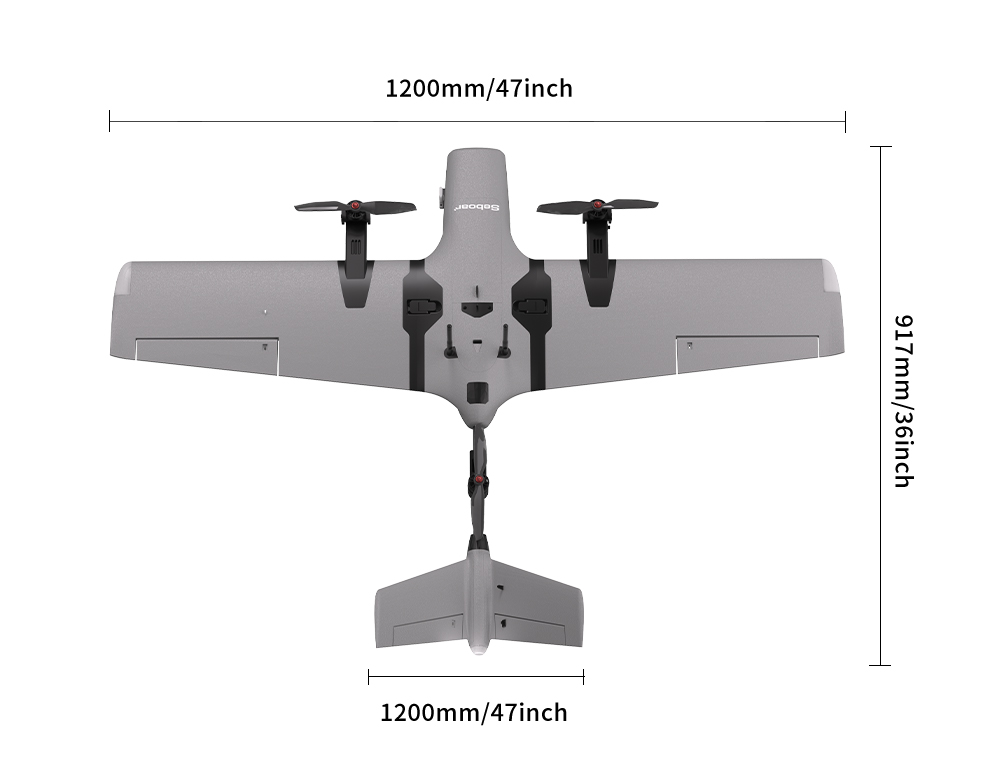
The Fixed-Wing Advantage Starts After Takeoff. Consider a compact VTOL fixed-wing platform with a 1,200 mm wingspan, 917 mm fuselage length and a 1.38 kg aircraft weight. Its maximum takeoff weight reaches 2.5 kg, giving the aircraft roughly 1.12 kg of additional mass capacity above its basic airframe weight.
That difference matters more than the absolute payload figure. A 6S 8,000 mAh battery provides the primary energy source, while the aircraft is specified for more than 60 minutes of flight and more than 60 km of range. Its economic cruise speed is 50 km/h, compared with a maximum speed above 130 km/h. The numbers reveal the intended operating logic.
The aircraft does not need to cruise at 130 km/h all the time. That would be a poor way to evaluate endurance. The 50 km/h economic-speed figure tells us that the wing is doing the heavy lifting once the aircraft is established in forward flight.
That is the fundamental reason to use a fixed wing. A multirotor continuously generates lift with propulsive power. A fixed-wing aircraft primarily obtains lift from forward airspeed over the wing. The propulsion system still consumes energy, obviously, but the aerodynamic burden is fundamentally different.
Here’s the thing: VTOL capability is expensive; fixed-wing cruise is where you recover some of that energy penalty. A practical mission therefore looks less like “vertical aircraft that happens to have wings” and more like an energy sequence: vertical takeoff → transition → wing-borne cruise → mission operation → return → transition → vertical landing
Every stage has a different power requirement. The engineering quality of the aircraft is largely determined by how well those stages are connected.
Why the Transition Is the Hard Part. A conventional fixed-wing UAV can accelerate along a runway, launch from a rail, or use another assisted takeoff method. A conventional multirotor does not care about stall speed because it generates lift directly through its rotors.
A VTOL fixed-wing UAV has to deal with both problems. During vertical flight, the propulsion system must generate enough thrust to support the aircraft’s mass. During forward flight, the wing gradually assumes the lift load. Somewhere between those conditions, the aircraft’s control system must manage changing aerodynamic forces while propulsion requirements are changing at the same time.
That is not merely a software problem. Motor sizing, propeller selection, wing loading, center-of-gravity location, control-surface authority, transition speed and structural stiffness all interact. A small change in one parameter can move the aircraft’s usable operating envelope.
For example, increasing payload from a light sensor package toward the 2.5 kg MTOW changes more than takeoff performance. It affects acceleration, stall margin, climb performance, transition behavior and cruise energy consumption.
This is why a specification sheet should always be read as a connected system rather than as a collection of independent numbers.
What the 60 km Figure Actually Tells Us. A stated range above 60 km sounds simple until the battery, cruise speed and endurance are considered together. At the stated 50 km/h economic speed, 60 km corresponds to roughly 72 minutes of theoretical travel time if the aircraft could maintain that speed continuously. But the specified flight time is only stated as greater than 60 minutes.
This is exactly why range and endurance should not be treated as interchangeable specifications. A real mission includes takeoff, transition, climb, loiter, payload operation, wind correction, return and landing. The aircraft also cannot normally consume every watt-hour stored in the battery without leaving an operational reserve.
So the >60 km range and >60 min endurance figures should be interpreted as operating-envelope indicators, not as a promise that a fully loaded aircraft can simply fly 60 km out and 60 km back. That distinction becomes particularly important when comparing VTOL fixed-wing aircraft with larger hybrid-electric platforms.
From Small UAVs to Hybrid eVTOL Aircraft. The useful comparison is architectural. Both systems are trying to exploit vertical takeoff where conventional aircraft infrastructure is inconvenient, then exploit efficient forward flight once airborne. The difference is how much engineering complexity is justified by the mission.
A small UAV can accept EPP construction, compact electronics and a relatively simple electric propulsion architecture because its mass and operating environment are limited.
A 1,000 km cargo aircraft cannot. Its propulsion system, structural design, thermal management, redundancy, flight controls, energy storage and certification basis all become substantially more demanding.
The interesting engineering question is not whether the aircraft is “bigger.” It is whether the hybrid architecture creates enough operational value to justify the additional mechanical and control complexity. Architectural Benchmarks: Market Standards vs Modern Engineering
Traditional commercial UAV architectures generally force a choice. A multirotor provides excellent low-speed control, hover capability and vertical operation, but its energy consumption during sustained flight can become a limiting factor.
A conventional fixed-wing UAV has much better cruise efficiency, but it needs another solution for takeoff and landing. A VTOL fixed-wing UAV attempts to remove that operational constraint.
The small aircraft described in the supplied engineering data demonstrates this through a relatively compact architecture: 1,200 mm wingspan, 2.5 kg MTOW, more than 60 minutes of flight time, automatic takeoff and landing, return-to-home and autonomous mission capability. The important point is not the feature list. It is the combination.
Automatic takeoff and landing means the aircraft can exploit fixed-wing cruise without requiring a runway. Autonomous waypoint missions allow the aircraft to use that cruise efficiency over a planned route rather than simply behaving like a manually operated multirotor. QGroundControl support and real-time telemetry provide the mission-control layer needed to turn the airframe into an operational system. Then there is the payload architecture.
The Z-1 Mini gimbal weighs only 69 g and operates from 10–26.4 VDC, with average power consumption of 4.5 W and stall power consumption of 18 W. Its three-axis non-orthogonal mechanical stabilization provides ±0.01° angular accuracy, while the pitch range extends from −105° to +145°. Those numbers are much more revealing than calling the gimbal “high precision.”
A 69 g sensor package is small enough to preserve useful payload margin on a 2.5 kg MTOW aircraft. At the same time, the 4.5 W average consumption is relatively modest compared with the propulsion system, so imaging can remain a continuous mission function rather than an intermittent payload activity.
The visible camera uses a 1/2.8-inch CMOS sensor with 8.29 effective megapixels, a 6.0 mm focal length and an f/1.0 aperture. Maximum output reaches 3840 × 2160 at 30 fps.
The optical geometry matters. Its 54.7° horizontal field of view provides broad scene coverage, while the 40.6 mm 35 mm-equivalent focal length gives the camera more useful reach than an extremely wide FPV-style camera. The system also provides 8× equivalent digital zoom, although digital zoom should not be confused with additional optical resolving power.
That distinction gets routinely blurred in marketing specifications. The AI tracking subsystem has an object detection range from 16 × 16 to 128 × 128 pixels, an identification delay below 40 ms, a 30 Hz tracking refresh rate and tracking output delay of no more than 5 m/s. These are system-level latency figures.
They matter because a tracking system is not judged only by whether it can identify an object. The aircraft has to receive that information quickly enough for the flight-control or payload-control loop to respond before the target moves significantly relative to the image frame.
That is where hardware and software stop being separate categories. The communications architecture adds another layer: up to 10 km wireless digital image transmission, integrated remote-control and video links, adaptive frequency-band capability, waypoint planning, autonomous missions, multi-drone coordination and real-time telemetry.
A 10 km video-link specification, however, should never be interpreted as a universal 10 km operational radius. Radio environment, antenna orientation, terrain, regulatory power limits, interference, altitude and required link margin can all change the practical result.
Engineering is full of these unpleasant qualifiers. They are also the difference between a specification and a field result. The Payload Changes the Aircraft’s Economics. A common mistake when evaluating VTOL UAV fixed wing platforms is to focus exclusively on flight time. Payload changes the equation.
The supplied aircraft has a 1,380 g basic weight and a 2,500 g maximum takeoff weight. That leaves approximately 1,120 g of theoretical mass capacity for battery-related configuration differences, payload, mounting hardware and other mission equipment.
The Z-1 Mini gimbal itself consumes only 69 g. That leaves substantial theoretical mass headroom, but it would be misleading to call the entire remainder available payload without knowing how the aircraft’s 2.5 kg MTOW was established. Structural margins, center-of-gravity limits and flight-performance requirements still apply.
A payload mounted too far forward can alter pitch balance. A payload mounted below the fuselage can change drag. A larger battery can increase endurance while simultaneously increasing takeoff mass. A high-power sensor can increase electrical demand and thermal load. This is why payload capacity should be evaluated alongside battery capacity and mission speed.
Not separately. Energy Replenishment Is Becoming an Architectural Metric. The DF600’s hybrid configuration highlights another issue that conventional electric UAV comparisons often overlook: energy replenishment.
Pure-electric aircraft are constrained not only by battery energy density but also by how quickly their energy source can be replenished in the field. For a small UAV, replacing a 6S 8,000 mAh battery can be operationally simpler than charging it repeatedly during a mission cycle. For a multi-ton aircraft, the problem becomes much larger.
The hybrid approach used by the DF600 is intended to reduce dependence on high-capacity battery packs and charging infrastructure while retaining vertical takeoff and landing capability. That changes the logistics model as much as the propulsion model.
A battery-electric VTOL aircraft may have a comparatively simple drivetrain but require substantial electrical infrastructure. A hybrid VTOL aircraft introduces an engine or generator system, fuel logistics and additional mechanical complexity. Neither architecture wins automatically. The mission decides.
The Real Benchmark Is Mission Architecture. The DF600’s stated 320 km/h maximum level-flight speed and 1,000 km full-load range demonstrate what happens when VTOL capability is combined with a much larger fixed-wing cruise system.
The smaller UAV’s >130 km/h maximum speed and >60 km range occupy a completely different part of the aviation spectrum. Yet the engineering principle remains recognizable. Vertical flight solves access. Fixed-wing flight solves distance. Autonomy solves repeatability. The sensor system solves information acquisition.
The communications system connects the aircraft to the operator and mission-control environment. Take any one of those away and the aircraft’s practical mission envelope changes.
That is why the next generation of VTOL UAV fixed wing design will likely be judged less by spectacular prototype demonstrations and more by boring engineering questions: How many missions can the aircraft complete before maintenance? How much payload can it carry at the stated endurance? What happens to range in wind? How quickly can batteries or fuel be replenished? What happens after a propulsion-unit failure? How repeatable is the transition? How much ground infrastructure is actually required?
Those questions are not glamorous.They are also the ones that determine whether an aircraft becomes useful hardware.
Certification Is Part of the Engineering. Certification forces an aircraft program to move beyond a demonstration of aerodynamic feasibility. Production consistency, system safety, component traceability, flight-control behavior, structural integrity and manufacturing processes become part of the engineering problem.
Prototype performance gets attention. Repeatable production gets aircraft into service. For VTOL aircraft, that distinction is particularly important because the architecture contains more interacting subsystems than a simple fixed-wing UAV.
The industry is therefore moving toward a less exciting but much more consequential benchmark: whether an aircraft can repeatedly perform its intended mission with predictable energy consumption, maintainable hardware and an acceptable certification and production pathway.
Where VTOL Fixed Wing Design Goes Next. The strongest argument for VTOL fixed-wing aircraft is not that they are universally better than multirotors or conventional fixed-wing UAVs.
They are not. Their advantage appears when a mission requires runway-independent operation plus sustained forward flight over meaningful distances.
The supplied 1.2 m-class UAV demonstrates the concept at the compact end of the spectrum. Automatic takeoff and landing remove runway dependence, while the fixed wing provides the aerodynamic efficiency needed for hour-class flight. A 69 g stabilized gimbal, 4K visible imaging, autonomous waypoint flight and 10 km digital transmission extend that basic aircraft into a complete sensing platform.
The DF600 demonstrates the same architectural logic at a dramatically larger scale: vertical takeoff, fixed-wing cruise, hybrid energy management and a stated 1,000 km full-load range. The technology is not really about making aircraft “do everything.” It is about allocating energy to the right flight regime. That is the engineering benchmark worth watching.
A VTOL UAV fixed wing aircraft earns its complexity only when the energy saved during wing-borne cruise, combined with runway-independent operation, creates a mission capability that a simpler aircraft cannot deliver.