
Most drone companies still obsess over the aircraft. Bigger motors. Longer wings. Higher payload numbers.That thinking is outdated.The remote controller has quietly become one of the hardest engineering problems in the entire UAV stack. A drone can have a perfect airframe and a powerful propulsion system, but a weak control link turns expensive hardware into an unreliable machine.
Look, this is where the industry gets uncomfortable. Many commercial UAV platforms still treat the controller as an accessory, almost like a keyboard attached to a computer. That approach made sense years ago when drones were simple flying cameras. It does not survive modern requirements involving public safety operations, infrastructure inspection, autonomous missions, and contested communication environments.The market is moving in another direction.
In June 2026, Jinming Industrial introduced its independently developed UAV flight control remote controller at Japan Drone 2026, reflecting a broader shift toward integrated UAV systems rather than isolated aircraft platforms. The company highlighted control stability, communication security, compatibility, and supply chain transparency as increasingly important evaluation factors for government and critical infrastructure applications.
The numbers behind this shift are difficult to ignore. Data cited from Verified Market Reports estimated the global UAV remote controller market at around USD 1.2 billion in 2024, with projections reaching approximately USD 3.5 billion by 2033.
But the interesting question is not the market size.The interesting question is why the controller suddenly matters this much.Because the controller is no longer just sending stick commands.It is becoming the operational brain between humans, autonomous systems, sensors, and aircraft.
The Control Link Problem Nobody Wants to Simplify.A modern UAV remote controller has to solve several conflicting engineering problems.Range requires transmission power. Reliability requires stable protocols. Low latency requires efficient communication architecture. Battery life requires power optimization. Compact design requires component integration.These problems fight each other.
A higher RF output does not automatically create a better system. It can increase range, but it also introduces thermal challenges, power consumption issues, and potential interference concerns. Wait, let me check that assumption again—the raw transmission number alone does not tell the whole story. A 1000 mW transmitter with poor antenna design or unstable firmware can perform worse than a lower-power system with better RF management.
This is why professional UAV control systems are moving beyond simple radio links.Firmware architecture, processor capability, encryption methods, module expansion, and hardware compatibility are becoming part of the controller evaluation process.A controller is no longer a remote.It is a network terminal.
Architectural Benchmarks: Market Standards vs Modern Engineering.Traditional commercial drone controllers often focus on basic requirements: ergonomic input, video display, and reliable communication within a controlled operating environment. Consumer-focused systems are usually designed around convenience, with the aircraft and controller developed as a closed ecosystem.
That approach works for predictable environments.It becomes less suitable when operators need flexibility, third-party integration, or long-term hardware transparency.
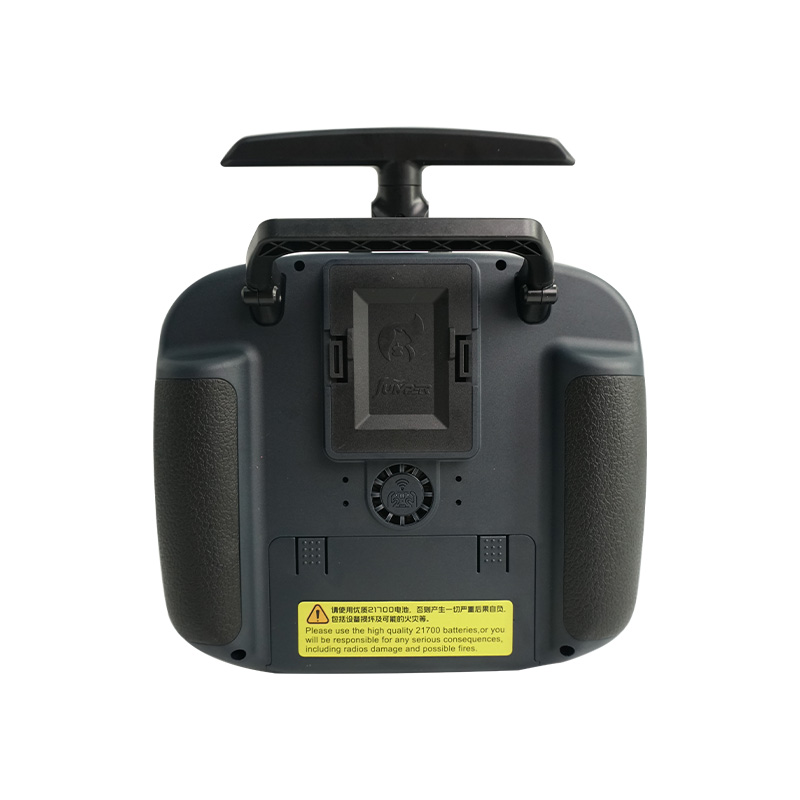
The Jumper T14 ELRS transmitter provides a useful hardware benchmark for understanding where modern controller engineering is heading. The system integrates an ExpressLRS 2.4 GHz RF platform with a maximum transmission power of 1000 mW. Instead of relying only on proprietary communication hardware, it uses an architecture designed around modular expansion and firmware flexibility.
The difference is not simply the specification sheet.It is the engineering philosophy behind the specification.The controller uses Hall sensor gimbals rather than traditional mechanical potentiometers. This changes how control input is measured. Hall sensors detect magnetic field variation, reducing physical wear points and improving long-term consistency during repeated operation.
For operators flying missions that require precise manual correction, small input errors accumulate. A drifting control signal is not a cosmetic problem. It can become a flight safety issue.
The system runs EdgeTX firmware on an STM32F407ZET6 MCU. This combination represents a move toward programmable control environments rather than fixed-function transmitters.Here’s the thing: hardware flexibility only matters when the software layer can actually support it.
A powerful processor with locked firmware provides limited value. A capable firmware ecosystem allows operators and developers to adapt the controller to different aircraft, communication modules, and mission requirements.
The T14 also includes a standard JR module bay for external RF expansion, a 2.42-inch OLED display with 128 × 64 resolution, and USB-C charging supporting up to 10 W input. The power system uses two 21700 Li-ion cells with a 6–8.4 V input range.Those details appear small.They are not.A removable RF module, accessible firmware, and replaceable power components all affect lifecycle cost and operational flexibility.
The physical design measures 185 × 175 × 79 mm and weighs 471 g. For field operators, weight becomes a constant tradeoff. A larger controller may provide better ergonomics and more hardware capability, but every additional gram increases transport burden during long missions.This is where modern engineering becomes less about chasing maximum specifications and more about balancing the entire system.
Why Legacy Drone Architecture Is Losing Ground.Many older UAV designs were built around a simple hierarchy:Aircraft first.Controller second.Software last.That order is changing.
Autonomous flight systems, AI-assisted navigation, and multi-sensor payloads require tighter communication between every component. The controller must exchange more than movement commands. It may need to manage mission data, telemetry, payload control, video links, and system status.
European industrial UAV platforms have traditionally emphasized certification, reliability, and structured integration. Russian military-oriented systems have often prioritized ruggedness and operational simplicity. Standard commercial drones have focused heavily on user experience and ecosystem control.
Each approach solves different problems.The emerging requirement is combining these advantages without creating a closed or fragile system.A future UAV controller will likely be judged less by how many buttons it has and more by how effectively it manages complex information flow.That is a major architectural change.
The Controller Is Becoming the Mission Interface.The next generation of UAV competition will not be decided only by flight time or payload capacity.Those numbers still matter.But the control layer determines how effectively those capabilities can be used.
A 60-minute aircraft with unreliable communication is not a 60-minute aircraft in practical operation. A high-resolution payload means little if operators cannot maintain stable control or receive trustworthy telemetry.
The remote controller is becoming the point where human decision-making meets autonomous machine behavior.That intersection is where future UAV systems will be won or lost.The drone is visible.The controller is where the real engineering battle is happening.