
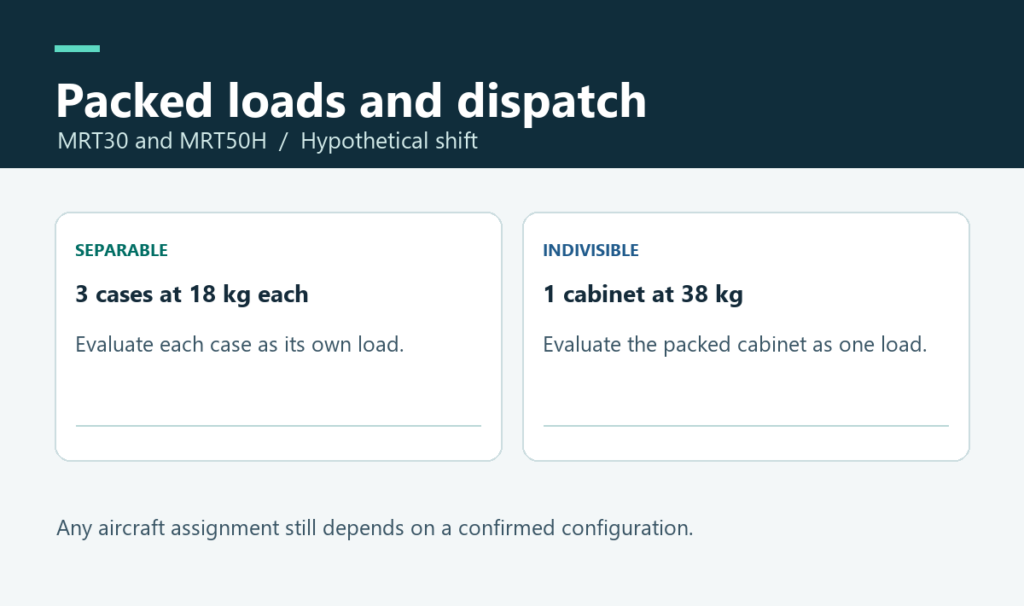
Commercial drone payload planning starts with the heaviest packed item that must travel as a single consignment. The MRT30 lists a 30 kg payload capacity, while the MRT50H lists a 30–50 kg payload range. These figures help screen the proposed loads. A total for the shift alone cannot show whether every individual consignment fits a suitable aircraft configuration.
Classify each packed load before assigning it to a transfer
The MRT30 cargo drone specification lists a payload capacity of 30 kg. A hypothetical shift with three 18 kg packed cases and one 38 kg sealed cabinet illustrates the difference between total and indivisible mass. The cases can be assessed individually. The cabinet exceeds the MRT30’s listed capacity even if the other proposed loads are light. Splitting the cabinet would change the job if its contents must stay together.
- Measure the cargo as it travels. Include the contents and container in the packed mass. Keep the dimensions with that measurement because fit and mass answer different questions.
- Identify the indivisible items. A cabinet may have to arrive intact, while separate tool cases can be assessed for separate transfers.
- Identify what must arrive first. Grouping smaller consignments helps only when the combined load fits applicable limits and arrives in time for the receiving crew.
Separate payload from the aircraft’s configured mass
The MRT50H cargo drone specification lists a 30–50 kg payload range and an aircraft weight of 29.5 kg without a battery. The MRT30 lists an approximate aircraft weight of 32.7 kg with its battery. The two aircraft figures are stated under different conditions. Directly comparing them would leave part of the aircraft configuration out of the decision.
The European aviation rules’ definition of maximum take-off mass includes payload and fuel in the maximum aircraft mass defined by the manufacturer or builder. Under that EU framework, a payload entry and the allowable total aircraft mass answer separate questions. The definition does not supply an approved mass or attachment arrangement for either model.
The example cabinet weighs 38 kg when packed. It falls within the MRT50H’s published payload range, which makes that model a candidate for assessment. The mass alone does not establish whether a specific configuration can carry that cabinet. A broad cabinet and a set of dense cases can have equal mass and require different fitting and attachment arrangements.
Sequence the transfers around the receiving crew’s work
The MRT30 lists a 3–10 m/s flight-speed range, while the MRT50H lists a maximum speed of 15 m/s. Neither entry gives a measured round-trip time for the example consignments. Loading, movement and receipt take different parts of the shift. Keep them separate in the estimate so a quoted speed does not hide the time needed on the ground.
If the cabinet is needed before installation begins, its first suitable transfer can matter more than sending the greatest number of cases early. Where no configuration has been confirmed for the indivisible load, keep that dependency visible and account for alternate transport. The separable cases can then be grouped around the time each is needed on site. That is the value of a packed-load plan: it shows which consignment determines the equipment decision and which can move in a different order.