
Many cargo drones on the market experience malfunctions even before their motors start up, and most of these malfunctions originate from the CAD screen.
A designer takes a lightweight multirotor frame, stretches the arms, bolts on bigger motors, increases battery capacity, and suddenly calls it an industrial transport platform. The specifications look impressive. The marketing slide says “heavy lift.” The reality is a machine carrying a large unstable mass on a flexible structure with flight controllers fighting physics every second.
Payload is not just weight. Payload is inertia. That distinction is where many commercial cargo UAV designs collapse. A 50 kg payload does not behave like adding another battery pack. It changes the entire dynamic system. The center of gravity shifts. Rotational response slows. Landing oscillations increase. Roll and pitch corrections become delayed because the aircraft has more angular momentum resisting every control input.
Here’s where the math actually breaks down: a drone carrying heavy cargo is not simply a bigger version of a photography platform. The control problem scales differently. The aircraft needs more attitude authority, more structural stiffness, and more predictable power delivery. Otherwise, the flight controller is basically trying to correct a moving pendulum attached to a vibrating carbon frame.
That is why the 2420 mm wheelbase of the Seboar MRT50H is not just a large dimension thrown into a specification sheet. It changes the mechanical equation.
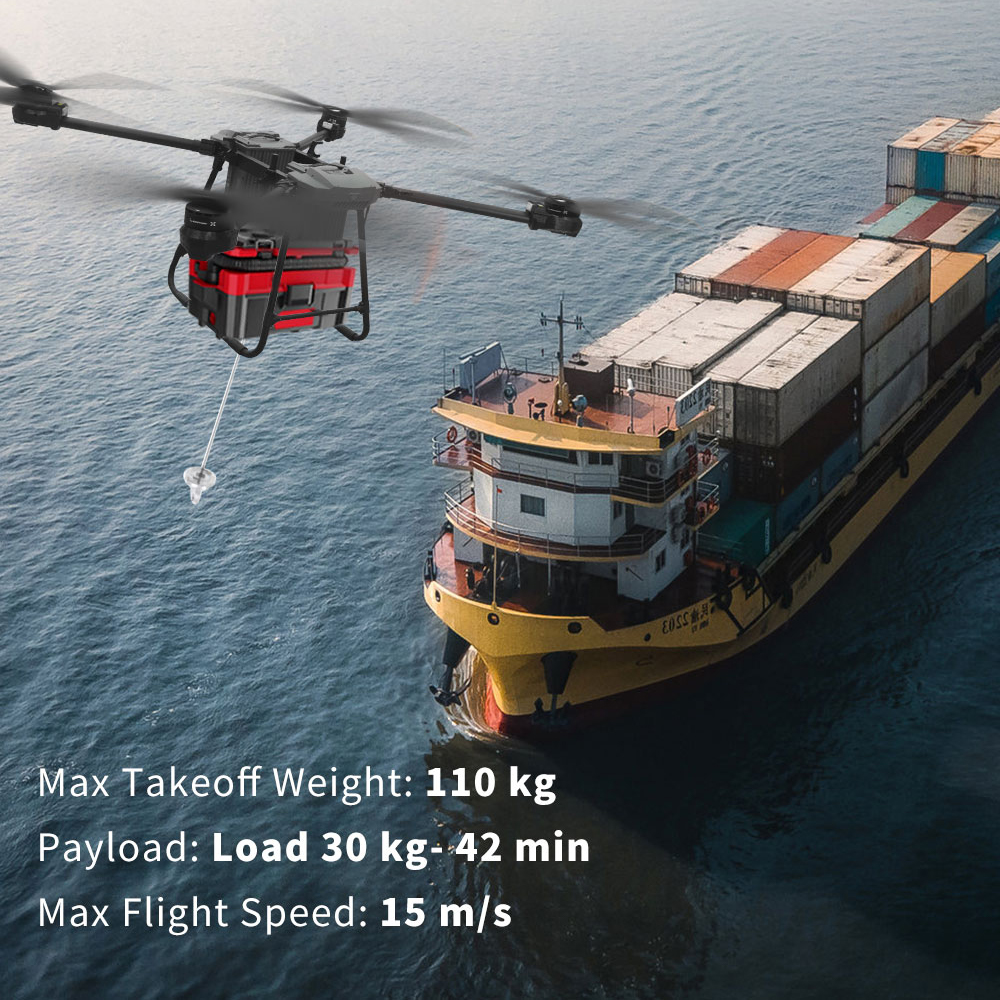
A longer wheelbase increases the distance between the propulsion forces and the aircraft’s center of mass. That gives the system a larger control moment when generating roll and pitch corrections. In practical terms, the aircraft has more leverage to fight payload-induced instability.
Small cargo platforms often run into a nasty problem: the motors have enough thrust to lift the load, but the airframe does not have enough authority to control it properly.
Big difference. Lift is easy. Control is expensive. Seriously, if I see one more “heavy-lift” drone advertisement showing only maximum takeoff weight without discussing attitude recovery, I’m going to lose my mind.
The MRT50H’s 30–50 kg payload range pushes the aircraft into a category where structural engineering becomes the limiting factor. A 29.5 kg aircraft weight without battery means the platform itself is already carrying substantial mass before adding cargo. That creates a different design requirement compared with lightweight delivery drones designed around smaller packages.
The frame cannot simply be strong enough to avoid breaking. It has to be rigid enough to avoid delayed response.
A flexible arm is not just a mechanical problem. It becomes a flight-control problem. When motors change thrust, the frame bends slightly before the aircraft attitude changes. The flight controller sees movement, compensates, then the structure catches up late. The result is overshoot, oscillation, and unnecessary energy consumption. Heavy cargo operations punish that weakness. Especially during landing.
Landing is where many engineers discover their theoretical payload numbers were fantasy. A suspended 50 kg load has momentum. When the aircraft touches down, the cargo does not instantly stop moving. It continues swinging, creating forces that travel through the landing gear, frame, and motor mounts.
A weak structure turns a controlled landing into a wrestling match. The extended wheelbase design addresses one of the most ignored problems in industrial UAVs: payload inertia management. The larger geometry provides more stability margin when cargo weight changes or when the payload is mounted away from the ideal center position.
Because real logistics operations are messy. Cargo is rarely perfectly balanced. Workers are rarely loading boxes with laboratory precision. Wind does not care about your simulation results. -Look, field operators do not fly in a clean engineering report. They fly near warehouses, construction sites, remote infrastructure, mountains, farms, and emergency zones where every imperfect variable appears at once.
The propulsion system is another place where lazy designs fail. A 50 kg payload configuration requires more than installing higher-power motors. High thrust systems demand stable electrical delivery. Voltage sag, battery stress, connector heating, and uneven motor loading can create performance degradation exactly when the aircraft needs maximum authority.
A drone that can lift 50 kg for ten seconds is not automatically a 50 kg cargo aircraft. The real test is maintaining controlled flight across changing payload conditions. That means the propulsion system, power distribution, flight controller tuning, and structural design must operate as one system.
The MRT50H’s 15 m/s maximum flight speed also reveals an engineering trade-off that many companies avoid discussing. Heavy-lift UAVs are not designed to win racing competitions. Increasing speed increases aerodynamic drag, power consumption, and structural loading. At large payload scales, every additional meter per second has a cost.
The practical target is not maximum speed. It is predictable transportation. For industrial logistics, emergency supply delivery, remote equipment transfer, and infrastructure support, reliability beats aggressive performance numbers. A cargo drone that arrives slightly slower but maintains control with changing loads is more valuable than a faster platform constantly operating near its mechanical limits.
The industry still has a weight obsession. Everyone talks about kilograms lifted. Almost nobody talks about kilograms controlled. That is the real engineering boundary.
A modern heavy-lift cargo UAV is not defined by how much mass it can get off the ground. Any oversized motor system can produce impressive thrust numbers. The difficult part is building a machine where that mass remains stable, controllable, and repeatable after hundreds of operational cycles.
Going forward, the payload capacity of cargo drones will no longer be a point of competition; rather, it will depend on who can understand that a 50-kilogram payload is not simply an object, but a mobile mechanical device attached to an aircraft.