
The biggest mistake in aerial cleaning hardware is assuming that a lighter drone is automatically a better drone.
That idea sounds logical on a whiteboard. Less weight means less power consumption, longer flight time, easier transportation. Nice theory. Real operations are less forgiving.
A cleaning drone is not carrying a camera. It is fighting physics. Once high-pressure water enters the equation, the aircraft is no longer a simple flying platform. It becomes a flying mechanical system dealing with continuous reaction forces, changing loads, airflow disturbance, and structural vibration.
Here’s the thing: many early concepts borrowed design principles from photography drones and tried to scale them upward. That approach ignores one uncomfortable fact — a drone hovering near a wall while pushing water at high pressure is experiencing a completely different engineering problem.
The QX140-X8 was developed around this reality. The aircraft was not optimized for minimum weight. It was designed around maintaining control authority during industrial cleaning operations. The platform supports a maximum take-off weight of ≤38 kg and uses a 14S 45000 mAh battery system to provide enough power margin for demanding workloads.
Because the machine has to manage a 16 L/min water flow system with instantaneous pressure reaching 20 MPa, stability becomes a mechanical requirement rather than a marketing feature. Small detail. Big consequence.
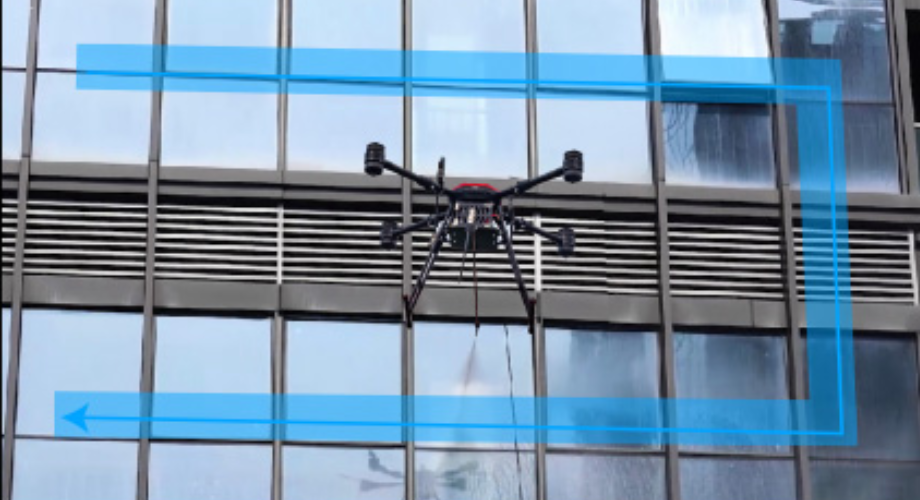
A consumer drone can tolerate minor attitude changes because its main job is image capture. A cleaning drone cannot. A few degrees of unwanted movement can change nozzle distance, affect cleaning consistency, or increase the chance of contact with a building surface.
Wait, let me rephrase that — engineers often confuse peak performance numbers with usable operating stability. A drone that produces impressive thrust on a test stand means little if it becomes difficult to control when external forces continuously push against it.
The water supply architecture shows this trade-off clearly. Instead of carrying a large onboard water tank, the QX140-X8 uses an external water supply system. This removes unnecessary payload growth and avoids the center-of-gravity changes caused by a shifting water load.
That decision looks less impressive in a specification sheet. It is probably the smarter engineering choice. Carrying water onboard sounds convenient, but the aircraft would constantly deal with changing mass distribution as the tank empties. For long-duration cleaning tasks, predictable handling is often more valuable than reducing ground equipment.
This design allows the platform to maintain operational endurance of up to 55 minutes for photovoltaic panel cleaning applications while keeping the airframe focused on flight stability and payload control. The same thinking applies to nozzle positioning.
The QX140-X8 uses a 1500 mm spray pipe and maintains a working distance of approximately 2–3 meters between the nozzle and the surface. Some people may see this as inefficient because the aircraft is not directly pressed against the target area.
That assumption misses the aerodynamic problem. Getting too close increases airflow disruption, spray interference, and collision risk, especially during facade cleaning where surfaces are uneven and visibility can be limited. The system accepts a controlled working distance and uses a high-pressure 20 MPa cleaning system to maintain performance.
Engineering is usually about choosing which problem you want to have. The future of cleaning drones will not be decided by who creates the lightest aircraft. It will be decided by who can build machines that behave consistently when conditions are messy.
Wind is one example. The QX140-X8 is designed with a maximum wind resistance capability of 12 m/s, because industrial cleaning does not always happen inside a perfect laboratory environment. Buildings create complex airflow patterns, elevated structures experience different wind conditions, and operators need predictable responses.
Let’s be real for a second: adding more sensors and automation does not fix poor mechanical fundamentals. A route-planning system cannot compensate for an unstable airframe. An intelligent navigation algorithm cannot remove vibration caused by an unbalanced payload. Software can improve operation, but it cannot negotiate with basic physics.
The QX140-X8 5.0 version adds route planning functions and modular nozzle configurations for repeatable industrial tasks, including photovoltaic panels, building facades, towers, and other elevated structures.
The technology direction is becoming clearer. Cleaning drones are evolving from experimental flying machines into specialized industrial equipment. The important question is no longer “How high can it fly?” or “How much weight can it save?”
The harder question is simpler. Can it perform the same task safely, repeatedly, and predictably after hundreds of operations?
That is where industrial UAV engineering separates from consumer drone design. The winning platforms will not be the ones with the most aggressive specifications. They will be the ones that understand the difference between a demonstration and a working tool.