
The drone motor market is entering a strange phase. Factories are scaling faster than engineers can rewrite the rules.
Funtown Electric’s planned jump from roughly 80,000 UAV motor units annually to 300,000 units is not just another production expansion story. It is a signal that propulsion hardware has moved from hobby-grade experimentation into a serious industrial supply chain. The uncomfortable part? More motors being produced does not automatically mean better drones.
A bad motor design multiplied 300,000 times is still a bad design. The real engineering battle is happening inside a few millimeters of copper winding, magnet strength, bearing tolerance, and thermal management. Production volume gets headlines. Electromagnetic efficiency decides whether a drone actually performs.
The market has spent years obsessing over airframes, cameras, and autonomous software while treating motors as interchangeable parts. That assumption is outdated. For high-dynamic UAV platforms, the motor is the control system’s physical muscle.
A flight controller can calculate a correction in milliseconds. The motor has to deliver it. Funtown Electric’s expansion follows the broader push for localized UAV supply chains, where domestic production programs are increasing demand for propulsion components. The company has developed 15 UAV motor models and operates dedicated power module production lines, including a US-focused line and another designed for customized, lower-volume manufacturing.
That manufacturing strategy reveals something important: drone propulsion is becoming less about one universal motor and more about application-specific engineering.
A logistics drone, a reconnaissance platform, and a 5-inch FPV racing machine are not asking the same questions from a motor. One wants endurance. One wants reliability. One wants violence. Not marketing violence. Mechanical violence. Instant torque changes. Rapid acceleration. Aggressive attitude corrections.
Look, this is where many commercial drone discussions become too clean. Engineers do not design motors in a perfect spreadsheet environment. They fight compromises. More KV can improve responsiveness but can increase current demand. More torque can improve lifting capability but can add weight. Higher efficiency sounds simple until heat has nowhere to escape.
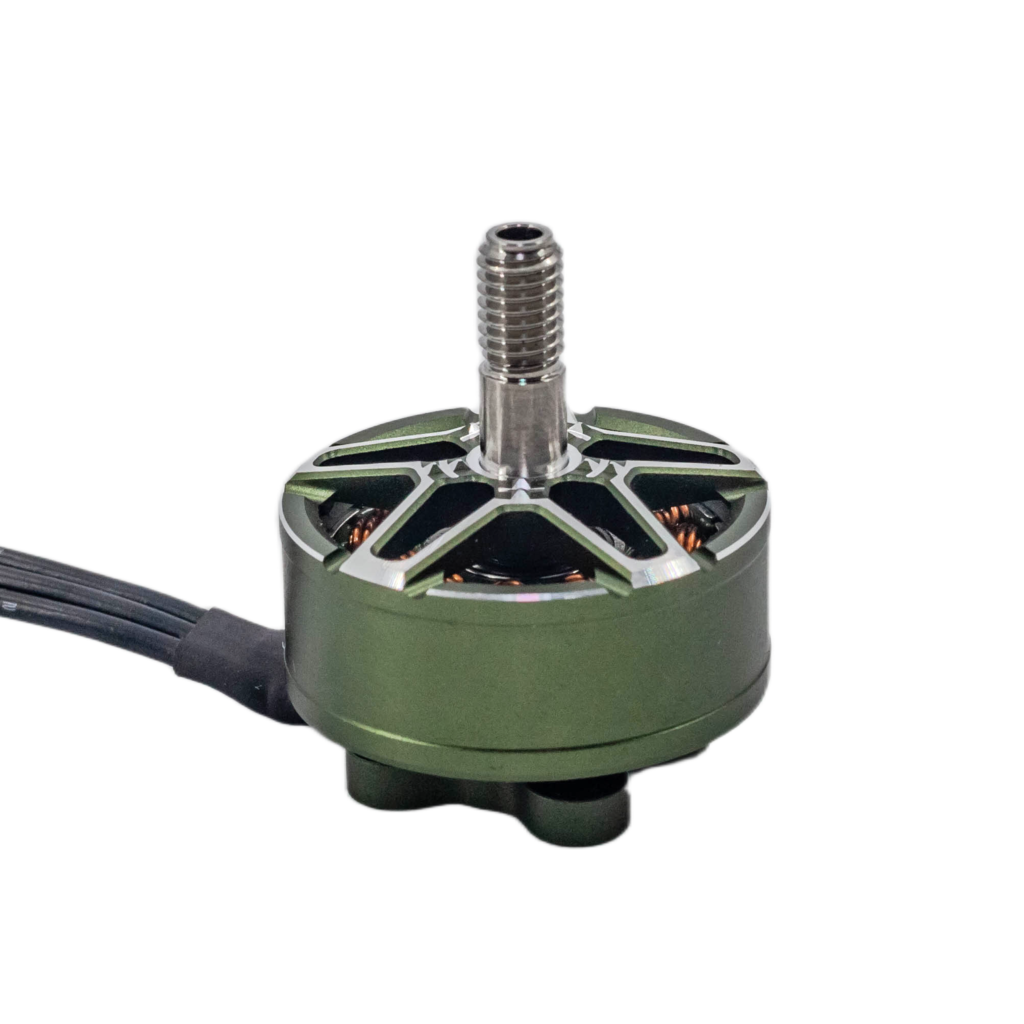
The numbers tell the story. Architectural Benchmarks: Market Standards vs Modern Engineering. The 2207 brushless DC outrunner architecture remains a common reference point for 5-inch FPV platforms because it sits near a practical balance between responsiveness, weight, and power delivery.
The benchmark configuration analyzed here uses a 22 mm × 7 mm stator size with a 1900KV rating, a 16 × 16 mm mounting pattern, and compatibility with 4S–6S LiPo battery systems. Those numbers are not random.
A 2207 stator provides enough electromagnetic volume to generate meaningful torque without turning a lightweight FPV frame into a heavy industrial machine. The 1900KV rating reflects a compromise between aggressive throttle response and manageable current draw on higher-voltage battery setups.
Compare this against many older commercial drone propulsion systems built around efficiency-first priorities. Traditional platforms often favor smoother operation, longer hover times, and conservative thermal margins. That approach works for mapping, photography, and inspection missions.
It struggles when the aircraft needs violent directional changes. Modern FPV propulsion design prioritizes transient performance. The motor is expected to recover from sudden load changes, maintain rotational stability, and respond immediately to flight controller commands.
That is why materials inside the motor matter. The analyzed unit uses N52-class neodymium magnets, precision ball bearings, a hardened steel shaft, and an aluminum alloy housing. These components directly influence magnetic strength, mechanical friction, shaft durability, and heat dissipation.
A cheap bearing does not create a dramatic failure on a specification sheet. It creates vibration. Vibration creates inaccurate sensor data. The control loop starts fighting a mechanical problem instead of flying the aircraft.
Here’s the thing: efficiency numbers are often misunderstood. A motor achieving approximately 80–90% efficiency under optimal load conditions does not mean the drone magically converts almost all battery energy into useful thrust during every flight.
Real missions include acceleration spikes, changing propeller loads, wind resistance, and aggressive maneuvering. The efficiency curve matters more than the peak number.
Wait, let me look at that assumption again—the interesting part is not the 90% figure itself. It is whether the motor stays inside a useful efficiency range while experiencing repeated high-load transitions. That is where race-style FPV propulsion separates itself from basic commercial hardware.
Funtown’s production expansion also highlights another shift: propulsion modules are becoming industrial products rather than isolated components. The company’s planned third UAV power module production line reflects expectations that demand will continue expanding beyond consumer drones into specialized platforms.
The same manufacturing ecosystem is also moving into adjacent robotics fields. A second-generation robotic dog joint module is scheduled for mass production in Q3 2026, while a logistics vehicle power module developed with Kude Technology is expected to enter production in Q4 2026.
The connection is obvious. Different machines. Same engineering problem. Move energy efficiently through compact electromechanical systems. The Real Constraint: Heat, Not Horsepower. Drone motors rarely fail because engineers cannot generate enough power. They fail because power creates heat.
A 2207 motor spinning aggressively on a 6S battery system can produce extreme thermal stress when paired with inefficient propeller choices or poor airflow. The aluminum housing is not just cosmetic. It is part of the thermal pathway.
The hardened steel shaft is not just a durability upgrade. It protects alignment under repeated acceleration loads. The N52 magnets are not just a premium component. They help maintain magnetic flux density inside a small motor volume. Every material choice is a negotiation. That is the part production reports rarely explain.
A factory can build hundreds of thousands of motors. The engineering challenge is ensuring each motor maintains predictable performance after thousands of vibration cycles, temperature changes, and rapid throttle commands.
Let’s be real for a second: the future UAV market will not be won by whoever makes the most motors. It will be won by whoever understands the relationship between manufacturing scale and mechanical reality. Volume creates availability. Engineering creates capability.
The next generation of drones will depend less on flashy external features and more on invisible hardware decisions buried inside propulsion systems. A 22 mm stator, a magnet grade, a bearing specification, or a winding choice can determine whether a drone performs like a precision machine or just another flying platform fighting its own limitations.