
A cleaning drone that can fly beside a skyscraper is not particularly impressive anymore.
Keeping it there while a pressurized hose pulls backward, wind pushes sideways, water changes the vehicle’s center of mass, and a cleaning head has to maintain a useful standoff distance from an irregular façade—that is the engineering problem nobody gets to solve with a glossy autonomy demo.
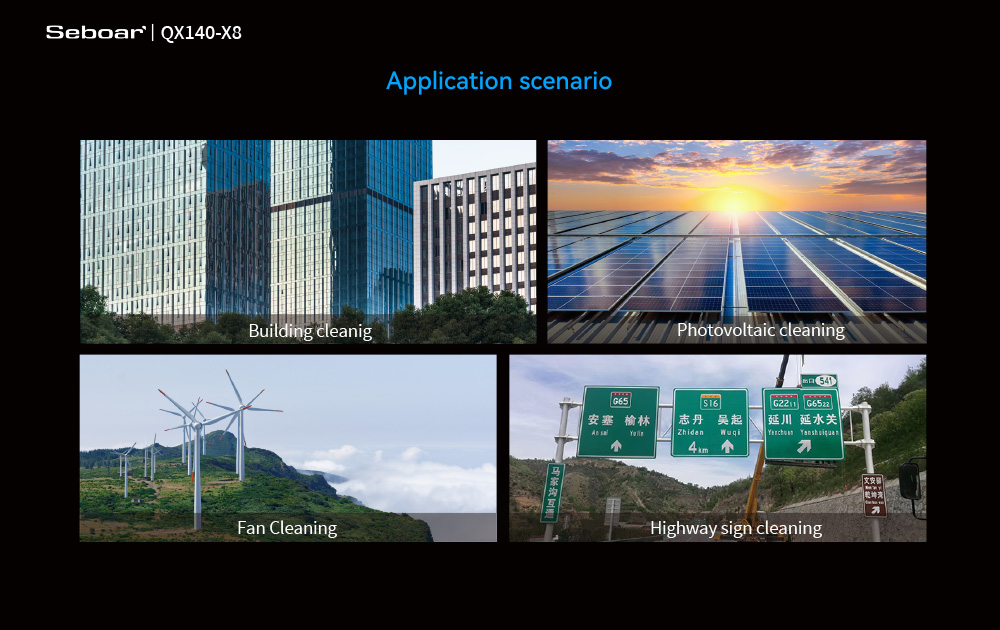
A recent August 2026 industry update on building-cleaning UAVs illustrates exactly where the market is heading. The systems described combine RTK positioning, laser-vision perception, autonomous obstacle avoidance and route planning, with operating modes that include autonomous cruising, point-based cleaning and work-data retention. The intended environments are not empty test fields either: curtain walls, steel structures and irregular exterior surfaces on landmarks, industrial parks, large public buildings and factories.
That sounds like a mature product category.
It isn’t. Not yet.
There is also a naming problem worth catching before anyone turns this material into a product claim. The supplied industry report identifies the cleaning-drone models as F100, F150 and FG50; it does not provide technical specifications for a QX140-X8. So if QX140-X8 is being used as the target keyword, it should not be presented as one of those three models without an independent specification source. That distinction matters because SEO teams have a bad habit of turning keyword alignment into technical fact.
RTK Does Not Make a Cleaning Drone Stable
RTK can provide highly accurate positioning under suitable GNSS conditions. Laser-vision perception can add environmental information that satellite positioning cannot. Autonomous obstacle avoidance can prevent the aircraft from blindly flying into a façade or surrounding structure.
None of those technologies, individually or collectively, guarantees a stable cleaning operation.
Here’s the thing: navigation accuracy and process accuracy are different engineering problems.
A conventional inspection drone can maintain a waypoint and capture usable imagery even if its attitude moves slightly. A cleaning drone has a much nastier requirement. The aircraft needs to hold a useful relationship with the building while the cleaning mechanism is actively disturbing the vehicle.
Consider the forces involved.
A hose running from the ground introduces drag and potentially changing tension. Pressurized water creates reaction forces at the nozzle. Crosswinds generate aerodynamic disturbances that become increasingly significant near corners, rooflines and other structures. The cleaning head itself may alter the vehicle’s moment distribution depending on its position and mechanical configuration.
So the control problem is no longer simply:
Where is the drone?
It becomes:
Where is the drone, where is the façade, where is the cleaning head, what forces are acting on the aircraft, and can the controller compensate quickly enough to maintain the required cleaning geometry?
That is a much harder question.
The Missing Number Is the One Customers Actually Need
The August 2026 report provides useful evidence of the technology direction, but its quantitative data is remarkably thin.
It identifies F100, F150 and FG50, and names RTK and laser-vision fusion perception. It does not disclose flight speed, endurance, payload, cleaning efficiency, effective cleaning area, positioning accuracy, obstacle-detection distance or operating cost.
Those omissions aren’t cosmetic.
For a demonstration, “autonomous cleaning” is enough to attract attention. For an actual commercial operation, it isn’t even close.
A building owner ultimately cares about something closer to cost per usable square meter cleaned.
That figure depends on several variables that marketing material usually keeps out of the frame: effective cleaning area per hour, water consumption, detergent consumption, battery or energy usage, operator intervention, setup and teardown time, maintenance frequency, equipment failure rate and weather-related downtime.
Suppose a drone can clean a façade autonomously but requires an operator to intervene repeatedly whenever wind conditions change or the hose tension becomes unstable. Technically, the aircraft is autonomous. Operationally, it may still be a remotely supervised machine with a sophisticated flight controller.
Those are not the same business model.
The Real Competitor Is Not Another Drone
The industry also needs to stop comparing cleaning UAVs only with other UAVs.
The real benchmark is the existing façade-cleaning workflow.
That means suspended platforms, rope-access workers, lifts, scaffolding and other established methods.
A drone therefore has to beat an incumbent process on more than flight capability. It needs to reduce setup time, improve access to difficult structures, maintain acceptable cleaning quality and produce a predictable operating cost while satisfying the customer’s safety and documentation requirements.
This is why the report’s emphasis on standardized operating procedures, safety controls and traceable maintenance data is more significant than the autonomy buzzwords.
For institutional customers, the deliverable is increasingly not “one drone.”
It is an auditable operation.
The aircraft, operator workflow, maintenance records, route data, work logs, incident handling and site procedures become part of the product.
That changes procurement.
A government facility or large industrial operator can tolerate a machine that is technically less spectacular if the supplier can demonstrate repeatable operations, documented maintenance and controlled risk. A spectacular prototype that requires an experienced engineer standing beside it for every job is a very different proposition.
Laser Vision Has a Job to Do
The combination of laser sensing and visual perception makes sense for façades because neither sensing method solves every problem on its own.
RTK establishes a global reference.
Vision provides environmental information.
Laser sensing can contribute geometric information about nearby structures.
The autonomous planner then has to turn all of that into a safe trajectory.
But a building façade is not a clean laboratory obstacle.
Glass reflects. Steel structures create complex visual and geometric conditions. Architectural protrusions can appear at different depths. Corners abruptly change the local environment. Cables, fixtures, signs and external equipment can become obstacles that are insignificant to a mapping algorithm but disastrous to a cleaning platform operating only a short distance away.
And there is another uncomfortable question: what happens when the perception stack disagrees with the GNSS solution?
A serious system needs a hierarchy of sensor confidence and a defined failure response. “Sensor fusion” is not itself a safety architecture.
Wait, let me put that more precisely: sensor fusion can improve state estimation, but the commercial value comes from what the vehicle does when the sensors become unreliable, contradictory or temporarily unavailable.
That failure behavior is where engineering maturity shows up.
Weather May Decide the Economics
Wind is particularly unpleasant for this application.
A small multirotor can compensate for moderate disturbances, but compensation consumes control authority and energy. As the aircraft operates close to a large structure, airflow can become less predictable, particularly around corners and edges.
Now add a hose.
Now add water.
Now ask the aircraft to maintain a consistent cleaning distance.
Suddenly the headline endurance figure—which the report does not provide anyway—is not enough to evaluate the machine.
A drone might theoretically remain airborne for a certain period under benign conditions, yet achieve substantially less productive cleaning time once hovering corrections, payload demands, wind and operational repositioning are included.
That distinction between flight endurance and productive endurance is going to matter more as this market moves from demonstration projects to routine contracts.
A ten-minute flight is not necessarily ten minutes of cleaning.
That sounds obvious. It is still routinely ignored.
“Autonomous” Needs a More Useful Definition
The industry would benefit from abandoning the binary distinction between manual and autonomous operation.
A more useful model is to describe how much of the workflow can proceed without human intervention.
For example, autonomous route planning is one capability. Autonomous façade following is another. Autonomous obstacle avoidance is another. Autonomous cleaning-path execution is another. Automatic recovery from abnormal wind, sensor degradation or communication interruption is another.
The last few capabilities are considerably harder.
The August 2026 update describes autonomous cruising, point cleaning, route planning and work-data retention, which suggests that cleaning UAVs are evolving beyond simple remote-controlled aircraft. But without intervention rates, failure statistics and operational case data, it is premature to translate those features into claims of fully autonomous commercial operation.
That is the line between a technology description and a sales fantasy.
The Next Battle Is Operational Data
The most interesting part of the emerging cleaning-drone model may eventually have very little to do with the aircraft itself.
Once every cleaning mission generates route information, surface coverage records, intervention events and maintenance data, the operator can begin measuring the process rather than merely performing it.
That creates a feedback loop.
Which façade geometries generate the most interventions? Which weather conditions cause the most aborted missions? How much water is being consumed per square meter? How often does the cleaning head lose its optimal working distance? Which components fail after a certain number of operating hours?
Those questions turn a drone from a flying machine into an industrial asset with measurable operating behavior.
That is where the technology starts becoming commercially interesting.
QX140-X8 Needs More Than a Keyword
For anyone researching or positioning a Cleaning Drone QX140-X8, the immediate problem is not finding another paragraph describing RTK and obstacle avoidance.
It is finding the engineering evidence.
What is the aircraft’s actual cleaning payload? What is its productive endurance under load? How is hose tension managed? What nozzle pressure and flow rate are supported? What is the effective cleaning width? How close can it safely operate to glass and other surfaces? What wind envelope is permitted? How many square meters can it actually process per hour? How much human intervention is required per mission?
Without those numbers, the product remains difficult to compare against conventional façade-cleaning equipment.
And that is the uncomfortable conclusion for the entire sector: autonomous flight is becoming a baseline capability, not the commercial finish line.
The winners in building-cleaning UAVs will probably not be the companies that demonstrate the most impressive drone flight.
They will be the ones that can repeatedly clean a difficult building, under documented operating conditions, at a measurable cost, with predictable human intervention and a safety process that a procurement department is willing to sign off on.
Flying is the easy part.
Cleaning is the product.