
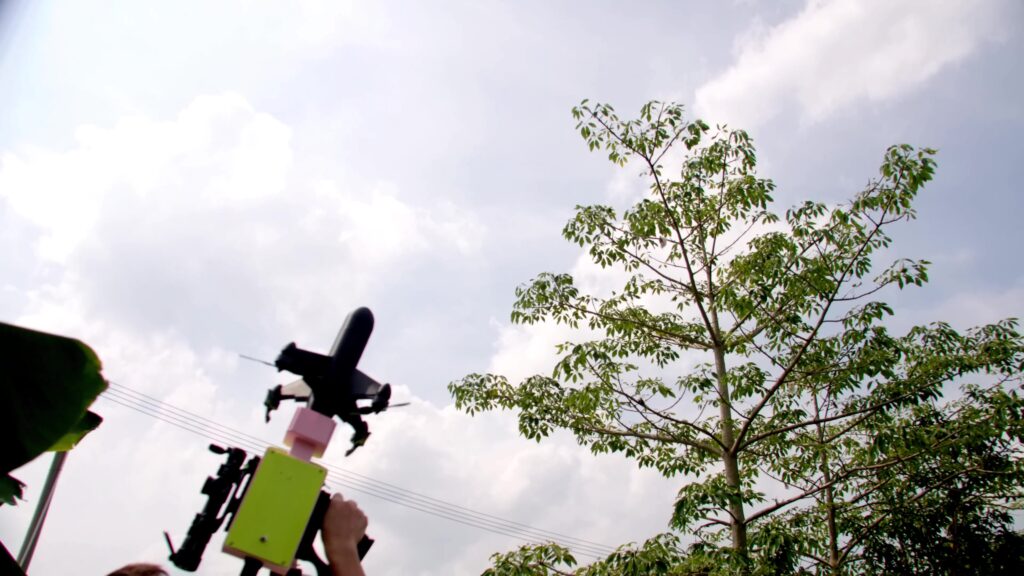
1,500 interceptor drones per day. That was the delivery rate Ukraine’s Ministry of Defence reported in December 2025 and January 2026. The number is striking, but it is also easy to misunderstand. Ukraine interceptor drones are not becoming important simply because more airframes are arriving. They are becoming important because the country is reorganizing detection, command, launch, guidance, production, and field feedback around them.
That distinction matters. A fast drone without a timely track is late. An autonomous terminal seeker without reliable target assignment is idle. A cheap interceptor that cannot be produced with consistent components is not really cheap at scale.
The aircraft is the visible part. The system around it decides whether it works.
The Number Everyone Will Misread
On January 7, 2026, Ukraine’s Ministry of Defence said military units were receiving more than 1,500 anti-Shahed drones per day. It also said units had ordered and received more than 7,000 tactical interceptors through the DOT-Chain Defence marketplace.
Run the simplest calculation: 1,500 multiplied by 30 equals 45,000 deliveries in a 30-day month if that rate is sustained. That is not a confirmed monthly production figure, and it says nothing by itself about launches, successful engagements, losses, reserves, or geographic coverage. Treating it as a kill-rate statistic would be wrong.
The useful signal is organizational. A flow measured in four digits per day demands standardized acceptance, batteries, spares, operator training, firmware control, storage, transport, and replenishment. Procurement is no longer a side activity. It becomes part of the air-defense architecture.
Ukraine’s political leadership has described the same shift from another angle. On January 19, President Volodymyr Zelenskyy said the Air Force would adopt a new approach to mobile fire groups, interceptor drones, and other short-range air-defense tools, including a new organization for that component.
That is a doctrine change, not a shopping list.
Why Ukraine Interceptor Drones Are a System, Not a Gadget
An interception chain has several distinct jobs: detect a target, classify it, maintain a usable track, assign an effector, launch within the remaining time window, guide the interceptor through the midcourse phase, and finish the engagement. A failure at any step makes the top-speed figure irrelevant.
This is why the phrase “drone versus drone” is too simple. The real contest is one network against another.
For Ukraine, interceptor drones sit inside layered air defense rather than replacing every other layer. The Ministry of Defence explicitly frames them as a way to increase counter-UAV coverage and preserve more expensive missile stocks. That role is narrower than a universal air-defense solution, but far more useful than pretending one low-cost platform can defeat every aerial threat.
The design target therefore changes. Engineers are not optimizing an isolated aircraft for an impressive demonstration. They are optimizing a response chain for repeated use under uncertain tracking, electronic interference, night conditions, weather, and rapidly changing target behavior.
Autonomy Is Moving Into the Terminal Phase
Manual piloting puts a hard ceiling on scale. More simultaneous tracks require more operators, more screens, more radio links, and more decisions made under time pressure. That does not mean removing the human from every decision. It means moving automation to the parts where reaction time and visual tracking become the bottleneck.
In June 2026, Ukraine’s Ministry of Defence reported that a Brave1 participant had developed a system that automates 95% of the interception cycle. According to the ministry, an operator selects the target and authorizes engagement; the system then guides the drone, identifies the target, tracks it, and completes the terminal action. The ministry said the system had passed combat testing in the Kharkiv region.
The 95% figure is an official claim, not an independent benchmark. Even so, it reveals the engineering direction: human authorization at the decision point, with machine assistance carrying more of the high-speed tracking workload.
That architecture also exposes new failure modes. Classification confidence matters. Sensor latency matters. A terminal seeker has to hold a track against background clutter, rapid angular motion, and changing illumination. Software updates must improve performance without turning fielded units into incompatible versions of the same product.
Autonomy reduces one bottleneck and creates a configuration-management problem.
Speed Matters, but the Performance Envelope Matters More
Interceptor marketing naturally gravitates toward maximum speed. Closing speed is important because a late launch cannot be repaired with better software. Yet speed is only one axis of the engagement envelope.
The Ukrainian Ministry of Defence describes the LITAVR interceptor as having a stated maximum speed of 350 km/h, a 40 km operational range, and a 9 km maximum operating altitude. The same official profile highlights daytime and thermal cameras, non-GPS navigation, radar integration, and automatic terminal guidance.
Those claims are specific to that system and should not be generalized to every Ukrainian interceptor. Their real value is showing what a meaningful specification sheet must cover. Speed, range, altitude, sensing, navigation, external-track integration, terminal guidance, and return behavior interact. Removing one column can make the others look better while making the system less useful.
Commercial high-speed platforms demonstrate the same specification discipline in a non-battlefield context. A buyer comparing airframes should read the full configuration table rather than the largest number in the headline; Seboar’s G250 high-speed FPV platform page is one example of how speed, control range, airframe mass, endurance, and operating limits need to be considered together.
The Cost Exchange Is Really an Industrial Question
Low unit cost is often presented as the decisive advantage of an interceptor drone. It is only the beginning of the calculation.
The UK government said in January 2026 that British production of the Ukrainian-designed Octopus interceptor would begin that month, with a target of thousands of units per month. It also said each Octopus costs less than 10% of the drone it is designed to defeat and that the design is updated every six weeks.
Both claims come from the program’s government sponsor, so they should be treated as attributed program figures rather than independent cost auditing. Still, putting cost and update cadence in the same announcement is revealing. The industrial model assumes the interceptor will change repeatedly.
A favorable airframe-to-target price ratio can be erased by expensive sensing, scarce operators, unreliable launch equipment, fragmented batteries, or excessive maintenance. The correct denominator is not merely the interceptor’s factory price. It is the cost of generating a credible engagement opportunity: detection, command, communications, launch, guidance, support, and replacement.
Cheap hardware attached to an expensive, brittle process is not low-cost air defense.
A Practical Evaluation Checklist
For governments, infrastructure operators, and system integrators studying Ukraine interceptor drones, seven questions are more useful than asking which model is fastest:
- Track compatibility: Can the interceptor consume target data from the radars and sensors already deployed?
- Decision latency: How much time passes between detection, classification, authorization, and launch?
- Degraded navigation: What happens when satellite navigation or the control link is unreliable?
- Day/night continuity: Does the sensing chain work across the intended lighting and weather conditions?
- Terminal workload: Which tasks remain with the operator, and which are automated?
- Configuration control: Can firmware, sensors, batteries, and airframes be updated without splitting the fleet into incompatible subtypes?
- Cost per defended event: What does the complete detection-to-engagement chain cost, including failed launches and support equipment?
These questions are deliberately system-level. The aircraft still matters. But the fastest airframe cannot compensate for a delayed track, and the smartest seeker cannot compensate for inconsistent production.
The same reasoning applies outside military procurement. Readers evaluating command links and operator interfaces can see the broader architecture problem in why remote-control architecture matters more than advertised range.
The Next Contest Is Software-Defined Air Defense
Ukraine’s 2026 interceptor-drone push shows three changes happening at once: delivery volume is becoming an operational variable, terminal guidance is absorbing more of the tracking burden, and manufacturing partnerships are being organized around frequent design updates.
None of that makes conventional air defense obsolete. It makes the lower layer denser and potentially more economical against the targets it is designed to handle.
The durable lesson is not that every country should copy one Ukrainian drone. It is that interceptor development must connect aircraft performance to sensors, command software, human authorization, production discipline, and field feedback. Ukraine interceptor drones are becoming a category of air-defense infrastructure.
That is harder to photograph than a 350 km/h airframe.
It is also the part that will decide whether scale produces protection or merely inventory.
Note: Operational and performance statements above are attributed to the Ukrainian and UK government sources linked in the text. They are not presented as independent laboratory verification.