
The drone industry has spent years treating the remote control as a glorified joystick with a screen attached.
That assumption is getting harder to defend.
On June 4, 2026, JINMING Industrial introduced its independently developed flight-control remote controller at Japan Drone 2026. The announcement itself was revealing—not because it disclosed some extraordinary RF specification, but because it did not. The company emphasized stability, communications security, compatibility, and supply-chain transparency as evaluation criteria for government, public-safety, and critical-infrastructure users, while leaving the controller’s actual communication protocol, frequency, range, redundancy, encryption, latency, interference resistance, and supported flight controllers undisclosed.
That gap matters.
A remote control is only as useful as the link architecture behind it. A beautiful touchscreen does not compensate for an unstable RF path. A long theoretical range does not mean much if the link collapses in a congested spectrum environment. And a secure protocol is not automatically a secure system if the flight controller, telemetry path, firmware, and ground station remain poorly integrated.
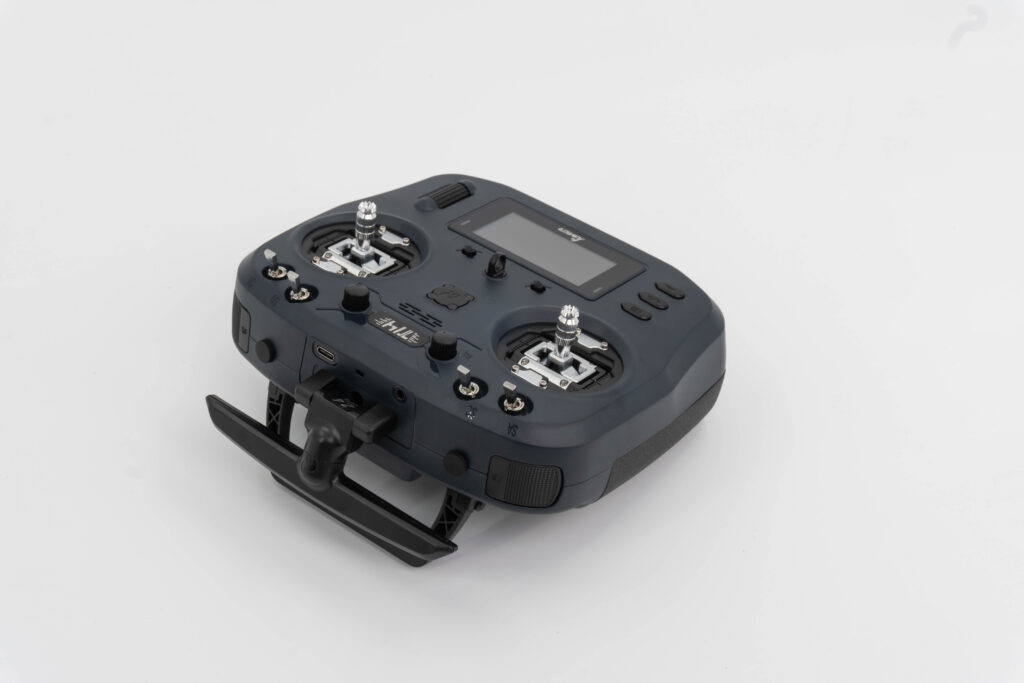
Here’s the thing: the hardware sitting in the operator’s hands is increasingly becoming the visible endpoint of a much larger control architecture.
The Market Is Growing, But the Number Is Easy to Misread
Verified Market Reports data cited in the source puts the global drone remote-controller market at approximately $1.2 billion in 2024 and projects it to reach $3.5 billion by 2033.
That sounds dramatic.
The arithmetic is actually more interesting.
$3.5 billion is about 2.92 times the 2024 figure, representing an increase of roughly 191.7%. The implied CAGR is approximately 12.6%.
But market expansion does not automatically mean operators suddenly need better-looking transmitters.
It reflects a broader shift in what the controller has to do.
Consumer RC equipment can often be judged by basic criteria: control feel, range, battery life, screen quality, supported protocols, and price. Industrial UAV systems introduce a different problem. The operator may need flight-state telemetry, configurable control logic, multiple aircraft profiles, long-range RF links, fail-safe behavior, peripheral integration, and compatibility with different flight-control architectures.
That changes the engineering target.
The controller becomes part of the system rather than a detachable accessory.
Architectural Benchmarks: Market Standards vs Modern Engineering
Consider the Seboar V16 series.
The V16, V16 Max, and V16 Pro are specified around a 2.400–2.480 GHz operating range, 6.6–8.4 V DC working voltage, and 450 mA working current. The controller uses a 4.3-inch IPS touchscreen and runs EdgeTX, while its RF architecture can be configured around either a 4-in-1 Multi-Protocol module or ExpressLRS.
Those numbers are more useful than vague claims about “professional control.”
Why?
Because each one exposes an engineering decision.
The 2.4 GHz band is convenient because it supports a huge ecosystem of radio hardware and established RC protocols. It also creates an obvious trade-off: 2.4 GHz is not some magically clean industrial control band. It shares spectrum with a large number of consumer and commercial wireless systems. Range, interference tolerance, antenna performance, receiver sensitivity, transmit power, modulation, packet rate, and environmental conditions all interact.
So the frequency number alone tells you very little about real-world control performance.
Wait, let me correct that slightly—the frequency still matters, but it is only the beginning of the RF analysis.
The V16’s two RF configuration paths also reveal a practical distinction between protocol flexibility and system specialization. A 4-in-1 Multi-Protocol configuration is fundamentally useful when one transmitter needs to communicate across multiple established radio ecosystems. ExpressLRS takes a different approach, prioritizing a dedicated high-performance link architecture with configurable behavior and extensive ecosystem support.
Neither automatically wins.
The correct choice depends on the aircraft, receiver, telemetry requirements, operating environment, antenna configuration, and required control-link behavior.
That is precisely where many generic remote-control comparisons fall apart. They compare frequency, screen size, and advertised range while ignoring the actual control architecture.
A controller weighing 750 g without its battery and measuring 286 × 128 × 182 mm also tells us something less glamorous but more practical: this is not designed around the idea that the operator merely needs a small handheld transmitter.
The physical controls matter.
Adjustable sticks and configurable switches are particularly relevant when the same controller is expected to support FPV drones, long-range FPV platforms, VTOL fixed-wing UAVs, industrial inspection aircraft, RC aircraft, and helicopters. These aircraft impose very different control requirements. A fixed-wing VTOL aircraft can expose flight-mode and transition controls that simply do not exist on a conventional quadcopter. An FPV platform may prioritize rapid manual inputs and low-latency feedback. An industrial aircraft may require a completely different telemetry and control workflow.
One controller serving all of them is therefore not just a convenience feature.
It is an interface-standardization problem.
Why EdgeTX Matters More Than the Touchscreen
The 4.3-inch IPS touchscreen is the obvious specification.
The firmware is arguably more important.
EdgeTX provides a configurable software layer for model configuration, control logic, telemetry, and parameter management. That means the controller can be adapted to different aircraft architectures without requiring the physical hardware interface to be redesigned every time the aircraft changes.
This is where modern remote-control design starts separating itself from older RC transmitter thinking.
The stick is not the product.
The configurable control architecture is.
A touchscreen can display telemetry, but the underlying software determines what the operator can configure, what information can be surfaced, how control inputs are mapped, and how different aircraft profiles are managed.
That distinction becomes particularly important for industrial UAV fleets. If an operator moves between different aircraft types, maintaining a consistent physical interface can reduce training complexity and operational mistakes. But software flexibility can also introduce its own failure modes if configurations become too complicated, poorly documented, or inconsistent across aircraft.
More flexibility is not automatically safer.
That part tends to disappear from marketing material.
Security Is More Than Encryption
JINMING’s emphasis on communications security and supply-chain transparency reflects a legitimate concern among government and infrastructure operators.
But “secure remote control” is an almost meaningless phrase without architectural detail.
A serious assessment should ask several uncomfortable questions.
What communication protocol is being used?
How is authentication handled?
Is encryption applied to the control link, telemetry link, or both?
What happens when packets are lost?
How does the system detect a degraded link?
Is there link redundancy?
Can firmware be independently verified?
What happens if the controller loses power?
What happens if the receiver loses the control signal?
How are firmware updates authenticated?
Can the aircraft continue safely without the controller?
Those questions are far more useful than asking whether a transmitter is advertised as secure.
The same principle applies to supply-chain transparency. Knowing where the transmitter is assembled is not enough. Engineers evaluating an industrial control system need visibility into critical RF components, firmware provenance, update mechanisms, communication dependencies, and third-party protocol implementations.
Security is a system property.
It cannot be bolted onto the transmitter after the industrial design is finished.
The Real Competition Is Between Architectures
This is where the comparison between a newly announced flight-control controller and established systems becomes interesting.
The JINMING announcement points toward autonomous control-system development but does not disclose the technical architecture required to evaluate its actual RF or control performance.
The Seboar V16 provides a more tangible set of hardware parameters: 2.4 GHz operation, selectable RF architectures, EdgeTX firmware, a 4.3-inch display, configurable physical controls, 6.6–8.4 V operating voltage, and 450 mA specified working current.
Neither dataset proves that one system is superior.
It does show how different engineering maturity can be judged.
A manufacturer that publishes only market positioning gives the reader a product narrative.
A manufacturer that exposes electrical, mechanical, RF, firmware, and compatibility parameters gives engineers something they can actually interrogate.
That distinction matters when the controller is deployed beyond recreational flying.
The Weakest Link Still Wins
The drone industry loves range figures.
They are easy to print on a product page and easy for buyers to compare.
They are also dangerously incomplete.
Control-link performance depends on transmitter output characteristics, receiver sensitivity, antenna efficiency and placement, modulation, packet rate, spectrum congestion, physical obstructions, aircraft orientation, regulatory limits, and environmental conditions.
A controller can have excellent RF hardware and still perform badly because the aircraft antenna is poorly positioned.
A receiver can be extremely sensitive and still become unreliable in a heavily congested RF environment.
A high packet rate can reduce latency while increasing bandwidth requirements.
A longer-range configuration can introduce other trade-offs in throughput or update behavior.
Engineering is full of these irritating little compromises.
That is why the V16’s published operating frequency and RF configuration options are useful, but they should never be mistaken for a complete performance specification.
The missing parameters are the interesting ones.
From Remote Control to Ground-Side Control Architecture
The bigger change is happening at the system level.
Modern UAV operators increasingly expect one ground-side interface to manage different aircraft, telemetry channels, flight modes, and mission configurations. The physical controller becomes the human-machine interface between an operator and an increasingly software-defined aircraft.
That creates three layers of engineering responsibility.
The first is human input: stick geometry, switches, ergonomics, display visibility, and operator workload.
The second is communications: RF protocol, latency, packet reliability, interference tolerance, authentication, and telemetry behavior.
The third is aircraft response: flight-controller firmware, failsafe logic, actuator response, navigation systems, and autonomous behavior.
The remote control sits between all three.
A failure anywhere in that chain can become a control problem.
Let’s be real for a second: calling the transmitter the “brain” of a drone is usually wrong. The flight controller, navigation stack, mission computer, and control software may perform far more computation. The transmitter is better understood as the operator’s command interface and one critical component of the control-link architecture.
That distinction becomes increasingly important as autonomous functions expand.
When autonomy handles stabilization, navigation, tracking, or mission execution, the operator’s control interface does not become irrelevant. It becomes more specialized.
The human needs fewer raw inputs and better system-state information.
That is a completely different design challenge.
What Engineers Should Actually Compare
For the next generation of industrial remote controllers, the useful comparison table is not simply screen size versus screen size.
It should include:
Control-link architecture: protocol, modulation, packet rate, telemetry path, and receiver ecosystem.
RF behavior: frequency range, transmit power, receiver sensitivity, antenna configuration, interference performance, and regulatory constraints.
Latency: measured end-to-end control latency rather than a theoretical protocol figure.
Reliability: packet-loss behavior, link recovery, failsafe timing, and degraded-link operation.
Security: authentication, encryption, firmware signing, update mechanisms, and supply-chain visibility.
Software architecture: model management, scripting, telemetry configuration, flight-controller compatibility, and update control.
Human factors: stick adjustment, switch layout, display readability, physical fatigue, glove compatibility, and operator workload.
Electrical architecture: operating voltage, current consumption, battery system, charging method, and thermal behavior.
Fleet compatibility: whether the same controller can reliably operate multiple aircraft architectures without creating configuration hazards.
That is the benchmark that matters.
Not how futuristic the transmitter looks.
The Next Remote Control May Not Look Like a Remote Control
The 2026 market shift is not really about selling more handsets.
It is about making the ground interface capable of handling increasingly complex UAV systems.
JINMING’s Japan Drone 2026 announcement reflects that direction, even though the absence of detailed technical specifications prevents a meaningful assessment of the new controller’s actual RF or control performance.
The Seboar V16 series represents another side of the transition: a configurable hardware platform combining EdgeTX, multiple RF configuration paths, touchscreen telemetry and configurable physical controls across several UAV categories.
The interesting competition will not be decided by who has the largest display or the longest number printed beside “range.”
It will be decided by architecture.
A modern remote controller has to maintain a reliable command path, present useful aircraft-state information, adapt to different flight-control systems, survive real RF environments, and fail predictably when something goes wrong.
That’s a much harder engineering problem than putting two sticks on a box.
And frankly, the industry should stop pretending otherwise.