
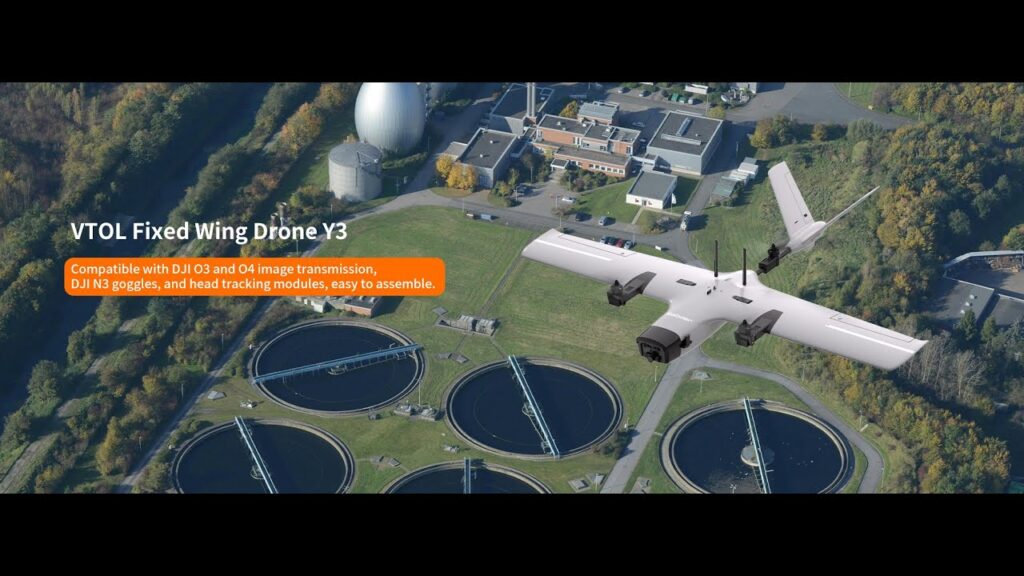
A fixed wing VTOL purchase can go wrong even when every number on the quotation is technically accurate. The aircraft may fly for 80 minutes, the data link may reach 30 km, and the gimbal may produce a sharp image—yet the complete configuration can still be wrong for the intended route.
The usual mistake is comparing airframes instead of missions.
A buyer should define what must be carried, how far useful data must travel, how much vertical-flight reserve is required, and what the aircraft must do when a transition or link fails. Only then do endurance and maximum range become meaningful.
1. Choose the VTOL Architecture Before Comparing Endurance
“Fixed wing VTOL” describes a capability, not one mechanical design. A standard QuadPlane uses separate lift motors for hover and a forward propulsion system for wing-borne flight. A tailsitter rotates the entire aircraft between vertical and horizontal attitudes. A tiltrotor changes the direction of its propulsion units.
Each arrangement moves complexity to a different place.
The official PX4 tailsitter documentation describes tailsitters as mechanically simpler and potentially less expensive to maintain, but harder to tune and fly through hover and transition, especially in wind. A standard QuadPlane carries lift hardware that becomes largely inactive during cruise, but its familiar hover attitude and separate forward propulsion can simplify payload pointing and field operation.
Ask the supplier to identify the architecture explicitly. Then ask which parts create lift in hover, which parts create thrust in cruise, and what happens after one propulsion component fails. “VTOL” by itself answers none of those questions.
2. Demand a Configuration-Specific Mass Budget
Maximum takeoff weight is not payload capacity.
The Seboar Y3/ROC WING family lists a 1,380 g aircraft weight and a 2,500 g maximum weight. The 1,120 g difference is a gross mass margin, not automatically 1,120 g of useful sensor payload. Depending on what the base weight includes, that margin may also have to absorb the flight battery, video transmitter, antennas, gimbal, cabling, mounts, and installation hardware.
A serious quotation should therefore show at least four measured values:
- airframe mass in the quoted build;
- installed battery mass and capacity;
- complete payload mass, including mount and cables;
- ready-to-fly takeoff mass with the required safety margin.
If a seller provides only maximum takeoff weight and camera weight, the buyer still does not know whether the mission configuration closes.
3. Separate Flight Distance, Control Radius, and Video Range
These numbers are regularly mixed together even though they describe different limits.
The Seboar fixed wing VTOL family page lists up to 60 km total flight distance, a 30 km control range, and 60-minute endurance for a standard configuration. Its optional 8,000 mAh configuration is listed at up to 72 km total distance and 80 minutes. A 60 km out-and-back route can fit inside a 30 km radius only in an ideal straight-line geometry, with no allowance for climb, transition, loiter, diversion, wind, or reserve. Total path length is not the same as distance from the ground station.
Configuration matters too. Seboar’s Y3 RTF1-2 and RTF6 product pages each list 10 km digital transmission, while RTF7 lists up to 5 km. A family-level 30 km link claim should not be copied onto a package that uses a different transmitter.
Before ordering, draw the intended route on a map and ask the supplier to mark the farthest command-link point, the farthest useful video point, and the planned return reserve. That one exercise exposes more risk than a page of headline specifications.
4. Treat Transition as a Third Flight Mode
A hybrid aircraft does not simply have “multirotor mode” and “fixed-wing mode.” It also has transition, a short phase with its own power demand, control blending, and stall risk.
The PX4 QuadPlane configuration guide warns that transition tuning must bring the aircraft above a safe airspeed before fixed-wing control takes over. It recommends a calibrated airspeed sensor and describes a transition timeout that can abort the maneuver if the required speed is not reached. ArduPilot’s transition documentation likewise notes that stopping VTOL assistance before sufficient airspeed can cause an immediate stall.
That turns several software and sensor details into commercial questions:
- Is an airspeed sensor included in the quoted package?
- What airspeed completes the forward transition?
- What timeout or abort action is configured?
- Can the aircraft return to hover safely after an interrupted transition?
- Will the supplier provide transition logs for the delivered takeoff weight?
A polished demonstration in calm air does not answer those questions for a payload-equipped aircraft in wind.
5. Reserve Battery for the Most Expensive Part of the Return
Fixed-wing cruise is usually the efficient phase. Vertical landing is not.
ArduPilot warns that all motors can draw heavily during a VTOL-to-fixed-wing transition and that voltage sag can become severe with high-capacity, low-discharge-rate batteries. The opposite end of the mission also needs a reserve: the aircraft must decelerate, transition back to hover, correct position, and descend vertically.
A buyer should not accept “80 minutes” as a complete mission plan. Ask for endurance at the quoted takeoff mass, expected wind, cruise speed, payload power draw, and landing reserve. Then request the voltage trace from a representative flight rather than a stopwatch result.
6. Buy the Sensor Decision, Not the Largest Camera Package
Payload selection should begin with the decision the operator must make.
For visible-light inspection and low-light observation, the Y3 RTF1-2 configuration lists a 4K color night-vision gimbal and a 10 km digital image link. For missions that require thermal detection plus visible confirmation and distance measurement, the Y3 RTF6 configuration combines visible imaging, a 384 × 288 thermal channel, and laser-ranging functions in a 117 g gimbal package.
Those packages do different jobs. A thermal channel can reveal a temperature contrast but may not identify the object. A visible camera can provide context but may fail in darkness or smoke. A rangefinder adds distance information, but it also adds integration, power, data, and operator-interface requirements.
The right question is not “Which camera has more features?” It is “What evidence must arrive at the ground station for the operator to act?”
7. Verify the Ground System and Deliverables
A fixed wing VTOL is an aircraft plus a ground system, configuration file, radio architecture, batteries, chargers, spares, and training. Two airframes with identical wings can deliver very different operational value if one arrives with an incomplete integration package.
Put these items into the purchase specification:
- exact transmitter, frequency options, antennas, and tested link mode;
- ground-control software and mission-planning compatibility;
- delivered parameter files and firmware versions;
- payload protocol, video output, and gimbal-control method;
- spare propellers, lift motors, servos, and field-replaceable parts;
- flight logs from a representative acceptance mission;
- training for transition, abort, return, and manual recovery.
Architectural Benchmarks: Market Standards vs Modern Engineering
A useful benchmark is not the longest specification list. It is how cleanly the supplier separates family-level capability from configuration-level capability.
The Y3 family illustrates why that separation matters. The shared 1,200 mm airframe can be paired with several imaging and link packages. The family page describes up to 60–80 minutes of flight time and a 30 km proprietary link option, while individual ready-to-fly packages publish shorter 5 km or 10 km links depending on the installed system. That is not necessarily a contradiction. It is a reminder that the airframe, radio, camera, and battery must be evaluated as one bill of materials.
Modern procurement should preserve those configuration boundaries. Do not let an optional radio become a standard range claim. Do not let an empty-airframe mass become payload capacity. Do not let cruise endurance become usable on-station time.
For a deeper look at why smaller hybrid aircraft are spreading across inspection and monitoring work, see why smaller VTOL UAVs are becoming more common. The commercial opportunity is real, but so is the integration work hidden between takeoff and a usable data product.
A Better Request for Quotation
Send the supplier a mission profile rather than asking for the “best” fixed wing VTOL. Include route length, maximum distance from the operator, payload mass and power, required image type, wind assumptions, takeoff elevation, reserve policy, and the data that must be delivered.
Then require the response to name the exact airframe, battery, radio, payload, firmware, takeoff mass, and tested endurance in that configuration.
That approach may produce a less dramatic quotation. It produces a far more useful aircraft.