
A foldable FPV drone wholesale quote can look precise while leaving the expensive questions unanswered. Unit price is obvious. The bill of materials, radio configuration, battery shipping method, firmware baseline, acceptance evidence, and spare-parts plan are often not.
That is where bulk orders go sideways. Two aircraft with the same model name can behave differently if the motor KV, receiver, video transmitter, battery, firmware, or payload interface changes between the sample and the production lot.
The solution is not a longer marketing brochure. It is a tighter request for quotation.
1. Define the Mission Before Asking for a Quantity Price
Start the RFQ with the job, not the airframe size. State the payload mass, required flight time with that payload, operating temperature, launch altitude, control environment, video requirement, transport method, and destination country.
Empty-aircraft endurance is a weak wholesale benchmark. Seboar’s ZD-10 product configuration, for example, lists up to 45 minutes without payload and a 3 kg maximum payload. The ZD-13 configuration lists approximately 40 minutes empty, 20 minutes at 3 kg, and 14 minutes at 5 kg.
That last comparison matters. Moving from 40 minutes empty to 14 minutes at 5 kg is a 65% reduction in published endurance. It does not prove every mission will lose exactly 65%; wind, battery condition, maneuvering, temperature, and reserve policy still matter. It does prove that an empty-flight headline cannot substitute for a loaded acceptance profile.
2. Freeze the Exact Bill of Materials
“RTF” is not a bill of materials. A production specification should name the frame revision, motor model and KV, ESC rating and firmware, propeller, flight-controller target, receiver protocol and frequency, video transmitter, camera, antennas, battery, connector, charger, remote controller, and included accessories.
Add a substitution rule. No component should change without written approval and an updated configuration sheet. A supplier may have a perfectly reasonable reason to replace a discontinued receiver or ESC. The buyer still needs to know because a substitute can alter wiring, firmware, RF behavior, thermal margin, maintenance stock, and training.
For a mixed fleet, assign a configuration code to every sellable combination. “ZD-13 GPS RTF, revision B” is traceable. “ZD-13 complete set” is not.
3. Separate Airframe Choice From Payload Choice
The Seboar ZD folding FPV family spans multiple frame sizes. For procurement, the useful distinction is not simply 10 inch versus 13 inch. It is the mass and endurance margin left after the actual payload, mounting hardware, power converter, antenna, and protective housing are installed.
The ZD-10 uses a 480 mm wheelbase and is listed at 2,496 g with battery. The ZD-13 uses a 520 mm wheelbase and is listed at approximately 3,147 g with battery, with a recommended 3 kg payload and a 5 kg maximum. Those figures describe different integration envelopes.
A maximum-payload number is a boundary, not a sensible cruise point. Ask for loaded flight time, takeoff mass, center-of-gravity range, and the exact payload mounting arrangement. If the payload draws aircraft power, add its continuous and peak current to the RFQ.
4. Localize the Radio Plan Before Production
Control frequency, video frequency, output power, antenna type, channel table, and labeling should be destination-specific line items. A radio combination that is technically possible is not automatically legal to market or operate in every country.
For US distribution, the FCC explains that radio-frequency devices imported or marketed in the United States must comply with its technical requirements and, where required, obtain equipment authorization. That makes “915 MHz receiver” or “5.8 GHz transmitter” an incomplete procurement description. The responsible party, authorization status, permitted operating power, label, user documentation, and exact radio SKU must be identified.
Range should also be written as a test condition rather than a promise. Specify antenna placement, output setting, line of sight, ground-station height, operating channel, environment, and the pass/fail link criterion. For a deeper engineering view, Seboar’s article on FPV video-transmitter performance explains why output power alone does not determine a usable link.
5. Decide Who Owns Remote ID
If the units are intended for US operations, put Remote ID responsibility into the purchase contract. The FAA states that drones required to be registered must comply with Remote ID. Compliance can come from a Standard Remote ID aircraft, an attached broadcast module, or operation inside a recognized identification area under the applicable limitations.
A buyer therefore needs more than “Remote ID supported.” Ask whether the delivered configuration includes an FAA-accepted Standard Remote ID implementation or a separate broadcast module, who supplies it, where its serial number is recorded, and how the module is powered and mounted. If the wholesale lot is delivered without it, say so plainly in the SKU and commercial documents.
6. Treat Battery Logistics as Part of the Product
Battery inclusion changes price, lead time, packaging, documentation, and freight options. Record pack chemistry, nominal voltage, capacity, connector, mass, approved charger, quantity per aircraft, and whether batteries ship packed with equipment or separately.
The timing is especially relevant in 2026. The IATA 2026 lithium-battery guidance says that, from January 1, 2026, lithium-ion batteries packed with equipment under PI 966 must generally be offered for air transport at no more than 30% state of charge unless the relevant state approvals apply. It also notes that all cells and batteries must pass the UN Manual of Tests and Criteria, Part III, subsection 38.3.
Do not wait until the cartons are ready to decide who provides the UN 38.3 test summary, dangerous-goods paperwork, compliant packaging, state-of-charge process, and freight booking. Put those deliverables into the quotation.
7. Make the Firmware Baseline Reproducible
Wholesale consistency is partly software consistency. Record the flight-controller target, firmware version, receiver setup, VTX table, modes, failsafe behavior, motor direction, sensor orientation, and any GPS configuration for each production revision.
Betaflight’s current documentation recommends backing up configuration before firmware changes and identifies diff all as the preferred CLI record of non-default settings across profiles. It also warns against restoring a dump into a different firmware version because parameter names and valid ranges can change.
That warning belongs in wholesale acceptance. Ask for a configuration export from the golden sample and from at least one unit in each inspected batch, together with the firmware version string. A replacement flight controller is far less useful if nobody can recreate the approved setup.
8. Convert the Sample Into an Acceptance Standard
The approved sample should become the reference configuration, not a sales demonstration that quietly disappears after the deposit.
Define incoming checks for model and serial numbers, fastener witness marks, folding-lock engagement, arm play, propeller specification, motor direction, connector polarity, receiver binding, video channel, camera image, failsafe, battery voltage, and accessory count. Then define a safe functional test: arming logic with propellers removed, sensor orientation, motor output order, radio loss response, and a short loaded flight at an agreed takeoff mass.
Use measurable tolerances. “Stable flight” is subjective. “Hover or controlled flight for a specified duration with the agreed payload, no unexpected mode change, and complete configuration record” can be accepted or rejected.
9. Price the Support Package, Not Just the Aircraft
A low unit price can become expensive when every damaged arm, propeller, motor, ESC, hinge, antenna, or connector requires a new international shipment. Ask for a two-part quotation: production aircraft and support stock.
The support list should include unit pricing, minimum spare quantity, lead time, interchangeability by revision, and replacement instructions. For distributors, add packaging artwork, labeling, manuals, configuration identification, warranty handling, and the response time for technical questions.
Architectural Benchmarks: Market Standards vs Modern Engineering
The old wholesale model compared frame size, maximum speed, range, and price. Modern procurement has to compare configuration control.
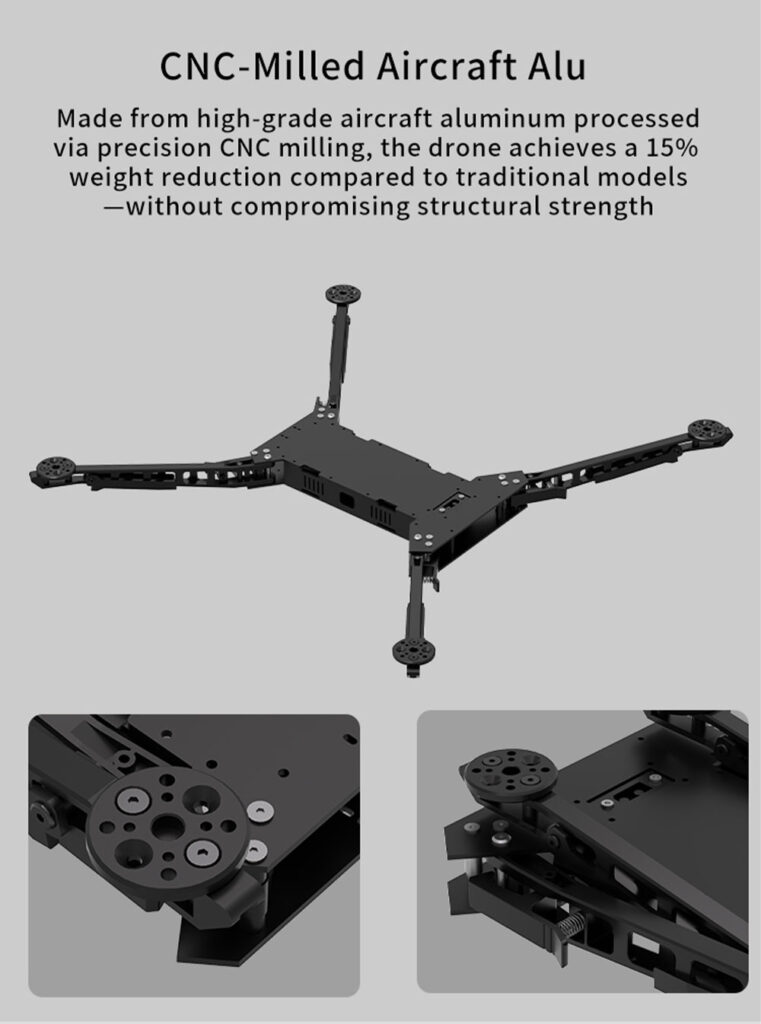
A folding aluminum airframe, a high-output video link, and a configurable F405-class controller can make a compact aircraft operationally flexible. The same modularity creates more opportunities for silent variation. Radio region, battery pack, firmware, receiver, payload wiring, and spare compatibility can all change while the product name remains unchanged.
That is the central purchasing insight: flexibility is valuable only when revisions are traceable.
A Better Foldable FPV Drone Wholesale RFQ
Send the supplier one controlled document containing the mission profile, quantity, exact configuration, destination market, battery-shipping responsibility, Remote ID requirement, required compliance records, acceptance test, production sample, spare-parts list, packaging, warranty process, and change-control rule.
Then ask for the quote against that document.
The result may be longer than a price message. It is also far more likely to describe the aircraft that will actually arrive.